

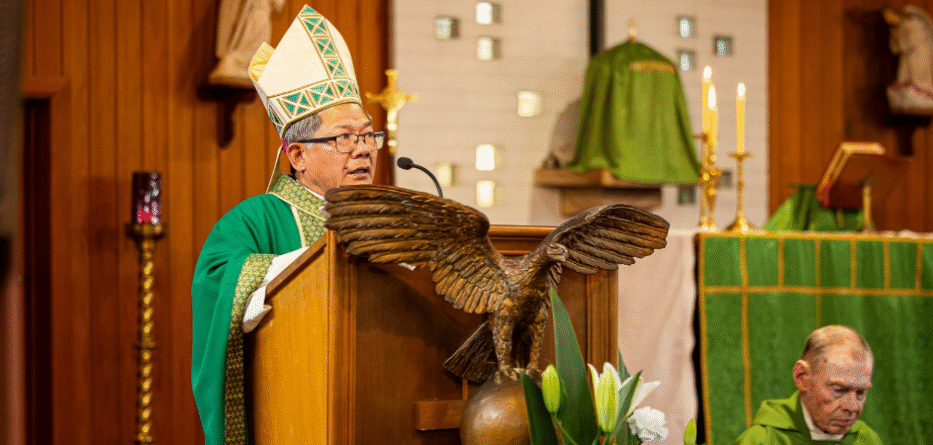
Most Reverend Vincent Long Van Nguyen OFM Conv DD STL, Bishop of Parramatta
Homily for the 30th Sunday in Ordinary Time, Year A
Readings: Ex 22:20-26; 1Thes 1:5-10; Matthew 22:34-40
The Church affirms God’s alternative world of hope
Dear friends in Christ,
We live in world of increasing intolerance, hatred and violence. The horrific attack against an independent MP in country Victoria during the week is a reminder to us that we cannot take for granted the peaceful, robust and friendly democracy we have long enjoyed. It is the mark of a mature society when we can pause to reflect, take stock and learn to live in harmony, civility and respect for all.
The Church too has a significant part to play as a bridge builder and a catalyst for a cohesive society. Amid the fears that threaten turn us into competitors, adversaries and even enemies against each other, we gather to affirm an alternative world of hope. The world of hope is God’s world of hospitality that admits even the neediest among us to the table. It is characteristic of the Church to embody this God and to manifest his trademark care for those who are neglected and forgotten by the dominant culture.
The Word of God this Sunday speaks to us about the importance of being such a church. God in Christ summons us to live and relate to each other in a way that is different to the zero-sum game where one group wins by causing another to lose. It is the “us versus them” mentality. We are called to practice an ethic of concern, care, support for one another so no one is excluded from the table or left behind.
In the first reading, we hear how the children of Israel receive instructions as to how they should live and behave towards each other. In Egypt, the Israelites knew what it was like to be on the margins of society and to experience vulnerability because of their social status and ethnicity. Now in the Promise Land, they are told they must show understanding, compassion and empathy towards others who are in similar situations: the strangers, the widows, the orphans, the poor and those in debt. “You must not molest the stranger or oppress him, for you lived as strangers in the land of Egypt”. It is a constant refrain in the Torah. The Torah reframes a new world.
In effect, they are exhorted not to replicate the system of oppression that they themselves experienced in Egypt. Instead, they are to form a post-exodus society, which would be the model for all the nations. This new society would be marked by concern for the common good and special attention to the most vulnerable. They are to be neighbour to one another and care for those on the margins.
This is also fundamentally the message of Jesus. Last Sunday, he reminded his disciples to prioritize their commitment to serve in this way: “Render to Caesar what belongs to Caesar and to God what belongs to God”. In other words, the duty of Israelites is to build God’s Kingdom of justice, love and compassion as a contrast society to Caesar’s exploitative, trickle-down and oppressive system. In today’s Gospel, Jesus defines that same vision of God’s Kingdom in terms of loving God and neighbour. He reminds them of the Shema, which is the daily Jewish prayer calling them to love God over above everything else. He then joins this command with loving one’s neighbour, so that one cannot keep one without the other.
Throughout Jesus’ ministry, we can see the way he expanded the idea of a neighbour to include not only the comrade member of the covenant community but also those who are considered outsiders and those who are seen as the ultimate “other”. In his embrace of the most vulnerable, despised and hated, Jesus presented a whole new way of seeing, acting and relating. He embodied the God who loves without limits and empowers us to act beyond our default self-centred system.
Dear friends,
The early Christians understood the significance of being fundamentally counter-cultural in how they lived, how they related, how they shared resources with the disadvantaged. In the second reading, Paul acknowledges the Thessalonians for their faith and love for outsiders. “They broke with idolatry and became servants of the real, living God”. They embraced a life of faith, hope and love in contrast to their pagan counterparts. They reached out to others beyond their borders.
Today, like our pioneers, we meet amid a fearful world that is prone to competition, domination, revenge and hostility against one another. In the face of assumptions and practices that undermine human dignity, we gather to affirm that God does not keep score of every affront and infringement. Instead, our God breaks the cycles of retaliation and the zero-sum games. His astonishing generosity enables us to usher in the new world of hope for all.
We are custodians of the Good News. The Kingdom vision of Jesus guides us as we endeavour to be a community that serves as an antidote to the politics of fear, self-interest and the economy of exclusion in our society. May we like the early Christians in Thessalonica share the Gospel with others “with the joy of the Holy Spirit” and show the world the witness of the true Christian love.