

Readings: Isaiah 45: 1, 4-6
1 Thessalonians 1: 1-5
Matthew 22: 15-21
In today’s gospel, two opposing groups, both threatened by Jesus, by his life and his teachings, join forces to trap him. The Pharisees opposed Roman rule and the supporters of Herod tolerated Roman rule, since they benefitted from it. Whilst Jesus himself did not engage in factional politics, he did ally himself with those who were oppressed, often making enemies of the oppressors, including religious authorities. His message threatened their comfortable life and their status.
The encounter in today’s gospel takes place at a difficult time politically. If Jesus suggested that people pay taxes, he would lose support from many. If he suggested that they not pay the taxes, he would be in trouble with the Romans. Those who came to Jesus from the religious leaders and the supporters of Herod came with malice in their hearts. They envisaged him being trapped in a ‘no-win’ situation. Instead of looking to the hatred and fear in their own hearts, they blamed Jesus for their fears and sought to remove him as a threat. Jesus’ challengers are silver-tongued hypocrites. They act indirectly, pretending to be pleasant to him. They ‘butter him up’ with compliments. In essence, they are untruthful and duplicitous. Their intentions are hidden – to all except Jesus.
Jesus acts in the opposite way. He is direct. He speaks the truth. He challenges them immediately. Jesus is not a game-player. He exposes their manipulation, names their hypocrisy and addresses their trap directly. Jesus ‘calls them out’. He acts in the world, but in a manner that reflects the ways in which God works – in truth. Psalm 51:6 says, indeed you love truth in the heart: then in the secret of my heart teach me wisdom. This is God’s way. Be truthful in your own heart. Act towards others with integrity and honesty. This is the path to wisdom. Falseness within our own hearts and in our relationships with others is often the ‘way of the world’, but it is not God’s way.
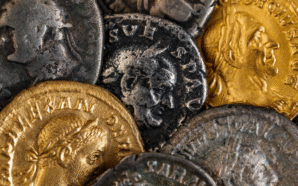
Jesus doesn’t engage in conflict with his challengers, but turns the tables with the simple truth. In essence, they trap themselves. The coin, which his detractors happily carry, has the emperor’s head on it, so Jesus urges them to return it to the emperor, but in doing so, he urges them to make sure that they don’t neglect the things of God. Fulfil your worldly duties, but guard your heart and your relationship with God!
It’s a common belief that religion and politics shouldn’t mix. They can both be contentious issues, at times even leading to war. Put them together and you often get an explosive situation. Jesus is not afraid to tackle conflict. He does it in a way that runs counter to how society often manages conflict. He puts it back on those who have the issue. He doesn’t answer his challengers’ questions directly, but uses an ‘obvious’ visual sign to challenge them to take responsibility for their own decisions.
Jesus is not saying that the questions they raise are unimportant. He lived in a world that made certain demands of him. Yet, he remained utterly faithful to his mission, even when the world persecuted him. He was totally immersed in the world, in its joys and its struggles, but he was not a slave to worldly ambitions. Jesus did, however, align himself politically, not to a particular party, but he clearly aligned himself with those who were oppressed.
In the first reading, we hear of Cyrus, a pagan ruler of Persia, not a man of the Jewish faith, being used by God to save Israel. He was anointed by God for this purpose. A man who might not be seen as being ‘of God’ is doing God’s work. God uses civil authorities to achieve his purposes.Isaiah
Trying to live the Reign of God in our own lives does not remove us from the realities of the world. We can’t live in an artificial reality. God chose to become part of the created world in the person of Jesus. Jesus’ mission was to the world, and so is ours. To minister to our world, we must be deeply engaged with others. Jesus doesn’t say that only those things that are clearly of God are good, whilst that which is not so obviously ‘of God’ is evil.
Jesus was so engaged with this world that some saw him as a revolutionary, as someone who might possibility overturn their comfortable existence. They feared that happening, and set out to trap him. In some ways, their fears were well founded. Jesus was a revolutionary, but not in the way they imagined. The revolution he led was a revolution of the heart, of turning our hearts to God, a revolution that continues today. Our hearts are constantly being challenged to turn around, to embrace repentance and conversion. This ‘revolution’ will continue throughout our lives. We need to ‘give back to Caesar’ the things that belong to ‘the world’, whilst holding on tightly to what is of God, the things of our hearts. This is a delicate dance, a dance that we sometimes get wrong, and a dance that challenges us to stay faithful to the journey.
For us, the simple message is to be engaged in our world and our community, without losing sight of the fact that our calling is to seek first the Reign of God, to seek the way of God, a way of being that strives to imitate Jesus. In doing that we become a loving and prophetic presence to our world. We are urged to expand our horizons and see God acting in many unexpected ways, often in new ways. Let us ask God to open our eyes and our hearts, and to give us the desire to be faithful to the things that are of God.