

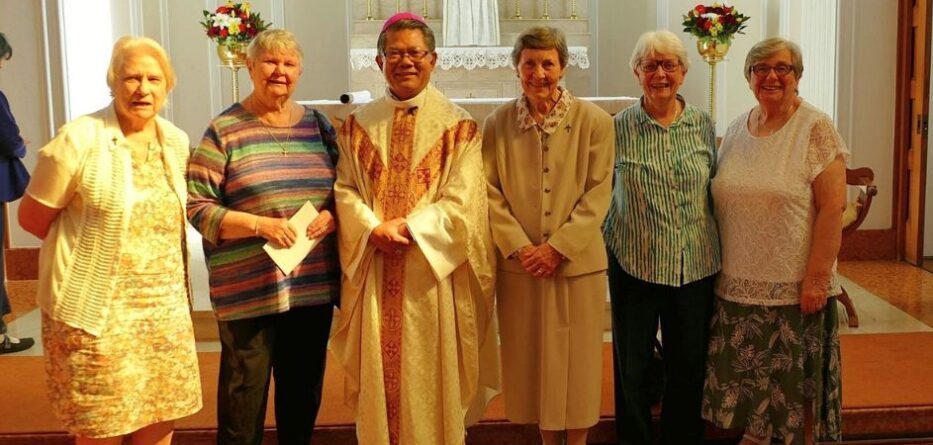
One of the oldest religious communities in the Diocese of Parramatta has met to decide on its future, and to give thanks for the hundreds of their members over the years who have dedicated their lives to help the less fortunate.
The Sisters of Mercy Parramatta have been ministering to the poor, sick and educating the young for almost 140 years. During that time, they have responded to the changing needs of church and society, establishing schools, orphanages, an aged care facility, child and family care centres, refuges and crisis accommodation for women and children at risk of homelessness. Recently the sisters ‘turned the sod’ on a new venture – a Senior Women’s Housing project to be managed by St VdeP Housing Australia.
But with few younger members, and the majority more than 80 years old, they decided some years ago gradually to hand over control of their ministries, such as their schools, to other like-minded groups. Now, with a diminishing pool of potential leadership among the sisters, they felt it was time to make arrangements for the future governance of the congregation and the continuing care of its members. This they would do by petitioning the Holy See to appoint a Canonical Delegate as an administrative representative of the Vatican to safeguard the interests and rights of the community and their status in the Church.
Deciding on their future
This decision to petition Rome to appoint a Canonical Delegate was taken at an “extraordinary chapter,” or meeting, of the congregation on 2 May, and was preceded by a Mass of the Holy Spirit in the Mercy Chapel in Parramatta, celebrated by Bishop Vincent Long OFM Conv.
Once the Canonical Delegate is appointed, the sisters will no longer meet in Chapter to determine future directions of the congregation but as a group will still retain autonomy over their day-to-day affairs through regular community gatherings.
“What we’ve done is taken steps to ensure that we can continue as a group, without an elected leader, by putting in place administrative and support mechanisms. These will provide for the needs of the group members and enable the continuation of our Mission of Mercy for as long as the sisters live,” said Sr Catherine Ryan, one of the members of the community and a former Congregation Leader. “All authority is still vested in the group, it’s not lost.”
Nevertheless, it was an emotional decision for a community that has such a long and deep history of involvement in the Diocese and in wider Sydney.
For Sr Catherine, a more significant and emotional day would be when Rome officially approves and announces the name of the new Canonical Delegate, which could be any time in the next 12 months.
‘The Order is God’s work’
Looking towards the future, Sr Catherine said words of their foundress, Mother Catherine McAuley, are as true today for the Parramatta Sisters as when she wrote them to her first companion in 1841: “We have ever confided largely in Divine Providence and shall continue to do so.”
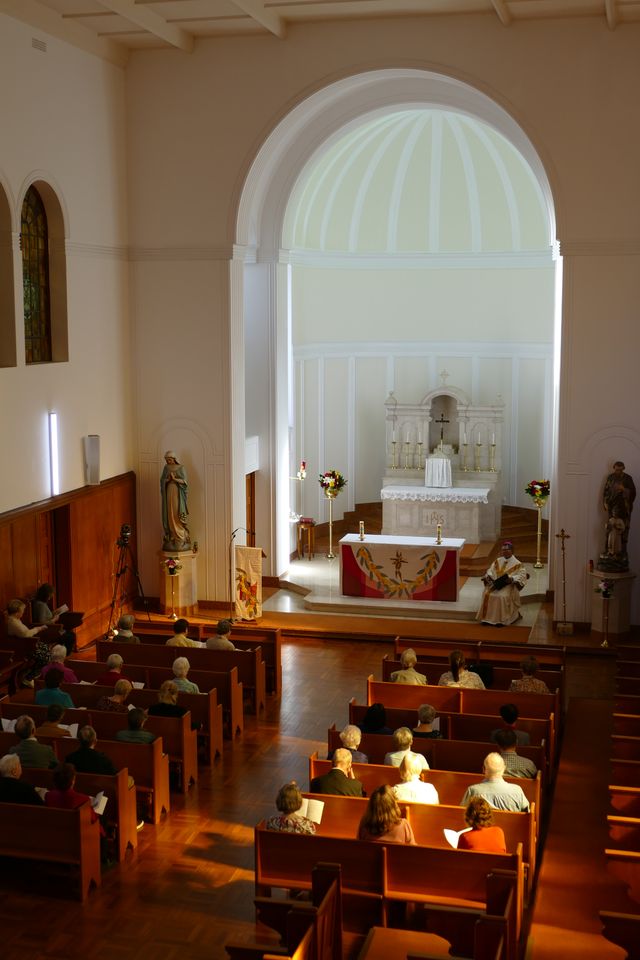
The Mass was held in the Mercy Chapel in Parramatta. Image: Supplied
Catherine McAuley also knew that the future of the order was not hers to determine: “The Order is God’s work – not mine. It will do just as well without me.”
Sr Catherine said Mercy was “still alive today in the many groups of lay people who are continuing the Mercy ministries and finding new ways to let God’s charism of Mercy find a contemporary expression”.
In his homily in the Mass before the meeting began, Bishop Vincent paid tribute to the congregation and reminded them that “nothing that was done in loving, generous and selfless service has been lost.
“The legacy of generations of Parramatta Mercy sisters lives on and continues to enrich the Church. As we pray for you today we do so with gratitude.”
He said the survival of religious communities was never guaranteed and many had “come and gone” over the years.
“Religious are never about immortality and numbers. As catalysts for the kingdom, we often occupy a precious yet precarious place, a liminal space rather than a centre stage,” said Bishop Vincent, himself a member of a religious congregation, the Franciscan Order of the Friars Minor Conventual.
“It is the security of insecurity, that is what we are called to embrace. It is the discipleship of vulnerability, humility and powerlessness that religious are challenged to model for others.”
Nevertheless, he acknowledged that the day was one full of emotion.
“The emotions are even more amplified and more conflicted because it is not just a building or a ministry that we have to let go,” he said. “It is our very existence as a congregation, with its proud history, tradition, apostolates and generations of dedicated members.”
But he said all the good that had come from the congregation would be “disassembled and recast into something else we are yet to comprehend”.
“Like Israel during the time of the exile, we let ourselves be drawn into the furnace of cleansing, even dying, so that God the potter can refashion or repurpose what is left of us into something that He alone knows and destines us to be.”
Responding to new needs
Sr Catherine said Catherine McAuley had founded the Sisters of Mercy Ireland in 1831, as a Gospel response to the enormous social needs of the time – degrading poverty, disadvantage, lack of education and knowledge of the Faith. As conditions changed over the years and in different places, Sisters of Mercy have responded to new needs.
By 1888, when they arrived in Parramatta, the pressing need of the Church, following the withdrawal of government funding for faith-based education, was the establishment of Catholic schools. Today the Catholic education system benefits from more than 60 years of graduate cohorts from Catholic teaching institutes ably taking responsibility for the teaching and administration of Catholic schools. This has freed sisters to identify and respond to different needs – for example the unemployed, refugees, the Cry of the Earth and First Nations issues.
Yet the legacy of a Mercy education endures.
Catherine McAuley taught that no work of charity could be “more productive for the good of society….than the careful instruction of women, since whatever be the station they are destined to fill, their example and advice will always possess influence”.
“We believe that to educate a woman makes a difference in the world,” she said.
Sr Catherine said: “Mercy is a reflection of a charism given by God, and we’ve been entrusted with it, but others had it before us and others will afterwards. We don’t own it, it’s a gift.”
To read Bishop Vincent’s homily, click here.
The Mass and ‘extraordinary chapter’ are examples of the Pastoral Plan priority of Prayer, and the objectives of A Church Walking Together and A Church Renewed in Spirit and Prayer. Visit Synodality to learn more.