

Deacon Adrian Gomez is passionate about working with young people, helping them in their formation as Catholics, and especially as leaders in their faith.
It’s something he’s been doing for years, firstly in the Broken Bay Diocese and now in Parramatta, where he works with the Mission Directorate within Catholic Schools Parramatta Diocese (CSPD), supporting schools in the Blacktown and Mt Druitt areas in the area of mission.
He even runs the youth group in his local parish, in northern Sydney, on his days off.
But he has another string to his bow – that of a Navy Chaplain – which at first glance looks to be very different from his work in youth ministry, but as he discovered actually has a lot of similarities.

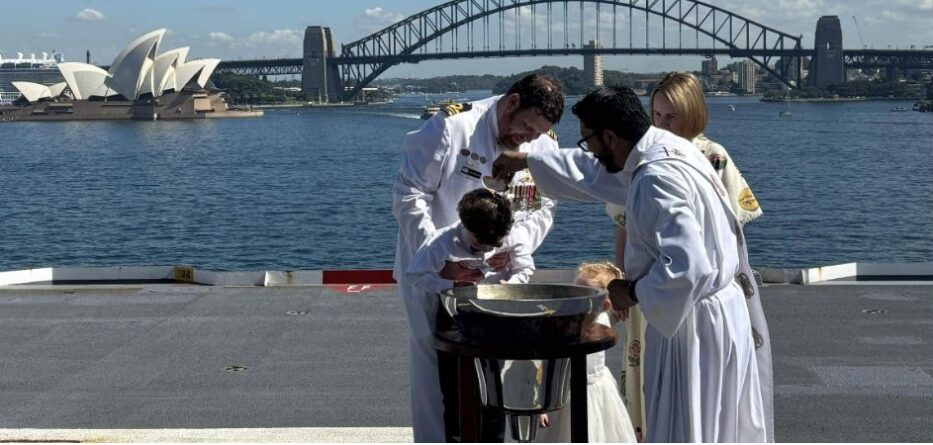
Deacon Adrian performing a wedding at the chapel at HMAS Kuttabul, Potts Point. Image: Supplied
“Part of what attracted me to the chaplaincy is it’s very much a form of young adult ministry,” Deacon Adrian said.
“A lot of people finish school or are early in their career and they will join the military for a period of service before they move on…Just having that way of supporting people as they’re still discerning their vocation is important.”
‘Pastoral and effective’
Deacon Adrian joined the Royal Australian Navy as a part-time reservist with the Military Ordinariate, through the Diocese of Broken Bay, about three and a half years ago after learning that the armed forces needed Catholic chaplains. Catholics are the largest group of men and women serving in the Australian Defence Force, and there is still a great need for full-time and reservist chaplains.
Chaplains complete the same initial training as other officers at HMAS Creswell, at Jervis Bay, on the South Coast of NSW. And this initial training was challenging. He had to complete marching, classes on leadership, the law of armed conflict, teamwork field exercises, chemical and biological defence (which included being tear gassed), firefighting, first aid, and hours spent in the pool for survival at sea training.
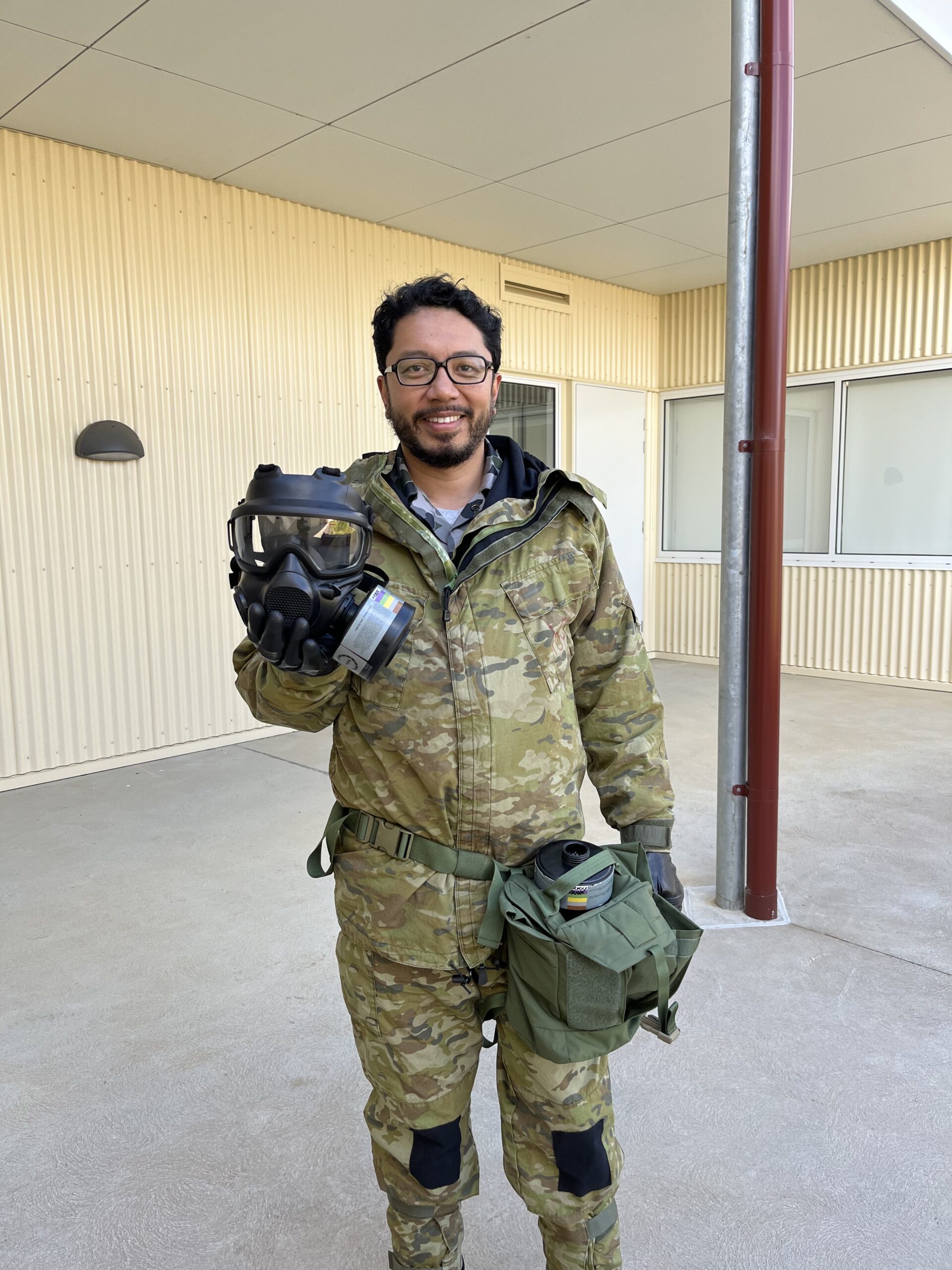
Deacon Adrian during gas mask training at HMAS Cerberus. Image: Supplied
“I had the opportunity to push myself to my limits and feel a real sense of pride that I achieved the right to wear an Australian uniform,” said Deacon Adrian.
Chaplains also spend a month at the Australian Defence Force Academy in Canberra completing the ADF Support Chaplaincy course. Most ADF chaplains are on loan from their local diocese but some belong solely to the Catholic Military Ordinariate, the military diocese that has jurisdiction over all ADF personnel anywhere in Australia and overseas.
After finishing his qualifications last year Deacon Adrian was working one day a week at the HMAS Kuttabul chaplaincy centre at Potts Point, supporting the four Sydney naval bases with baptisms, weddings and funerals and taking Holy Communion to members in hospital. He also provides confidential support for servicemen and women.
“This was a real way of actually being able to do something I felt was pastoral and effective, to actually support our service people who were literally willing to put their lives on the line for their country, and to show them that the Church is with them.”

The guard of honour after the wedding at HMAS Kuttabul. Image: Supplied
He said chaplains in the navy occupy a unique position outside the command structure, and this allows anyone – officer or sailor – to feel they can go to them for confidential support.
“The chaplains are really trusted,” Deacon Adrian said. “That’s a historical thing. Anyone can go to a chaplain and just get support, or for them to be a sounding board because things can get really frustrating in military life.”
‘A sense of tradition’
Some of the more enjoyable, and unusual, aspects of being a navy chaplain are those associated with the sacraments of baptism and marriage.
He said the navy has a tradition of holding baptisms on ships, which goes back hundreds of years to when it was first started by the Royal Navy.
“We take the ship’s bell, flip it upside down, put it in a stand, fill it with water and that’s what we use for the baptismal font.
“I then bless the water, and afterwards the child’s name and the date of the baptism are engraved on the inside of the bell.”
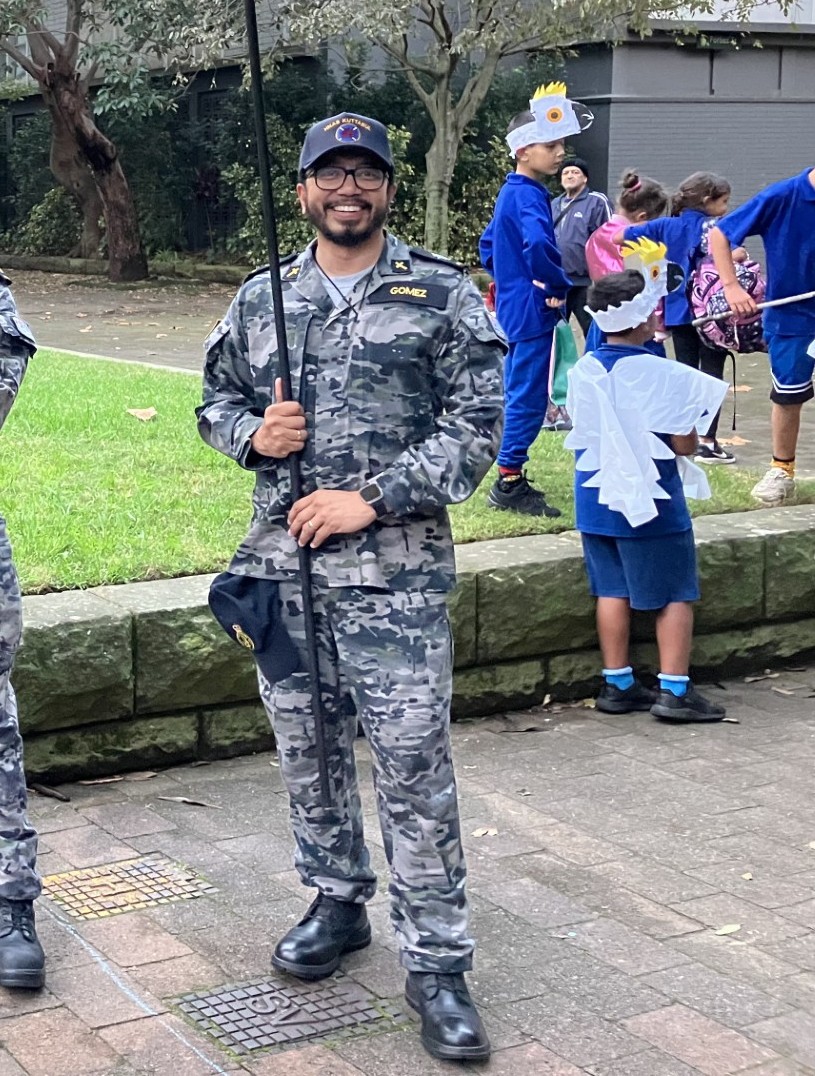
At the Woolloomooloo Parade in May. Image: Supplied
At the first baptism Deacon Adrian performed as a navy chaplain the father was reading the names on the bell and found the name of one of his own friends.
“So that sailor had been baptised in that bell and then gone on to serve in the navy. That sense of tradition being passed on like this I found quite powerful,” he said.
Marriages in the navy can also have an unusual twist. At the most recent wedding Deacon Adrian officiated, the groom and some of the guests were dressed in full dress uniform, including swords.
“The groom asked me if I wanted a sword and I was very tempted, but I did say ‘no’,” he said.
“Then at the end there was a guard of honour with swords drawn, so that was quite impressive.”
A Parramatta connection
Deacon Adrian has been assigned as the chaplain to lead the annual HMAS Parramatta II memorial service on 23 November at Queens Wharf Reserve, Parramatta, at 11am.
For more than 80 years families and supporters have commemorated the loss of the HMAS Parramatta II off Libya on 27 November 1941. The Parramatta was one of the warships used to supply and support the allied forces besieged at Tobruk – including the courageous Australian ‘Rats of Tobruk’.
While defending supply ships the Parramatta was hit by a torpedo from the German submarine U-559. Most of the crew, including all of the officers, were lost with the ship.
“It’s important to keep the memory alive of those who paid the ultimate price to serve and defend our nation,” he said. “I hope the people of Parramatta remember with pride this ship that bore their name in the seas of the Far East, Red Sea and the Mediterranean during the Second World War.”
‘Still highly respected’
The increasing secularisation and multicultural nature of modern Australian society has meant the navy chaplaincy has had to expand from the days when there were just Anglican, Catholic and Protestant denominations.
Today there are Buddhist, Hindu and Muslim chaplains, as well as non-religious “maritime spiritual welfare officers”, he said.
“Even with increasing secularisation navy chaplains are still highly respected, and that’s a great thing.”
For more information about the work of the Catholic Military Ordinariate in providing military chaplains to support the Australian Defence Force please have a look at their new website. Any donations to support their clergy in providing for the care, comfort, benefit and welfare of members of the ADF is appreciated.