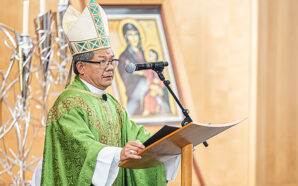


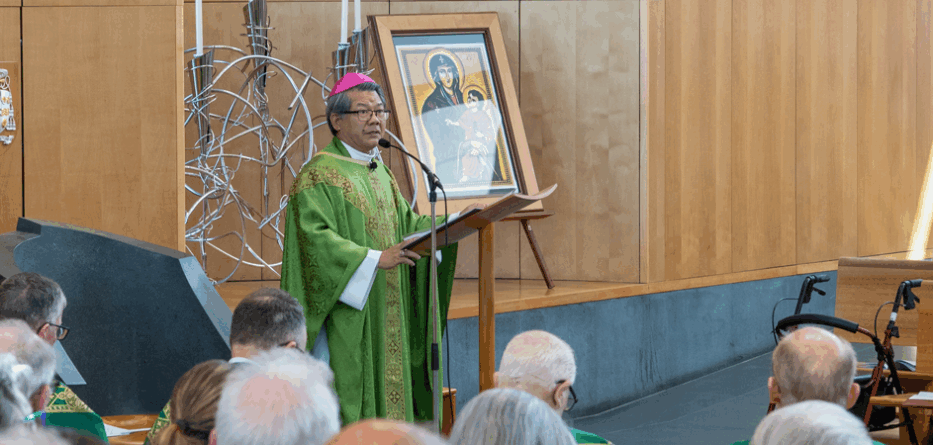
Most Reverend Vincent Long Van Nguyen OFM Conv DD STL, Bishop of Parramatta
The 33rd Sunday in Ordinary Time Year C
Readings: Malachi 3:19-20; 2Thess 3:7-12; Luke 21:5-19
Being an authentic embodiment of God’s love and presence in the world
I have recently returned from a Jubilee Year Pilgrimage with a group of our Catholic school teachers. It was a deeply invigorating experience, and we were grateful for the opportunity to connect with our Christian history and heritage. We purposely framed the journey around the theme of “rediscovering the hidden treasure”, meaning that we wanted to dig deep, to go beyond the surface and to recapture the inspiration that characterised the church of our origins. I called the pilgrimage “the journey from institution to intuition”. We didn’t simply see what tourists want to see: the magnificent basilicas, the famous sculptures and paintings etc. We were interested in recovering -perhaps not the imaginary Holy Grail- but the original fervour with which the early Christians lived the Gospel, often in the face of personal loss, marginalisation, persecution and even death.
I am pleased that in addition to visiting many magnificent edifices that have stood the test of time as enduring symbols of the Christian faith, we were inspired by the hidden church, born in the necropolis and the catacombs of ancient Rome, born in darkness of suffering, and yet shone as a beacon of hope for the world. It was paradoxical that the church was at its best when it was poor, persecuted and powerless. We discovered that underneath the veneer of a powerful, triumphalist and even imperialist Christendom, there lay the church of our origins: few in numbers, marginalized and persecuted, yet a powerhouse of prayer, solidarity and witness.
The Word of God this Sunday challenges us to rise to new and more empowering way of being church. Metaphorically, both Malachi and Jesus speak about the destruction of the old structures and the emergence of the new way of living and witnessing on the part of the believers. Against the background of loss and hopelessness, they both prophesy about God’s plan that summons the people to a new future, so that the matrix of brokenness becomes the venue for new possibility.
In the first reading, the prophet Malachi speaks about the burning anger of God. He uses apocalyptic language to describe the day of judgement. The wicked will be burned like stubble. But the sun of righteousness will shine on the just with its healing rays. Malachi prophesies about the renewal of the Temple and its worship. The long exile that preceded the return to Israel and the rebuilding of the Temple was seen in hindsight as a cleansing time. They will make the offering acceptable to the Lord on account of their renewed faith.
Malachi’s message is that God uses pain and suffering as a means to test and cleanse them, in order to make them more authentic, more true to their calling. Therefore, they should not fear and shirk from testing times. Rather they should embrace them and grow through them. The long arc of God’s story points towards not just Israel’s restoration but the restoration of all things according to the divine design. Malachi summons them to a new future after the exile. This new future does not simply consist in the regaining of former status in Palestine. It is not “make Israel great again”. Rather it will be a humble remnant people learning to be a beacon of light and a sign of God’s presence in the world.
In the Gospel, Jesus talks about the impending crisis in terms of the challenges and adversities that his disciples must be prepared to face. He speaks of the destruction of the old temple which will be a catalyst for a new Israel. The crisis that the death of the old will create will also bring believers an opportunity to bear witness to the new. The end time is not doom and gloom for those who believe. In fact, it can also be the blessing in disguise, the moment of purification and maturity of faith.
Things may be disheartening now but the future belongs to God, and the disciples must not lose heart but must act in favour of that future. Therefore, we are exhorted to discern the way of God in times of turmoil and upheaval. What distinguishes us as true believers is the ability to discern and to live the creative power of the Spirit through the chaos of decline, death and renewal.
Dear sisters and brothers,
The metaphor of the death and destruction is poignant for us as we transition from an old fortress-like, insular, self-referential, triumphal and cleric-dominated Church to one that is more engaged, dialogical, synodal and aligned with the poor and the oppressed. But let us not be afraid of the dying of the old just as the prophecy of destruction is followed by the fresh hope of a new dawn.
Christianity may be returning to the earlier times in terms of being a marginalized or even unpopular minority. But if we follow the example of our ancestors and the early Church in being an alternative society, a community of justice, inclusivity, solidarity, prayer and support, then it is the future worth dedicating our lives to. As a church, we are called to die and rise again: dying to power, dominance, wealth and influence; rising to be a force of solidarity, a prophetic voice, a social conscience and a source of hope for the poor and the planet. May the Holy Spirit empower us to be an authentic embodiment of God’s love and presence in the world.