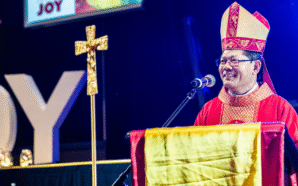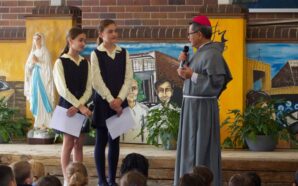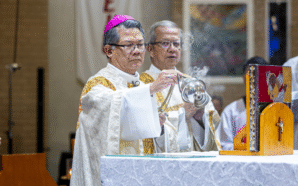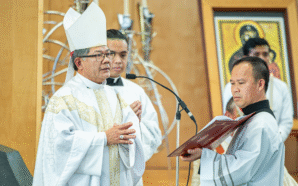


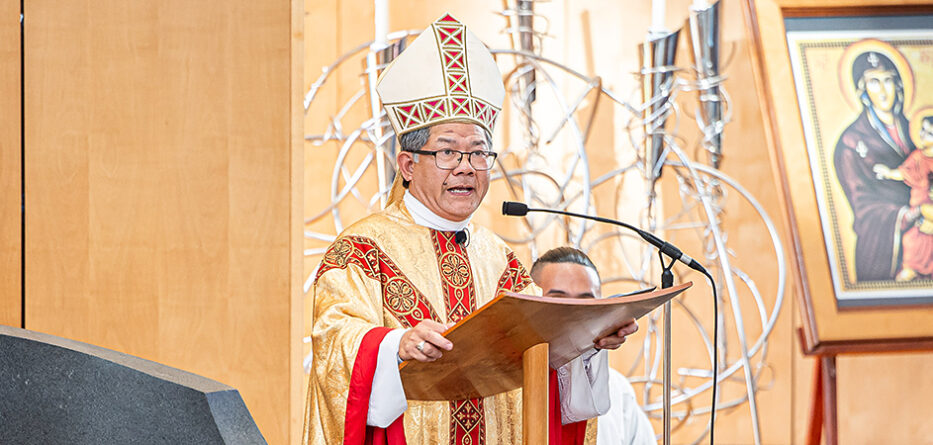
Most Reverend Vincent Long Van Nguyen OFM Conv DD STL, Bishop of Parramatta
Homily for the Australian Catholic Youth Festival pilgrimage and student and youth leaders Commissioning Mass on the Solemnity of Christ the King at St Patrick’s Cathedral, Parramatta.
Readings: 2 Samuel 5:1-3; Psalm 121(122):1-5; Colossians 1:12-20; Luke 23:35-43
23 November 2025
Building a new kingdom in which the cosmic Christ is its centre
Dear sister and brothers,
Sometimes, one can learn a great deal in the most unlikely places and among the most unlikely people. Dietrich Bonhoeffer, who was imprisoned and killed because of his opposition to the Nazis, went to America to study in order to become a Lutheran pastor. As it turned out, he reflected that he learned more from the mixed race at Harlem than he did at the upmarket white middle-class suburb in New York where he was placed. He quickly saw a parallel between the injustices suffered by African Americans and those of the German Jews in his home country.
Six years ago, I went to Papua New Guinea to meet the refugees who were held in indefinite offshore detention facilities – a policy Australia adopted to keep boat people from entering our country. I was deeply touched by their resilience, camaraderie and humanity in the face of harrowing tragedy. I learned more from these men than whatever support and solidarity I could offer them. Despite the ordeal, their human dignity was unbroken.
The Word of God this Christ the King Sunday also speaks of the best of human nature and God’s revelation through the most unexpected of people and places. It challenges our assumptions, certainties and prejudices. The God that Jesus made manifest is unashamedly the God of those on the margins or, as Pope Leo said in Dilexi Te, those on the receiving end of societal indifference. Therefore, our Christian faith will be less than authentic if it does not break down every barrier, or bring close those who are distant, unite strangers, and reconcile enemies. For Christ the King demands nothing short of a radical alignment of our attitude and behaviour with his vision of a dignified life for all.
The book of Samuel tells us the story of the unlikely election of David as the new king of Israel. Already in earlier episodes, against established norms, he was chosen ahead of his older brothers. He was the boy shepherd whom not even his father thought was destined for greatness. Here, he is pitched as the underdog against the mighty King Saul, who had adopted the way of the empire. The story puts in bold relief the biblical notion of God favouring the underprivileged, the common and the unworthy. St Paul would say, “God chose what is foolish in the world to shame the wise; God chose what is weak in the world to shame the strong.” To put it in another way, God reveals his power through the vulnerability of the weak, rather than the narrow channel of the strong and the privileged. This is the thread that runs through sacred history, including the call of an unlikely peasant girl from Nazareth.
The Gospel story, too, is the epitome of the subversive, vulnerable and powerless God. The scene was one of monumental failure, incomprehensible tragedy and sheer despair. Jesus was dying on the cross. His mission had come to a disastrous end. He had been rejected by his own people, denied by his companions, condemned and crucified as an example to others, and even seemingly abandoned by his own heavenly Father.
Yet, God’s revelation was made precisely at the moment of utter vulnerability. Jesus revealed himself to the good thief, who turns out to be the unlikely hero. He recognises the way of the powerless Messiah and entrusts his fate to him. “Jesus, remember me when you come into your kingdom”. If betrayal, cruelty, hatred, scapegoating and killing were demonstrations of human nature at its worst, the exchange between Jesus and the good thief shows human nature at its best. With his promise, “Indeed I promise you, today, you will be with me in paradise”, Jesus shows the triumph of love over hatred, good over evil and life over death.
Dear brothers and sisters,
Today, we gather to pray especially for student leaders and pilgrims who will attend the Australian Catholic Youth Festival in Melbourne. To the former, I say you have an important role in influencing your peers. Lead with integrity, fairness and compassion! To the latter, I say thank you for your generous commitment to join this pilgrimage. Pope Leo, in his message for young people today, encourages you to be the sacrament of God’s love and the visible face of Christ in the world. He asks young people to form friendship with Christ that helps us to overcome closed-mindedness and suspicion. He says, “Do not follow those who use the words of faith to divide; instead, make plans to remove inequalities and reconcile divided and oppressed communities. To that end, let us listen to the voice of God within us and overcome our selfishness, becoming active artisans of peace.”
Today’s celebration reminds us of the kingdom vision which was at the heart of the Gospel message. It also frames our horizons with a hope that galvanises us into action. As Paul reminds us in the second reading: “God wanted … all things to be reconciled through him and for him, everything in heaven and everything on earth”. We are called to build a new kingdom in which the cosmic Christ is its centre. In a time of rising tensions and divisive ideologies, our challenge is to embody the inclusive kingdom vision of Jesus –one that is rooted in justice, compassion, solidarity and service. Only by living that vision fully as the Body of Christ can we become a lighthouse for the world. As Jesus tells Pilate, let us be on the side of truth, listening to his voice and enacting his vision, starting from the least among us.