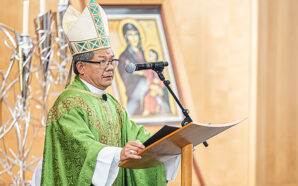


Most Reverend Vincent Long Van Nguyen OFM Conv DD STL, Bishop of Parramatta
The Dedication of St John Lateran
Readings: Ezekiel 47: 1-2,8-9,12; 1 Corinthians 3:9-11;16-17; John 2:13-22
Dear sisters and brothers,
Today, we are celebrating the feast of the dedication of St John Lateran, which is the Pope’s Cathedral. As such, this ancient basilica is considered ‘the mother and head of all churches of Rome and the world’. In celebrating this feast, we affirm our communion with our Holy Father, Pope Leo XIV as our chief shepherd. Under his leadership, we seek to be the living temple of God. The celebration invites us to reflect on the important role of church buildings in our lives as communities of faith. It also challenges us to recognise our personal baptismal identity as temples of the Holy Spirit, and to confirm that identity by the way we live.
St John Lateran was destroyed by fire and rebuilt into one of the greatest basilicas in the world. Interestingly, the story of our own Cathedral, St Patrick’s, which is retold in the recently launched book by Mons John Boyle has similar parallels. Fr John has faithfully captured and recorded the amazing story of how we, the People of God in Western Sydney and the Blue Mountains, responded to the double challenge of repairing the old and building the new. Thus, here in our local church as well as at the Lateran, Divine Providence accompanied the efforts not only to rebuild a Cathedral but to create a seamlessly cohesive structure between the new and the old. The fire paradoxically was the catalyst for the young Diocese to reimagine its symbol of unity, faith and mission.
The Word of God on this day encourages us to live out our call to be the visible presence of the Divine. Our spiritual ancestors were constantly refined and purified through the exodus and later the exile. They learned to become the alternative society that shone as the light for the nations. The Christian community that was born after the death and resurrection of Jesus continued this legacy. Even after they had been expelled from Jewish synagogues, they learned to become, in the words of St Peter, the living stones built into a spiritual temple.
In the first reading, the prophet Ezekiel responds to the pain of the exiles as they remembered their beloved Temple in Jerusalem profaned and destroyed by the invaders. With prophetic imagination, he prophesies about a new temple that will surpass the old with superior quality and life-giving features. It will be the source of a mighty river which flows and enriches the land. Through this image, Ezekiel imagines a renewed Judaism that will emerge from the exile and will be the source of life and hope for the world like the water out of Eden.
The prophet rallies his battered people. Though humbled and cleansed by the exile, they are summoned to rebuild themselves into a model society. This is a sobering and poignant lesson for the Church. We have much to learn from our ancestors in faith. In the spirit of humility and repentance, we need to relearn how to be the sacrament of God and his living temple in the world.
In the Gospel, Jesus is portrayed as acting with authority. He drives out the traders and rebukes those who aid and abet a corrupt system of worship. This radical action was not merely aimed at those who showed lack of respect and decorum in a sacred place. The trading activities in the Temple at the time were, after all, necessary for the people to fulfill the requirements of the Law such as the offering of animals. Rather, Jesus’ indignation would have aimed at those who exploited others for their benefit. It was his challenge against the political, religious and economic interests that ultimately sent him to the cross.
The story does not end there. He declares: “Destroy this sanctuary and in three days I will raise it up”. This declaration amounts to an inauguration of a new way of worship which is no longer bound up with animal sacrifices and the temple. This is as revolutionary as his reply to the Samaritan woman at the well: “The hour is coming when you shall worship the Father neither on this mountain nor in Jerusalem. The true worshippers will worship the Father in spirit and truth”.
Dear brothers and sisters,
Today, we celebrate Prison Sunday in Australia. We remember the prisoners who despite their past have an inherent dignity. May they always maintain resilience and hope in the face of adversity. We stand with those who work in the prison system, including the courts, the police, the officials and in particular the chaplains. Many of the latter are Catholic who endeavour to care for the inmates with the love and compassion of Christ. Like the widow, they give without counting the cost. Their ministry starts from the standpoint of humility, not from superiority. It is the gift of Chaplains and Pastoral Workers in our prisons to be with the prisoners, to listen without judgement, to be our companion on the journey and to care with Christian compassion.
We are living through a trying time in the Church. But this can also be a kind of blessing in disguise. Just as Jesus cleanses the temple by driving out the unworthy elements in the worship of God, we might also need this kind of cleansing to get rid of all the things that are contrary or unconducive to true Gospel living. Let us commend these candidates in our prayers as they journey towards their priestly consecration. As we draw strength from the Eucharist, may we become one with Christ, the living stones of the new temple and by serving our brothers and sisters, witness to the all-embracing love of God.