


Homily for the First Sunday of Lent, Year A, and the first Healthcare Ministries formation and support Mass at Our Lady of the Angels Parish, Rouse Hill
Readings: Genesis 2:7-9, 3:1-7; Psalm 50(51):3-6, 12-14, 17; Romans 5:12-19; Matthew 4:1-11
22 February 2026
We recognise Him whose body is broken for us at the breaking of bread
What is a loving, therapeutic relationship in healthcare for family, friends, patients and parishioners that is life-giving rather than death-dealing? How do we know the difference? How do our relationships nurture and sustain life from conception to its natural end in a loving, life-giving way? And finally, how do we nurture and transform our desire to bear the light of Christ to the world in such a way as to inform our vocation to be ministers of the love of Jesus for those around us who are sick or dying – our families, our patients, clients, parishioners receiving the sacraments of the sick, and so on? To these issues, and more ,will be the focus of our Healthcare Ministries Formation and Support Masses on the fourth Sundays of the month in 2026.
The love of Jesus unites all of us in a communion of participation in the mission of the Church in healthcare. This is synodality – that we walk together as one. Jesus, whose body is broken for us, which is the theme of the International Eucharistic Congress in 2028, is the vine, and we are the branches. We cannot walk alone and isolated from both Jesus and our faith community, our gathering where we recognise Him at the breaking of bread.
As we begin the season of Lent this Sunday, let us remember that our relationships matter in the healing of the sick and the dying. The love of Jesus can transform our care for others into an encounter that enables us and those we care for to find healing and be at peace when facing the end of their lives, while living in resurrection hope.
It is also precisely because our relationships matter that we are called to be ministers of the love of Jesus for the sick and the dying. This ministry has an internal focus when caring for our family, the domestic Church – e.g. bringing holy communion home to family members. The ministry also has an external focus, e.g. bringing communion to patients in hospitals or aged care. The external focus when caring for our neighbour has Sacramental, Professional and Pastoral streams in a synodal relationship of care.
As we begin our Lenten journey, our Gospel reminds us of the three temptations of Jesus. There is a reason why Jesus, true God and true man, human in every way except for sin, was tempted before the start of His public ministry. Jesus is showing us that it is not a sin to be tempted. Rather, we sin when we give in to temptation. Jesus, in being fully human, also faces the same temptations that we face – he is the High priest, as the letter to the Hebrews says, who understands our human weaknesses because He has been tempted himself, even though He is without sin.
Let us then have a closer look at the three temptations of Jesus.
In the first temptation, to turn stones into bread, we are invited to reflect on our motivation when we do good work. Just because we do good work, like feeding the poor, does not mean that we have a set of scales, as if our good works justify our sins in other areas of our lives.
For example, we can combine works of charity with funding abortion services in the name of population control and ‘fertility services’, as happens with some charitable foundations. In this way, we risk losing our integrity as missionary disciples.
The second temptation is to take God’s love for granted. By throwing ourselves down from a height, like the second temptation of Jesus, we are reminded to be prudent and wise in our decision-making. We are called not to take God’s love for us for granted, to be rash, and in this way, abuse the unconditional love of God for every one of us. For example, we may want to provide services for the homeless in our neighbourhood. This is a good thing. But we need to consider the risks involved, and it may be prudent to consult with police and ambulance services as to the best ways to minimise the risks of an emergency happening, especially late at night.
The third temptation is a temptation to power and control. This is especially a temptation for professionals caring for patients who often consult them in a moment of fragility and vulnerability. It can be easy to keep busy arriving at a diagnosis and a management plan instead of being there for the patient, listening to their concerns and establishing a therapeutic relationship with their patients. Professional care as a means of being a minister of the love of Jesus for our patients is a vocation calling us to humility and compassion in caring for our patients. In other words, being a professional does not mean that the professional becomes God for their patients, and this calls for humility in approaching the therapeutic relationship.
As we begin our Lenten observance, let us be mindful of the call of the Prophet Joel to let our hearts be broken, not our garments torn.
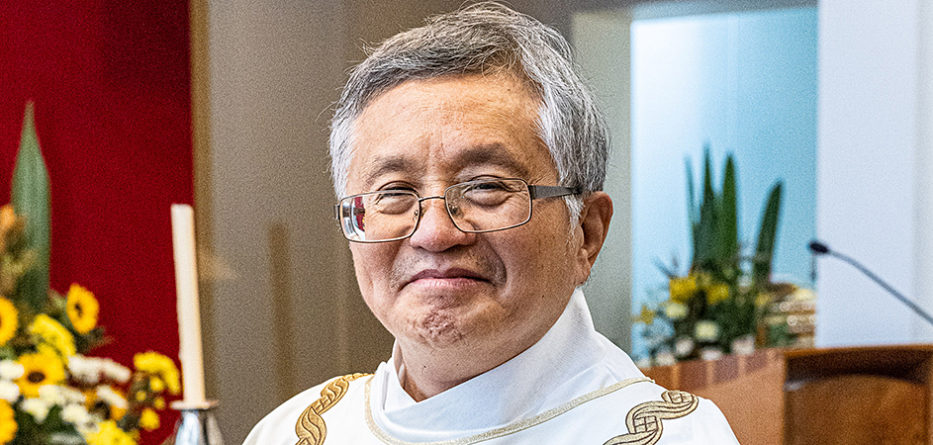
Deacon Michael Tan is Deacon assisting at St John the Evangelist Parish, Riverstone.
The next monthly formation and support Mass for those in the healthcare ministry of the Church will be held on Sunday 22 March, with a location to be confirmed. View updated information via parracatholic.org/events or email Deacon Michael Tan on Michael.Tan@parracatholic.org.
The healthcare ministry of the Diocese aligns with the Diocesan Pastoral Plan priority of Formation and Walking Together. Visit Synodality to learn more.


