

During the Chrism Mass, priests gather around their bishop to renew their priestly vows, affirming their commitment to ministry, sacramental service, and unity with the local church.
Therefore, I would like to reflect today on priestly ministry. This year marks the 20th anniversary of my priestly ordination. For my priestly ordination, I chose a passage from the Epistle to the Corinthians, a passage that describes the efficacy of grace and which Augustine refers to as a key passage against the Pelagian doctrine:
“What do you have that you did not receive? If you did receive it, why do you boast as if you did not receive it?” (1 Cor 4:7)
Referring to this passage, the consecrating bishop said: “It is not the function, but the existence itself that is decisive.” Because of their special closeness to Jesus, priests are instruments of God. This requires humility. “A tool cannot boast about what the artist accomplishes with it.”
Since I was already a full professor in Rome at the time of my priestly ordination, the bishop, himself a former professor of ecumenism, warned: Without the corresponding willingness to serve, theological knowledge cannot bear fruit.
“Even in the study of God, the temptation lurks to elevate oneself above others.” That is why Paul already demanded that no one should make themselves important to the benefit of one person and to the detriment of another.
Therefore, every priest is called to make his own the words from the Letter to the Ephesians, where it says: “Pray for me, that when I open my mouth boldly to proclaim the mystery of the gospel, the right words may be given me.”
In this 20th year of my priestly ordination, however, another passage from the Gospel of Matthew frightens me: “One of the Twelve, the man called Judas Iscariot, went to the chief priests and said, ‘What are you prepared to give me if I hand him over to you?’ They paid him thirty silver pieces, and from that moment he looked for an opportunity to betray him.” (26:14-16)
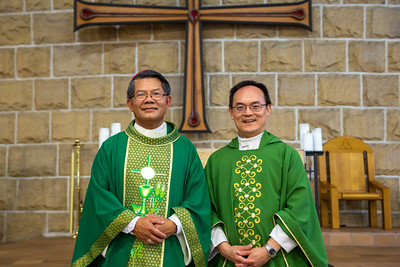
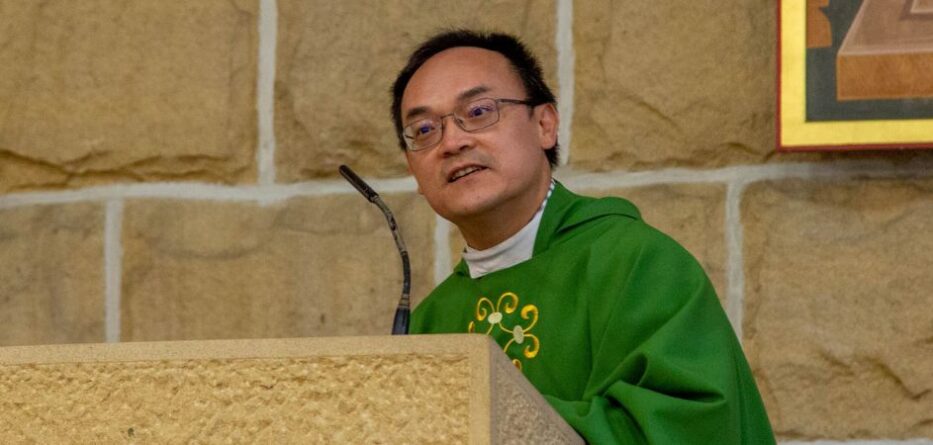
Fr Joseph with Bishop Vincent Long OFM Conv, Bishop of Parramatta. Image: Supplied
The high priest paid Judas for his service of betraying Jesus. This raises a personal question for me: What is Jesus Christ worth to me personally? Am I willing to betray Jesus for a certain sum of money? Am I prepared to sacrifice a human being simply to satisfy my own needs and greed?
Greed consumes everything, without regard for others. Then there is the addiction to popularity, the greed for “likes“.
The proclamation of the word degenerates into a spectacle in which the preacher puts himself on display. Jesus Christ is betrayed by the fear of becoming unpopular.
Then there is the greed for power and money. Access to the priest is granted to those who have much and give much. Sacraments are “sold” to the few. Power attracts power. These are the dark forces that consume the soul of a priest.
It is forgotten that priestly service is a spiritual endeavour. The priestly ministry is understood as service to God and humanity, which should not be primarily focused on personal prestige or material gain, but on proclamation and service to one’s neighbour.
Augustine emphasised that priestly authority must be understood solely as service (ministerium) to the Body of Christ. The priest does not act on his own authority, but as an instrument of God.
Augustine spoke of the “Altar of the Heart,” where priests and believers together offer the sacrifice of humility. The priestly ministry is characterised by the experience of the boundless love of Jesus Christ, who gave himself up on the cross. Priestly humility means imitating this self-giving in one’s own life (becoming oneself a Eucharist).
In summary, for Augustine humility is the foundation that prevents priestly service from leading to pride or arrogance.
As I said, God’s grace is sufficient, and not my personal, fleeting gifts and talents.
Fr Joseph Lam OSA is the Parish Priest of St Michael’s Parish of Baulkham HIlls.
His latest book, Saint Augustine on Listening, Humility and Unity. The Augustinian Root of Pope Leo XIV, was launched on 26 March 2026 by Sister Dr Margaret Ghosn, theologian and Principal of Maronite College of the Holy Family in Harris Park, and Bishop Vincent Long OFM Conv, Bishop of Parramatta.
If you would like a copy of the book, please contact Baulkham Hills Parish via admin@parishofbaulkhamhills.org.au with Subject Line: Book Order.
This reflection is an example of the Diocesan Pastoral Plan priority of Formation to achieve the objective of becoming a Humble and Healing Church. Visit Synodality to learn more.