

Homily for the Ascension
1 June 2025
Readings: Acts 1:1–11; Psalm 46(47):2-3, 6-9; Hebrews 9:24-28, 10:19–23; Luke 24:46-53
Listen at soundcloud.com
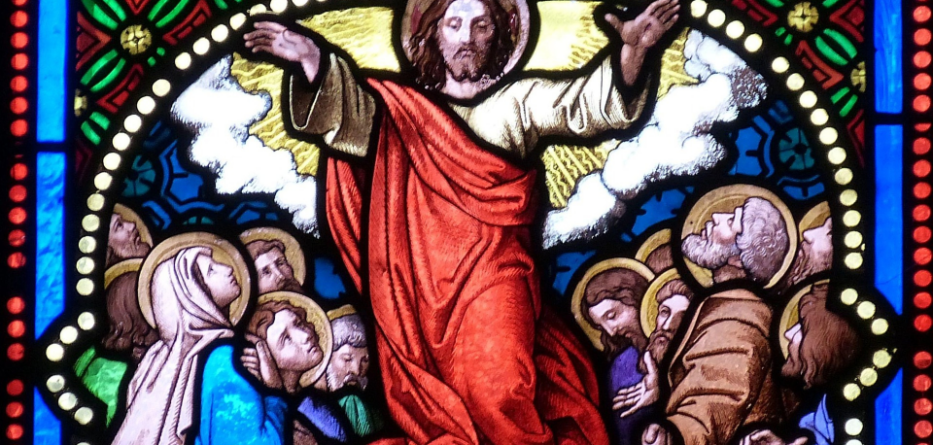
On this feast of the Ascension, we hear both the conclusion of Luke’s gospel and the beginning of the Acts of the Apostles. Written by the same author, these two passages provide us with the link between the two books. It’s the moment when the apostles are asked, ‘Why do you stand looking into heaven?’ The two men who ask the question are in white garments and they appear to the apostles just as Jesus is being lifted up and disappearing from them. Two men in white garments, just as there were at the Transfiguration (evocative of Moses and Elijah), and just as there were when the women went to Jesus’ tomb.
Scripture scholar Luke Timothy Johnson observes: ‘The form of the men’s question to the disciples…formally resembles the challenge put by the two men to the women who came to the tomb. There it was, “why are you seeking the one who lives among the dead?,” followed by the correction, “he is not here but has been raised!” (Luke 24:5–6). Here it is, “why do you stand looking into heaven?,” again followed by a correction: “he will come in the same way you saw him going into heaven” (Acts 1:11)’[1]

Looking Up Sculpture by Tom Friedman, in Brisbane River. Photo by Fr Frank Brennan SJ
It’s easy for us at this particular moment in the Church to imagine something of what it must have felt like as the disciples looked up to the sky. Jesus was leaving them. They were now on their own. They were perplexed. We have all experienced a touch of this in recent weeks with the death of Francis, awaiting the election of Leo. Danny Huang is a Filipino Jesuit who has spent many years in Rome in senior positions of administration and in the academy. The night before Francis’ funeral, he wrote:
‘My heart aches with sorrow and a deep sense of loss at the thought that you are no longer with us. At the same time, I thank God for the unexpected gift that you have been to the Church, to our world, and to me.’
‘In this crazy world and difficult time, it would have been so good to have you continue as our leader and guide. I confess I feel a little lost and apprehensive, now that we no longer have you. Teach me to continue to trust in the God of surprises. Help us to keep your legacy alive by living and teaching what you taught and lived.’[2]
Like the disciples at the Ascension, we are assured that we are not alone; we are not directionless. The Holy Spirit is within us; the Holy Spirit is leading us.
I am one of those Catholics who was greatly consoled and inspired by the papacy of Francis. Like Danny Huang, I was worried about what might lie ahead, in part because of the bitter division manifested in the highest ranks of the hierarchy in the last few years of Francis’ papacy, when unity and communion were under threat. Our own Cardinal Pell had participated in the writing of a document which described Francis’s pontificate ‘as a disaster in many or most respects a catastrophe’. This document appearing under the pseudonym Demos was the work of a number of senior Vatican personnel. It stated: ‘The new pope must understand that the secret of Christian and Catholic vitality comes from fidelity to the teachings of Christ and Catholic practices. It does not come from adapting to the world or from money. The first tasks of the new pope will be to restore normality, restore doctrinal clarity in faith and morals, restore a proper respect for the law and ensure that the first criterion for the nomination of bishops is acceptance of the apostolic tradition.’ Pell himself wrote an article just before his death attacking the Synod on Synodality which was getting underway. He wrote: ‘The Catholic Synod of Bishops is now busy constructing what they think of as “God’s dream” of synodality. Unfortunately this divine dream has developed into a toxic nightmare despite the bishops’ professed good intentions.’
Then in July 2023 Cardinal Raymond Burke and his companions who were very concerned about some of Francis’s teaching and pastoral practices submitted five questions to the pope asking whether ‘Divine Revelation should be reinterpreted in the Church according to the cultural changes of our time, and the new anthropological vision promoted by these changes’. Rather they stated that ‘the Divine Revelation is binding forever, immutable, and therefore not to be contradicted’. They were particularly concerned with issues such as the blessing of same sex unions and the possibility of women being ordained to the diaconate or the priesthood.
Pope Francis answered their concerns in some detail just a couple of days before the first session of the Synod on Synodality got underway. Suffice it to say, they were not satisfied, and they were even more disturbed two months later when the Dicastery for the Doctrine of the Faith published Fiducia Supplicans further elaborating on some of Pope Francis’s answers, allowing the blessing of couples in same sex unions. The Dicastery stated that ‘there is the danger that a pastoral gesture that is so beloved and widespread will be subjected to too many moral prerequisites, which, under the claim of control, could overshadow the unconditional power of God’s love that forms the basis for the gesture of blessing. Precisely in this regard, Pope Francis urged us not to “lose pastoral charity, which should permeate all our decisions and attitudes” and to avoid being “judges who only deny, reject, and exclude.” Let us then respond to the Holy Father’s proposal by developing a broader understanding of blessings.’[3]
With the death of Francis, his critics will be sure to agitate their concerns once again. During the last session of the Synod on Synodality, there was a theological forum on the relationship between the local church and the universal church. At the end of the session, a young layman asked a very thoughtful question of the panel about what possibilities there might be in a synodal church for decentralisation of decision-making and diversified implementation. As an example, he gave the response of the African bishops who decided to opt out of any blessing of same sex couples as permitted by Fiducia Supplicans. He wondered whether similar diversity might be permitted in the Church in relation to the role of women and ‘other issues particularly those that might be socially or culturally conditioned’.
Cardinal Robert Prevost, as he then was, volunteered to respond and offered an answer. He drew attention to Acts 2:42: ‘They were constant in their attention to the teaching of the apostles, the fellowship, the breaking of bread, and the prayers.’ He went on to develop the four types of perseverance we need as Christians. He spoke of:
- Perseverance in the doctrine of the apostles – unity comes out of doctrine while authority might be given to episcopal conferences to deal with doctrinal, liturgical, ethical and moral issues
- Perseverance in communion – not uniformity but unity, with deep respect for the diversity that exists
- Perseverance in the breaking of the bread – eucharist and solidarity – focusing on what unites us; sometimes we are divided over secondary issues rather than focusing on what unites us
- Perseverance in prayer – remembering that a synod is not a political assembly but a spiritual experience looking to the Holy Spirit who lives in us and to whom we have to be attentive.
He concluded his answer: ‘I think we’re on the road so to speak. This takes time and I think we all need patience to move forward but there are elements in this very text which can accompany us in that.’[4]
In this response, I sensed the safe pair of hands stretching Francis’s pastoral solicitude to all, especially those on the peripheries, while at the same time warmly embracing unity. The final document on the Synod on Synodality states: ‘The ministry of the successor of Peter “safeguards legitimate differences while taking care that what is particular not only does no harm to unity but rather is conducive to it” (Lumen Gentium 13, Ad Gentes 22). The whole Church has always been comprised of a plurality of peoples and languages, of vocations, charisms and ministries at the service of the common good, as well as of local Churches. In turn, these local Churches have always possessed their own rites and disciplines as well as their own distinctive theological and spiritual heritage. The unity of this diversity is realised by Christ, the cornerstone, and the Holy Spirit, the source of all harmony.’[5] At his mass for the beginning of his pontificate, Leo expressed his desire for ‘a united Church, a sign of unity and communion, which becomes a leaven for a reconciled world’.[6]
As we celebrate the feast of the Ascension, let’s enjoy the consolation and the challenge of those words uttered by the Risen Jesus just before he left the apostles: ‘It is not for you to know the times or seasons that the Father has established by his own authority. But you will receive power when the Holy Spirit comes upon you, and you will be my witnesses in Jerusalem, throughout Judea and Samaria, and to the ends of the earth.’ Let’s pray for Pope Leo, for Francis’s great supporters and his persistent detractors, that we might all with the gift of the Holy Spirit persevere in the teaching of the apostles, the fellowship, the breaking of bread, and the prayers – to the peripheries, to the ends of the earth. Go now, you are sent forth to be a leaven for a reconciled world.
Fr Frank Brennan SJ is serving as part of a Jesuit team of priests working within a new configuration of the Toowong, St Lucia and Indooroopilly parishes in the Archdiocese of Brisbane. Frank Brennan SJ is Adjunct Professor of the Thomas More Law School at ACU and is a former CEO of Catholic Social Services Australia (CSSA). Fr Frank’s latest book is An Indigenous Voice to Parliament: Considering a Constitutional Bridge, Garratt Publishing, 2023 and his new book is ‘Lessons from Our Failure to Build a Constitutional Bridge in the 2023 Referendum’ (Connor Court, 2024).
[1] Luke Timothy Johnson, The Acts of the Apostles, Sacra Pagina Series (Collegeville, MN: The Liturgical Press, 1992), 31.
[2] Daniel Huang SJ, ‘Remembering Francis: A great Pope, an unforgettable brother’, 28 April 2025, available at https://www.rappler.com/voices/thought-leaders/opinion-remembering-francis-great-pope-unforgettable-brother-jesuit/
[3] Fiducia Supplicans, ##12-13.
[4] See https://www.synod.va/en/the-synodal-process/phase-2-the-discernment-of-the-pastors/the-second-sessionofthe-XVI-assembly1/the-forums/the-mutual-relationship-local-church-universal-church.html at 1:40:00 – 1:46:00
[5] XVI Ordinary General Assembly Of The Synod Of Bishops, For a Synodal Church: Communion, Participation, Mission, Final Document, ##37-38
[6] https://www.vatican.va/content/leo-xiv/en/homilies/2025/documents/20250518-inizio-pontificato.html