

Catholic schools in Australia stand at a crossroads. For generations, they have been places of strong identity, clear purpose, and deep community trust. They still are. Yet the context in which they now operate has shifted. Many of our families come to our schools from diverse faith backgrounds and experiences. Some carry rich traditions of belief and practice, while others are seeking connection, meaning, or a deeper understanding of faith for the first time. Our students bring with them this same diversity, alongside a genuine openness to belonging and purpose. Our staff, too, bring great generosity and commitment, while often continuing their own journeys of faith and understanding.
In this reality, the question is no longer how we preserve Catholic schools, but how we renew their mission.
At times, it is argued that the global intelligentsia of Catholic education see Catholic identity as having been reduced to visible markers – symbols on walls, liturgies on calendars, and language in policy documents. While these elements remain important, they are not sufficient on their own. What is needed is a shift from a model of maintenance to one of mission: moving beyond the preservation of structures toward the fostering of genuine encounter.
At the heart of Catholic education is not a system, but a person – Jesus Christ. If our schools are to remain authentically Catholic, they must be places where young people encounter a living tradition, not simply inherit an institutional one.
This conviction has been echoed recently at the highest levels of the Church. In a message conveyed to the bishops of France during their recent assembly in Lourdes, the Vatican – at the initiative of Pope Leo XIV – highlighted the central place of education in the Church’s mission. The message underscored that formation is not a peripheral concern but essential both to the future of society and to the Church’s evangelising work. It also acknowledged the increasing pressure faced by Catholic institutions in maintaining their distinctive identity, urging leaders to remain steadfast. Without a clear and explicit reference to Christ, Catholic education risks losing its very reason for being.
This has profound implications for leadership.
Leadership in Catholic schools cannot be confined to operational effectiveness. It must be formational. Middle leaders, in particular, play a critical role. They are closest to staff and students, shaping culture in ways both explicit and subtle.
If they are not formed as leaders of faith, there is a danger that the mission of the school becomes fragmented.
In this context, the current work of Catholic Schools Parramatta Diocese (CSPD) is both significant and necessary. There is a clear and growing commitment to supporting staff not only in their professional practice, but in their personal faith journey. Through formation opportunities, dialogue, and ongoing accompaniment, CSPD seeks to deepen educators’ understanding of Catholic identity and its integral connection to the life of the school. This recognises an essential truth: that the effectiveness of Catholic education is inseparable from the formation of those who lead and teach within it. When educators are supported to explore faith with confidence and authenticity, they are better equipped to witness to that faith in their vocation as teachers.
Equally, we must attend to culture. A Catholic school should feel different, not because it is exclusive, but because it is deeply human. Dignity is upheld. Each person is known, valued and loved. Relationships matter. Indeed, schools are a human relations organisation this is where Catholic identity becomes visible – not in slogans, but in lived experience.
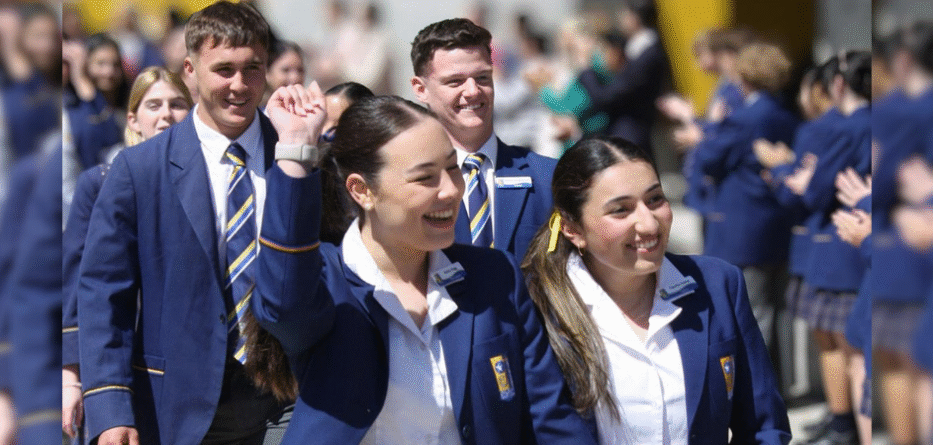
Students, too, must be active participants in this mission. Formation cannot be something done to them. It must be something they grow into. When students are invited into leadership, service, and reflection, they begin to see themselves not just as learners, but as active contributors to a community shaped by the Gospel.
The future of Catholic education will not be secured by nostalgia. It will be shaped by courage – reimagining, investing in people, and renewing our focus on the heart of our mission.
Catholic schools have always been more than places of learning. They are places of holistic transformation. The challenge before us is to ensure that this transformation remains real, relevant, and deeply centred in faith.
Frank Chiment is the Principal at St. John XXIII Catholic College, Stanhope Gardens.
For more information about Catholic schools, find a school near you or visit Catholic Schools Parramatta Diocese.