

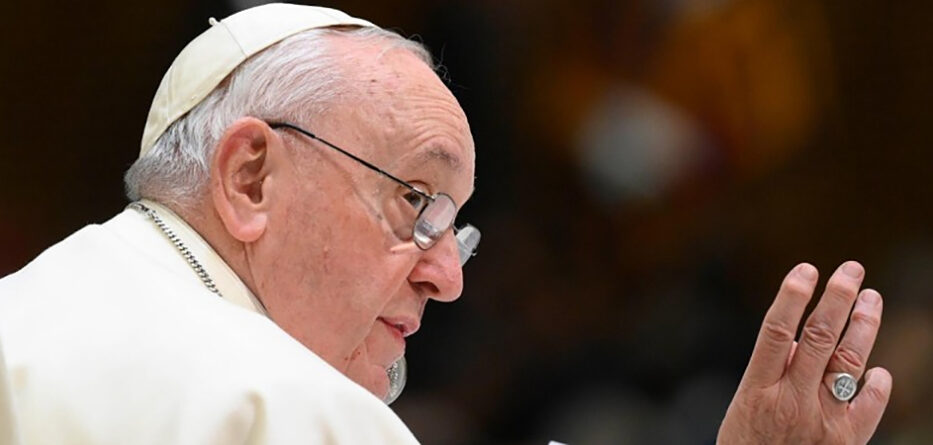
Pope Francis died on April 21, 2025—one year ago. During these last few weeks the world has been focused on his successor in an unusual way while an imbroglio unfolded between Pope Leo XIV and Donald Trump that could seem silly if the subject matter were not so serious. I have no doubt there will be more words exchanged between the Pope and the President if warm weather brings new escalations of ICE enforcements around the United States or some other fresh outrage. But in the midst of all that, we should not lose sight of Pope Francis’s memory or his lasting contributions to the Catholic Church and the world.
The first thing we should say is that Pope Francis was an uncommonly brilliant man with an extraordinary mind. That needs to be said because I read a prominent Catholic writer just days ago insist that Pope Leo “is more theologically orthodox than his predecessor, and brighter.” Time will tell whether that first claim is true—I think Francis and Leo are much the same. But the slur against Francis’s intelligence not only is unfair to both men, it is patently false.
The preoccupation with papal intelligence is a strange consequence of the 35-year-long John Paul II-Benedict XVI era of professor-popes. Speaking as a professor, let me say boldly that—taking nothing away from John Paul and Benedict, themselves—I don’t think professor-papacies were good for the Church. Across recent decades a version of Catholic faith has been cultivated which sees the Gospel of mercy and love like a syllabus of reading assignments, and it tempts us to think our intellect matters as much as our goodness. I have been a professor for a quarter-century, and I will sing the virtues of the intellectual life for a nickel. But we should not make the mistake of confusing faith with intellect. After all, as Pope Benedict XVI reminded us, “Being Christian is not the result of an ethical choice or a lofty idea, but the encounter with an event, a person, which gives life a new horizon and a decisive direction.” God is love.
Still, let us pay some attention to Pope Francis’s intelligence. I urge everyone to read his autobiography, Hope, which appeared early in 2025. The books is compiled out of interviews with Carlo Musso, a journalist, who captured Francis’s own words. The book is an astonishing tour of Pope Francis’s mind. He had a remarkable amount of literature and poetry, drama and opera at his immediate command. The range of his sympathies and intellect was extraordinary for someone trained in chemistry. That’s no insult to chemists—it simply is to say that Francis (unlike most of us) was not a captive to the narrowness of his education. His curiosity and his understanding stretched in many directions. That is always the signal of a great intellect.
There could be something else to notice here, too. Francis did not receive his education in North America or Europe, but in Latin America. It seems not at all unlikely that low estimations of Francis’s intelligence and his contributions are animated by some cultural bias. The Latin American reception of the Second Vatican Council was different from the North American and European reception of the Council. Francis was steeped in that Latin American reception—his intellectual biographer Massimo Borghesi describes Francis’s debts to Amelia Podetti, Alberto Methol Ferré, and others. Their ideas might be unrecognizable to many in the Global North. But they are sophisticated, and they shaped Pope Francis’s distinctively Latinamente vision for the Church, one still coming to fruition in the new pontificate of Leo XIV. Differences between Francis and Leo on what matters are exaggerated. Leo was born and educated in the U.S. But like Francis, Latin America shaped who he is.
At the heart of Francis’s vision lie three interlocking ideas—interculturality, solidarity, and synodality. Those lines can be traced from Francis’s papacy along a line that now stretches into the future.
Interculturality refers to the meeting of many cultures over the Christian message. It is not a blending of cultures that changes them. Rather, it is seeing how revelation is reflected in all human cultures, and an invitation to all peoples to learn from one another’s experiences of the Gospel. Interculturality pays close attention to context, which Pope Francis highlighted in 2023 by calling for “a fundamentally contextual theology, capable of reading and interpreting the Gospel in the conditions in which men and women live daily, in different geographical, social, and cultural environments, and having as its archetype the Incarnation of the eternal Logos.”
Solidarity was the theme of Pope Francis’s most important encyclical letter, Fratelli Tutti. Solidarity has been a principle of Catholic social doctrine for a long time, and Pope John Paul II (who appreciated Poland’s Solidarity Movement) advanced solidarity in a 1987 encyclical of his own. Yet Francis achieved something else entirely with Fratelli, elevating solidarity in such a way that it became the keystone of the Church’s social teaching—the principle that tells us why other principles like human dignity or the preferential option for the poor matter. Solidarity is “thinking and acting in terms of community and the priority of the life of all over the appropriation of goods by a few.” When we understand that, we understand everything else that the Church tells us about social life.
Yet, the signature of Francis’s papacy is synodality. Synodality is a style for the Church based on the theology of the Second Vatican Council—which, itself, drew synodality from the early church. The synodal style invites every person in the Church to participate in leading the Church, and commits everyone in a new way to the Church’s mission in the world. Our distinctive roles do not change—priest, pope, layperson, etc. But synodality invites everyone in the Church to listen to one another together much as the early church did, transforming how the Church fulfills its mission. Synodality means giving attention to relationships in the Church, “the strengthening of synergies.” As Pope Leo has said recently—”No one is called to dominate; all are called to serve. No one should impose his or her own ideas; we must all listen to one another. No one is excluded; we are all called to participate. No one possesses the whole truth; we must all humbly seek it and seek it together.” This is synodality.
Francis gave us a very simple way to think about all that interculturality, solidarity, and synodality mean together: “Todos, todos, todos!” The Church is for “everyone, everyone, everyone.” And, that “for” has an important double meaning. The Church offers an invitation to believe for everyone. And, the Church is for the whole human family—the Church is a ministry for everyone.
A year since Pope Francis died, we are only beginning to understand fully the depth of the gifts he gave to the Church and the world. To call him “Francis the Great” would sit awkwardly with the Christian simplicity of his ministry. Yet I have little doubt history will mark his papacy as a turning point—the moment the Catholic Church began really to live out the Second Vatican Council’s call to be a Church at service to the whole world. It is a monumental achievement. May he rest in peace.
With thanks to Steven P Millies.