

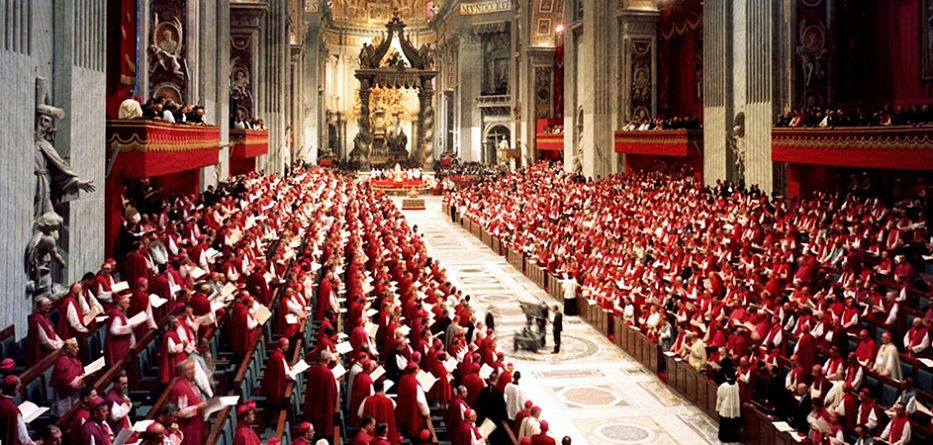
As we approach the 60th anniversary of the close of the Second Vatican Council on Dec. 8, it is a chance to look back at that council’s most influential and important documents, many of which appeared in a flurry in the waning months of 1965 (coming up on Dec. 7: “Gaudium et Spes” and “Dignitatis Humanae”). But in mid-November was the 61st anniversary of another of the biggies: The “Dogmatic Constitution on the Church,” better known by its Latin title, “Lumen Gentium.” And it is not possible to understand the provenance of 1965’s blockbuster promulgations without recognizing the importance of “Lumen Gentium” for the council and the church.
The constitution, wrote America associate editor Donald R. Campion, S.J., shortly after its publication, “ranks as the master work of this 21st ecumenical assembly. It must be recognized, moreover, as a landmark in two thousand years of Christian history.” While Father Campion realized that other council documents were awaited with greater anticipation, the dogmatic constitution “stands as an invitation to development in Christian faith and order that will challenge generations to come.”
Looking back on “Lumen Gentium” five decades later, the theologian Gavin D’Costa wrote in America that the document “movingly emphasizes the central goal of the Catholic life, the call to holiness and charity—but mediated through the sacramental life of the church.”
Some of the most resonant and memorable phrases of Vatican II come from “Lumen Gentium,” including the description of the church as a mystery and as the people of God and the assertion of a universal call to holiness. The constitution also affirmed “the common priesthood of the faithful” that all the baptized share. Linking the church as it exists today to the history of salvation and God’s original covenant with Israel in the Old Testament, “Lumen Gentium” simultaneously emphasized the church’s nature as a divine institution and as a pilgrim people on a journey.
Theological kerfuffles aside, “Lumen Gentium” also stands out among church writings of any era for its evocative language and literary style. That is another reason it is so often quoted and referenced: its appeal to the better angels of our nature.
To continue reading this article, click here.
James T. Keane is a Senior Editor at America.
With thanks to America and James T. Keane, where this article originally appeared.