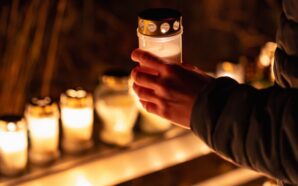


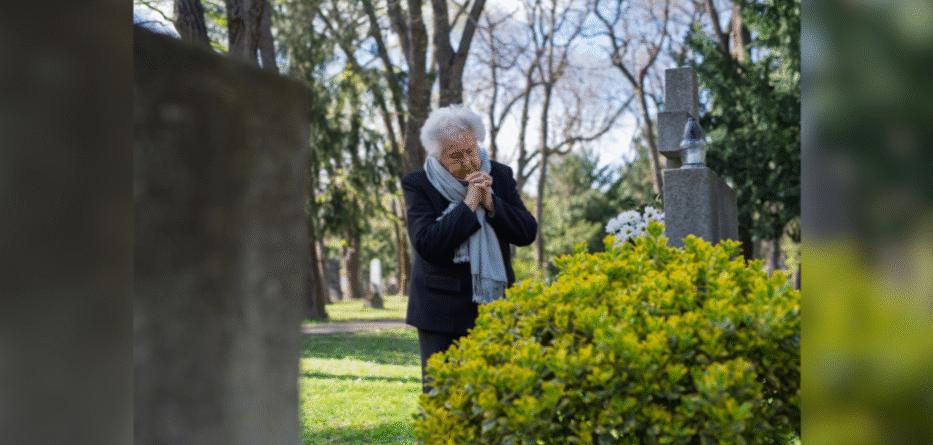
It is a consolation to pray often, in the Communion of Saints, for the dead.
The Feast of All Souls Day each year, reminds us that death is an important reality that we must all inevitably face. Theologian Ladislaus Boros once described it as our ‘moment of truth’.
But for very human and understandable reasons, we often avoid contemplating our mortality. Why?
In 1974, cultural anthropologist Ernest Becker won the Pulitzer Prize for his book The Denial of Death. The fear of our eventual extinction is so terrifying, so anxiety producing, Becker argued, that virtually all cultures construct elaborate schemes to deny our mortality and enable us to believe that we are immortal. In fact, Becker believed that perpetuating this denial of death constitutes one of the chief functions of culture.
But denying death is disastrous. It causes us to form illusory, false selves, and even worse, according to Becker, it foments all the horrific violence and aggression towards others that we see in the world today (since we must prove other death-denials false, and even eradicate them, else ours is exposed as a lie).
The denial of death, then, can never be our way as believers in Jesus, the Crucified and Risen One. For Christians are called to face the reality of death and hold it in creative tension with our sure hope of resurrection. The Crucified One is the Risen One!
Our faith in the Resurrection does not mean avoiding the brutal truth that death is a terrible and awesome moment. That is why we constantly ask Mary, Our Mother (in the Hail Mary), to “pray for us now and at the hour of our death”.
No wonder then, the care and love we as Christians give, when we lovingly pray for our loved ones who have gone before us ‘marked with the sign of faith’. Every person deserves the beauty and dignity of being lovingly prayed for.
In the Irish tradition, there is the beautiful practice of the ‘wake’ – where friends and relatives hold vigil and‘accompany’ the deceased person before the final rites of the Church. The body is reverenced and blessed because it is a ‘seed’ being planted that will rise to new life. In the early Church the body was buried facing the east, expressing the expectation of the second coming of Christ.
Celtic poet John O’Donohue (who died suddenly in 2008 at age 52) often wrote of the mystery of how death transfigures our separation:
It is a strange and magical fact to be here, walking
around in a body, to have a whole world within you and
a world at your fingertips outside you. It is immense
privilege, and it is incredible that humans manage to
forget the miracle of being here.
The more lonely side of being here is our separation
in the world. When you live in a body you are separate
from every other object and person. Many of our attempts
to pray, to love, and to create are secret attempts at
transfiguring that separation in order to build bridges
outward so that others can reach us and we can reach
them. At death, this physical separation is broken. The
soul is released from its particular and exclusive location
in this body. The soul then comes into a free and fluent
universe of spiritual belonging.
O’Donohue captures something of the sense of mystery and sheer awe surrounding the ‘passing over’ of the human person back into the silent heart of God.
Perhaps a sense of the mysterium tremendum is the reason for the famous ancient Latin tag De mortuis nilnisi bonum – ‘Of the dead, speak nothing unless good’ – for it conveys a profound truth.
For to pray for the dead, especially on All Souls Day, ultimately demands of us that we ‘let God be God’. No trying to ‘play God’ in any way and judge other people after their deaths.
Like it or not we are not in control. God is.
To pray for the dead is, in the poet Mary Oliver’s words, “to let it go” and to stand vulnerable, aware that ‘underneath are the everlasting arms. (Deuteronomy 33:27).
Br Mark O’Connor FMS is the Vicar for Communications in the Diocese of Parramatta.