

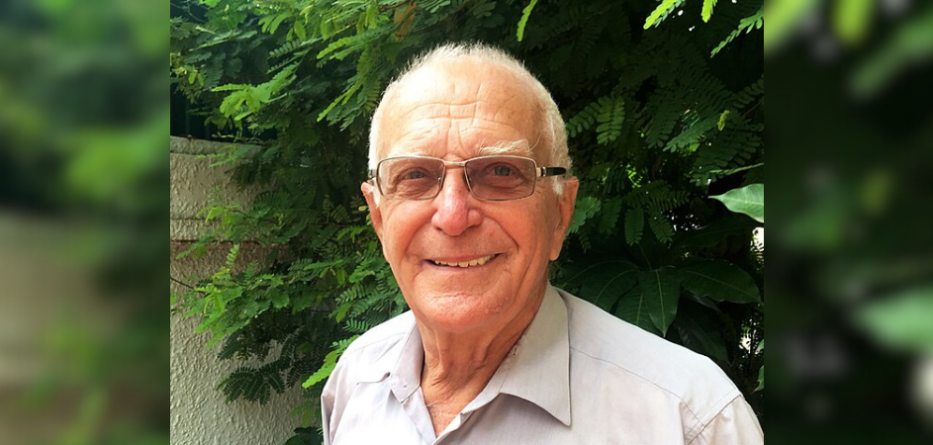
Father François Ponchaud, MEP, who exposed the Khmer Rouge atrocities in Cambodia during the 1970s, passed away January 17 at 85. He helped integrate Cambodian refugees in France and contributed to the reconstruction of Cambodia and the local church.
In 1965, François Ponchaud, a young priest with the Paris Foreign Missions Society (MEP), arrived in Cambodia, a small peaceful country with a population of seven million at the time. He immediately began studying the Khmer language and culture to be able to celebrate Mass and teach in the local language. “After Vatican II, he refused to say Mass in Latin,” explains Father Vincent Sénéchal, the current MEP superior general. “He had a strong character.”
Denouncing the Khmer Rouge
During this time, the Vietnam War was raging along one of the country’s borders. After the fall of Prince Norodom Sihanouk in March 1970, a civil war broke out in Cambodia. In Phnom Penh, surrounded by the Khmer Rouge, Father Ponchaud continued to teach, translate the Bible… all while gradually becoming aware of the brutality of the regime that would take over.
On April 17, 1975, the capital fell. Two million people were expelled from the city. Expelled as one of the last Westerners in May, Father Ponchaud remained at the country’s border in Thailand, gathering testimonies from Khmer refugees. In 1977, after returning to France, he published Cambodia: Year Zero, the first account detailing what Pol Pot and the Khmer Rouge regime (1975-1979) were doing to the Cambodian people. The book had an international impact, as most Western elites saw the Khmer Rouge’s rise to power as a positive development for Cambodia. “The newspaper Libération even suspected him of being a CIA agent!” recalls Father Sénéchal. Father Ponchaud also wrote a history of the Church in Cambodia called The Cathedral of the Rice Field: 450 Years of History of the Church in Cambodia, published in 1990.
The intellectual and humanitarian
Around 60,000 Cambodians sought refuge in France, and Father Ponchaud, with the support of the MEP, created the Espace Cambodge (Cambodia Space) association, providing support and resources for the Cambodian community, particularly refugees. “Espace Cambodge helped about 20,000 Cambodians integrate into France,” said Benoît Fidelin, who chaired the association for 15 years.
Returning to Cambodia in 1993, Father Ponchaud helped rebuild a ravaged country. He founded the Cambodian Catholic Cultural Center, translated the texts needed for liturgy and the transmission of faith into Khmer, and worked with a team, including Protestants, to translate the Bible… while starting a humanitarian effort. “He spoke Latin, Greek, Hebrew… He was a great intellectual,” recalls Fidelin. “But he didn’t want to limit himself to office work, ‘to be a Benedictine,’ as he would say. “With Espace Cambodge, which became Avenir Cambodge (Future Cambodia) in 2011, we built schools, middle schools, a hospital, bridges, roads, and an irrigation network in the poorest, most dangerous, and most neglected areas of the country.” The Khmer Rouge’s guerrilla warfare continued to ravage the country until 1998.
Father Ponchaud rigorously carried out this humanitarian work, only involving Cambodians on-site. Today, the French association has taken responsibility. The final tasks are to complete the construction of a maternity ward and the renovation of a hospital in the countryside.
A man of faith, culture, and dialogue
Born in 1939 in Sallanches, Haute-Savoie, southeastern France, the son of one of 12 children from an agricultural background was raised in a religious family. A good student at the minor seminary, he had already felt the call to religious life at that time. After serving in the paratroopers in Algeria for more than two years, he joined the Paris Foreign Missions Society. Life at the seminary in Bièvres, in the Paris region, was difficult for him, as he found the courses “mediocre” and the discipline too “rigid.” “He was rebellious, sometimes angry; it wasn’t always easy to work with him,” said Father Sénéchal. In Rome, he completed his formation with studies in theology and ancient languages. In 1964, he was ordained a priest.
“He was especially a man of faith with an incredible culture,” said Fidelin. “Caught in a crazy historical tragedy, he helped countless Cambodians, both in Cambodia and France, as well as in the reconstruction of the church. He helped rebuild entire communities.” He was committed to dialogue with Buddhism, Cambodia’s majority religion. “He was a free and stimulating man,” added Father Sénéchal.
A resurging Catholic Church
Today’s Catholic Church in Cambodia is now made up of many small communities after the local Catholic community was persecuted and almost disappeared during the 1975-79 genocidal Khmer Rouge regime that left at least 2 million people dead. The first Mass since that time was celebrated only in 1990, and 90 percent of the country’s Catholics have only been baptized in recent years.
There are no dioceses in Cambodia, but three ecclesiastical jurisdictions: Phnom Penh vicariate, Battambang prefecture, and Kompong Cham prefecture. About 97 percent of the 17 million Cambodians are Buddhists, and 2% are Muslims. According to Church statistics, there are around 75,000 Catholics in Cambodia.
Gaspar da Cruz, a Portuguese friar of the Dominican Order, brought the Catholic faith to Cambodia from 1555 to 1556. Despite French colonization in the 19th Century, Christianity had little influence in the country. According to the Vatican statistics, Catholics in Cambodia numbered 120,000 in 1953, and in 1972, there were about 20,000 Christians, most of them Catholics.
Reproduced with permission from La Croix International.