

“Let us drink anew from this Eucharistic spring.”
Ever since I was blessed to serve as event chairman of the papal Mass at the Los Angeles Memorial Coliseum in 1987, during the second pastoral visit of Pope St. John Paul II to the United States, I have watched the papal liturgies celebrated throughout the world with particular attention. I do so not only as a Catholic priest of more than fifty years, but as a liturgist with academic training in sacramental and liturgical theology. The grammar of the liturgy is the grammar of sign and symbol, and the manner in which these elements are chosen, shaped, and proportioned in such historic celebrations remains decisive for how the faith is expressed and handed on in the various nations of the Church.
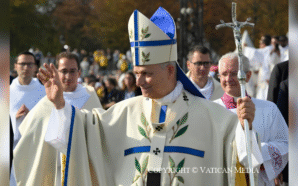
I must candidly admit that Pope Leo’s Corpus Christi Mass in Madrid brought me to tears at the sheer beauty of this expression of faith. More than a million people filled the streets of the Spanish capital for the Mass and Eucharistic procession on the Solemnity of the Body and Blood of Christ, gathered in the Plaza de Cibeles — that square better known internationally for Real Madrid’s victory celebrations, now given over entirely to the victory of the risen Lord. The turnout had begun the night before, when, by the accounts, some 600,000 young Spaniards kept vigil and knelt for several minutes in silence alongside the Holy Father, a quiet rebuke to every assumption that the faith has no future among the young of a secularized Europe. NPRNPR
Noble simplicity
The Second Vatican Council, in Sacrosanctum Concilium, spoke of the noble simplicity proper to the reformed Roman Rite, and this Mass was a splendid example of that value — not only in the symbols that adorned the temporary sanctuary, but in the music that drew the faithful into genuine participatio actuosa.
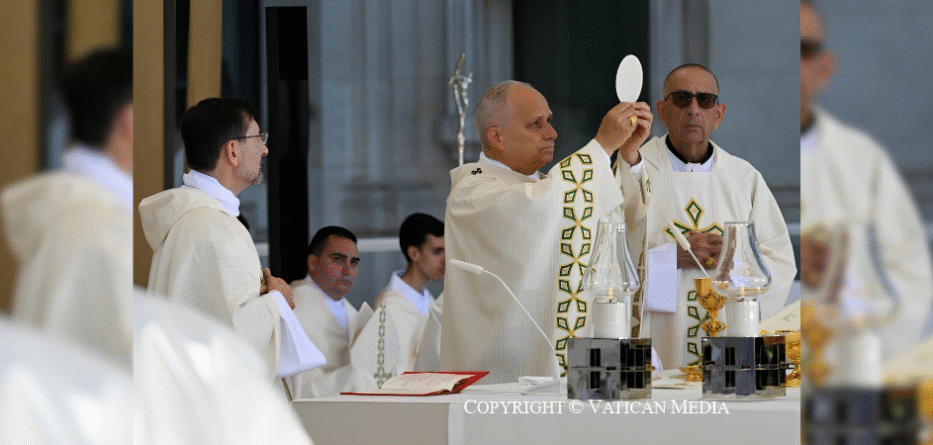
The sanctuary was itself a catechesis. The altar took center stage, clothed in beautiful linens that matched the chasuble of the Holy Father and his concelebrants, all crafted by Granda, the historic Spanish house of liturgical art outside Madrid. I write of Granda with personal affection. I worked with their representatives in the interior enhancement of Mission Basilica San Juan Capistrano, where they crafted the Grand Retablo, the new altar, ambo, and tabernacle, the stations, and the retablos honoring our titular saint, St. John of Capistrano, and St. Peregrine. Theirs is among the finest sacred craftsmanship in the Church today, and to see their hand at work on so vast a stage was a particular joy.
The exquisite monstrance carried in the procession was likewise a Granda work. Note how its green enamel mirrored the green vesture of the presider and concelebrants — sign answering sign, the very coherence the Council intended.
A word on the provenance of the crucifix, for it was no incidental prop. The figure of the Lord suspended above the altar — rising to some four and a half meters — was a recreation commissioned expressly for the occasion, modeled upon an image from the artisanal workshop of the Sisters of Bethlehem: the Familia Monástica de Belén, de la Asunción de la Virgen y de San Bruno, the enclosed community founded in France in 1951 whose life is given over, as their own tradition has it, to the silent search for the face of Christ. The original from which it was drawn belongs to the workshop the sisters maintain at the Monasterio de la Bondad de Dios in Huelva; one of their number, Sor Miriam, confirmed that they had been told their Christ would preside over the papal altar. The carving reproduces the forms of eleventh- and twelfth-century art — a contained geometry, an absence of superfluous ornament, a studied sobriety — the Romanesque idiom that gives us, precisely, the Lord reigning from the tree rather than expiring upon it. It was reminiscent of the medieval Christus triumphans: the Lord reigning as victor from the cross rather than hanging as victim. The larger scenic ensemble that framed it was the work of the architects Concha Sánchez Maíllo and Cristina del Río Villegas, who conceived the whole liturgical space with this Christ as its anchoring sign.
The choir of hundreds, joined by orchestra, was not present to entertain but to engage — to lift the assembly into sung prayer of their own. The entrance was the Spanish setting of Lucien Deiss’s Priestly People, Pueblo Sacerdotal, rearranged for chorus, orchestra, and assembly, music accessible enough that a million voices could make it their own. This is what the Council asked of sacred music, and what is so often forgotten: that it serve the song of the whole Body, not replace it.
The homily: the real presence goes out into the streets
The heart of the celebration was the Holy Father’s homily, and it deserves more than a passing word, for it was a sustained meditation on the very theme that gives Corpus Christi its genius — that the Eucharistic Lord does not remain enclosed, but goes out.
Pope Leo began by insisting that the day is more than another entry on the liturgical calendar; it is a return to the heart of the faith to renew our love and fidelity to God. He honored Spain’s long Eucharistic genius — the floral carpets, the altars raised in the streets, the carefully wrought monstrances, the hymns and vestments that have shaped this nation’s piety, art, music, and architecture for centuries. But he refused every temptation to reduce the procession to heritage. The procession, he insisted, is not an exhibition, a remnant of folklore, or a mere display of beauty, but a profession of faith in the risen Lord who is alive and walks among us still. Catholic World Report + 2
From this he drew the homily’s governing image. Just as Christ gives himself as food in the Eucharistic celebration, so the procession shows that he is not confined to the church but comes out to meet us. The Lord, he said, travels the streets, crosses the squares, and visits our neighborhoods, dwelling in the settings of our daily lives — a God who is close, who walks with his people, the Lord of history. This is the deepest logic of Corpus Christi: that the real presence is not a possession to be guarded behind walls but a presence that processes, that seeks out the city. Catholic World ReportCatholic World Report
And because the Church in Spain has long joined this solemnity to the Day for Charity, the Holy Father drew the moral consequence with unusual force. The Christ who passes through the streets in the monstrance is the same Christ who identifies with the poor, the downtrodden, and the forsaken. The procession, then, makes a demand on us before it makes a spectacle of beauty: it is not merely a matter of bringing out the monstrance, but of allowing ourselves to be brought out — out of our selfishness and indifference, out of a comfortable and private faith — so as to be converted and to become builders of a new world. Here was the homily’s pivot from devotion to discipleship, and it was masterful: the same verb, to bring out, turned from the Host upon the priest’s hands to the heart in the believer’s breast. Catholic World ReportCatholic World Report
This led to the line that the press has rightly seized upon. The task of Spain, the Pope said, is to ensure that its inherited religiosity does not become “a museum of the past to be visited,” but remains “a school of faith from which to draw even today.” It is a phrase worthy of a liturgist, for it names precisely the danger that besets every tradition: that what was once a living grammar of prayer hardens into an artifact admired from behind glass. A school, by contrast, forms; and this school, he said, teaches us to kneel before God and before our neighbor, since no one can kneel before the Lord while despising his brother. National Catholic RegisterCatholic World Report
The Holy Father then did what the finest preachers do — he handed the assembly two Spanish witnesses to carry the doctrine home. He recalled St. Manuel González García, the “bishop of the abandoned tabernacle,” whose life teaches that the Eucharist is honored not only in great celebrations but in the silent fidelity of those who keep the Lord humble company day by day. And he turned to St. John of the Cross, imprisoned in wretched conditions in Toledo around Corpus Christi of 1578, who knew the hidden Presence even in the dark. The Eucharistic Jesus, the Pope said with the saint, is the eternal spring that lies hidden — a spring that quenches thirst without blinding, without imposing itself by outward power or spectacle. For a Mass of overwhelming visual grandeur, it was a salutary correction: the glory is real, but the Lord’s manner remains hidden, gentle, given. Catholic World ReportCatholic World Report
The splendid reflection gathered it all. We are to drink again from the Eucharistic spring, the Pope urged, not to be enclosed in private devotion, but to be sent out to refresh our families, the poor, the suffering, and those who have lost hope. And he closed with an image I shall not soon forget: that the Lord present in the Eucharist might transform each of us into bread that is broken, given, and offered. Lex orandi, lex credendi, lex vivendi — the law of prayer becoming the law of belief becoming the law of life. The whole homily was that triad set in motion. Catholic World ReportCatholic World Report
A Eucharistic Prayer, and a quiet rebuke
It is worth noting that the Holy Father prayed the Third Eucharistic Prayer — that magnificent composition of the reformed Missal, with its great anamnesis and its intercession for the whole Church — rather than acceding to the traditionalist obsession with the Roman Canon as the only worthy anaphora. The reformed rite is not impoverished. On a day when more than a million were drawn into the mystery, the Church’s own contemporary prayer proved more than equal to the glory.
Communion and procession
Holy Communion was provided for the vast assembly through the hundreds of priests who concelebrated, each vested in a stole whose design echoed the principal chasubles — again, sign answering sign, the unity of the one priesthood made visible.
The Eucharistic procession that concluded the liturgy was carried out with great dignity, the Holy Father himself bearing the Blessed Sacrament through the assembly and the streets of Madrid. Children who had recently made their First Communion scattered flower petals, religious sisters bore candles, and the Pope walked beneath a golden canopy carrying the monstrance, as the crowds knelt and tossed flowers as the Eucharist passed. The route along the Calle de Alcalá was carpeted with sixteen floral designs fashioned from more than thirty thousand carnations — those very altars erected in the streets of which the Pope had preached. The choir and assembly sang familiar Eucharistic hymns, interspersed with Eucharistic texts proper to the occasion, and the liturgy concluded with the Holy Father blessing all with the Eucharistic Lord and a beloved anthem in Spanish. Catholic Review, Catholic World Report.
What I witnessed in Madrid was not nostalgia, and it was not mere magnificence. It was the reformed Roman Rite, celebrated with the noble simplicity the Council intended, opening out — as the Lord himself did — into the streets of a city and the heart of a people. Cum Petro et sub Petro, the Church went out to meet the world, bearing the only thing she has ever truly had to give.
Msgr. Arthur Holquin is a retired priest of the Diocese of Orange and retired rector of Mission Basilica San Juan Capistrano. He publishes Liturgy and Truth on Substack.
Reproduced with permission by Liturgy and Truth by Msgr. Arthur Holquin, S.T.L.