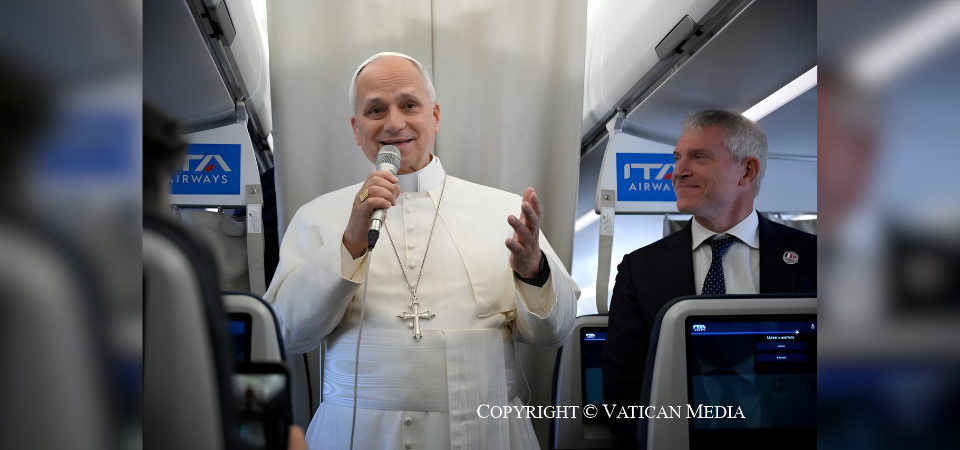


The documents of the Second Vatican Council are among the most frequently invoked texts in contemporary ecclesial life and among the least frequently reread. Pope Leo XIV, in his catechesis during his Wednesday General Audiences, has charted a different course, offering the Church a reinterpretation of the Council that does not dwell on its controversies but returns to its living source. Just as St. Augustine in a garden in Milan was led to the reading of the Word of God by the words Tolle, lege (“Take and read”), so Leo XIV takes the conciliar text and reads it, inviting the Church through this gesture to do the same. If Vatican II is like a great cathedral, the pope has not led us to a side door, nor to a secluded chapel, but before the main entrance that leads to everything else: Dei Verbum, the Word of God. Before anything else it said about the Church, the modern world, and the liturgy, the Council points to the original fact: God speaks, and this speaking is called “friendship.”
A Choice Not to Be Taken for Granted: Why Vatican II and ‘Dei Verbum’
The theme itself is significant. The 60th anniversary of the closing of the Second Vatican Council was celebrated on December 8, 2025, yet Leo XIV never mentions it as the reason for his choice. This makes his choice all the more significant: a free choice reveals a priority.
Like each of his predecessors, the pontiff has made clear, right from his introductory catechesis,[1] the desire to “rediscover the beauty and the importance of this ecclesial event.” But for him, the Council is not a historical event closed in on itself. It is not a matter of repeating what Vatican II said, but rather of realizing anew what it accomplished. The pope wants the Church to “welcome the rich tradition” that has characterized it and, at the same time, to reflect on “the present and renew our joy in running toward the world to bring it the Gospel.” To accomplish today what the Council did then, we must return to its texts, capturing the same spirit with which they were written. Leo XIV suggests this in the tone of Augustinian mystagogy: that generation “rediscovered the face of God as the Father who, in Christ, calls us to be his children.” For the pontiff, re-reading the Council means setting out in search of that same face. And it is in this sense that some theologians speak of Vatican II as “an ongoing theological event.”[2]
Leo XIV quotes John Paul I to emphasize that what is needed is “not so much organizations or methods or structures, but a deeper and more widespread holiness.” Ecclesial reform does not arise from more effective meetings, but rather from spiritual renewal. The pope therefore wants his interpretation of the Council to be direct and faithful to the conciliar texts: “It will be important to get to know it [= the Council] again closely, and to do so not through ‘hearsay’ or interpretations that have been given, but by rereading its Documents and reflecting on their content.” Spiritual renewal and the re-reading of the texts are not two parallel paths: dynamism and content are mutually implicated, because every ecclesial event contains within itself an intelligence that inhabits it and makes it fruitful.
The first document considered by Leo XIV is significant. Dei Verbum (DV), the Dogmatic Constitution on Divine Revelation, was part of the final group of texts promulgated by the Council on November 18, 1965. It is the shortest of the four Constitutions, yet it had perhaps the most complex editorial history of all the other conciliar documents, after the original preparatory outline, De fontibus revelationis, had been heavily criticized at the beginning of the Council, in October 1962.[3] The result was, as Pope Benedict XVI stated, “one of the finest and most innovative [documents] of the entire Council, […] and still needs to be studied more deeply.”[4] By taking Dei Verbumas the starting point for his discussion of Vatican II, Leo XIV acknowledges its programmatic and methodological primacy, even though chronologically it appeared last. For many theologians, this document constitutes the foundation of the entire conciliar teaching: the Word of God comes first, then everything else.[5] The pontiff’s choice confirms this criterion.
One Source, Many Voices
It is common practice to identify Dei Verbum with the doctrine on Sacred Scripture.[6] Yet the title itself directs our gaze further, toward Revelation understood as God’s living and personal self-communication to humanity in Christ Jesus through the Spirit.[7] The concept of the “Word of God,” in its theologically informed usage, carries with it a layered semantic richness whose center is, according to the Johannine Prologue, the eternal Word made flesh (cf. John 1:1-14). From this Christological center, the Word of God radiates out toward creation (libernaturae), prophetic history, and apostolic proclamation – the living Tradition, chronologically prior to Scripture – to finally reach Scripture itself. The title Dei Verbum, therefore, keeps this analogical plurality open, without resolving it.[8]
With Dei Verbum, Vatican II does not primarily introduce a new biblical hermeneutic, but rather proposes a different understanding of Revelation as a personal communication from God himself: “Jesus Christ radically transforms man’s relationship with God, which is henceforth a relationship of friendship.”[9] It is this exuberant and overflowing friendship that unfolds in the manifold forms in which the Word reaches us in creation, in Tradition, in Scripture, in proclamation, and in the Spirit. This expressive diversity of the Word of God neither fragments nor confuses Revelation.
Scripture, in its various books, is this convergence in its normative form. “[The Church] has always maintained them, and continues to do so, together with sacred tradition, as the supreme rule of faith” (DV21). In them, the Incarnate Word continues to speak through the human words that the Spirit has inspired. The divine Word always transcends the human words that convey it, surpassing them without nullifying them.[10] It is the Holy Spirit, promised by Jesus in the Upper Room, who guarantees this living and unifying abundance.
Here a clarification is needed that sheds light on the entire post-conciliar debate. The term fons (“source, wellspring”) is used in the conciliar documents in an analogical sense. First and foremost, there is a single divine “source,” the God who reveals himself, from whom everything flows (cf. DV 9). Scripture and Tradition can in turn be defined as “sources,”[11] rightly but analogically, according to the order of transmission (cf. DV 21). Scripture and Tradition are for us sources of knowledge of Revelation, but they are not its “origin,” since it is Revelation itself from which they proceed.[12] The problem with the old “two sources” model was not so much the use of the plural as the separation of these two channels from their common origin, treating them as opposing and self-sufficient elements. Dei Verbum does not eliminate the language of sources, but traces it back to the divine “origin,” so overflowing that it flows into two inseparable channels.[13] Here the pope grasps the decisive core: Scripture is “wholly related to Jesus Christ.” It is this relationship, not its antiquity, not its formal authority, not its literary beauty, that constitutes “the profound reason for its value and its power.” Theology, too, takes shape from this relationship, understood as the human attempt to use words to enter into the divine Word, allowing oneself to be guided by it in the use of one’s own words.[14] It is this living superabundance that the Council chooses to name with a surprisingly simple word: “friendship.”
The Dialogical Dimension of Revelation
It is this friendship that, as Leo XIV noted in his first catechesis[15] on Dei Verbum, the Council places at the center (cf. DV2). It is the words of Christ himself that establish it: “I do not call you servants, […] but I have called you friends” (John 15:15). In them, a new relationship is established between God and humanity: a friendship. For the pope, the conciliar document is important not because it offers solutions from below, but because it grounds our being in an order that comes from above, and it is precisely from there that the space of prayer opens up, what Pope Leo XIV describes as “listening” and “exchange”: the place where our words encounter the Word of God. “God’s Revelation […] has the dialogical nature of friendship and, as in the experience of human friendship, it does not tolerate silence, but is nurtured by the exchange of true words.” Situated in history and always open to interpretation, they are nevertheless capable of being translated into all languages, because the divine life they express is, by its very nature, sempermaior.
Leo XIV distinguishes between the “word” and “chatter.” The latter commits no one; it “stops at the surface and does not achieve communion between people.” The “word,” on the other hand, has the power to create authentic relationships, not merely by exchanging information, but by revealing who we are. A “chat” among friends is indeed a good thing, but the pope is referring to that kind of word which, stripped of presence, fails to be true and builds nothing. The true word, on the other hand, creates relationship, because the Word par excellence is a Person.
The Word of God transcends any text that attempts to contain it: it is the Word that the Father spoke once and for all in the Son, which the Spirit prepared through the prophets, incarnated in history, entrusted to the apostles, and continues to keep alive throughout time. Scripture and Tradition are its faithful and inseparable transmission: they are not two containers that imprison it, but two living forms in which it continues to engage every generation. Precisely because Jesus is the Word of the Father, his incarnation reaches human words, takes them up, heals them, elevates them, and transfigures them, as St. Augustine affirms: “[Christ] did not disdain to take us into himself; indeed, he did not even disdain to transfigure us in himself and to speak with our words, so that we too might speak with his words.”[16] The Word of God creates a new relationship, and “by speaking to us, God reveals himself to us as an Ally who invites us into friendship with Him.”
By its very nature, a covenant must establish common terms upon which the two parties can enter into communion. Yet, as the pope observes, there is always an asymmetry between God and man: “In the Covenant, there is a first moment of distance.” In Christ, however, something essentially new takes place: God does not merely speak to humanity from afar or make a covenant with it, but enters into its condition, takes on its flesh, and from within makes us “sons and daughters” by virtue of his shared humanity. This is a true re-creation. Our communion with God, our “likeness” to him, is therefore achieved only “in the relationship with the Son made man” who calls us “friends.”
Leo XIV reminds us that friendship with God is realized “first of all in liturgical and community prayer, in which we do not decide what to hear from the Word of God, but it is He Himself who speaks to us through the Church.” It follows that “the first attitude to cultivate is listening, so that the divine Word may penetrate our minds and our hearts.” Our conversation with God is not a supplication in the strict sense, but something more revealing and vulnerable: “We are required to speak with God, not to communicate to Him what He already knows, but to reveal ourselves to ourselves.” Prayer becomes a journey in which we become more fully who we are, children of God, friends of God, because, when we accept this invitation and nurture this relationship, “we will discover that friendship with God is our salvation.”
Christ’s Gaze on Reality
The pope’s second catechesis[17] on Dei Verbum explored this insight in greater depth. The greatest contribution of Dei Verbum is not the space it opens up for modern exegesis. That space, in fact, had already been inaugurated by Pius XII’s Divino Afflante Spiritu (1943), which had authorized and encouraged the historical-critical method. The true novelty lies elsewhere: “The deepest truth about God and the salvation of man shines out for our sake in Christ, who is both the mediator and the fullness of all revelation (cf. DV 2).” According to Leo XIV, it is not enough “to consider Jesus as the channel of transmission of intellectual truths”: rather, we are called to participate with our whole selves in Christ, “in his own way of inhabiting and passing through the world,” which includes, indeed presupposes, a true and normative doctrine. “Jesus himself invites us to share his gaze on the world.”
Revelation cannot be reduced to mere information: in Christ, truth and Person coincide, and what is revealed in him transcends any particular expression.[18] This is why God communicates not merely a content, but a relationship, a “covenant” that profoundly transforms those who receive it.
The pope identifies three principles that characterize Revelation as a participatory mystery. The first is that “Jesus reveals the Father to us by involving us in his own relationship with Him.” Through the power of the Holy Spirit, we too become genuine participants – friends – in this dialogue. The second is that “Thanks to Jesus we know God as we are known by Him (cf. Gal 4:9; 1 Cor 13:13).” Christ is both the place where we recognize the truth of God the Father and the place where we discover that we are known by Him. We are “called to the same destiny of full life.” The third principle is that “Jesus Christ reveals the Father with his own humanity.” To know God in Christ means to embrace “his integral humanity”: “God’s truth is not fully revealed where it takes something away from the human, just as the integrity of Jesus’ humanity does not diminish the fullness of the divine gift.”
The Deposit of Faith: From Seed to Tree
Pope Leo XIV devoted his third catechesis[19] on Dei Verbum to the relationship between Scripture and Tradition, emphasizing that there is in fact no tension between them, but rather a living dynamism within their unity. The name of this dynamism is the Holy Spirit. The Spirit is, in fact, the One in whom Scripture and Tradition share a single origin and tend toward a single Trinitarian end (cf. DV 9). This theme is introduced beginning with the promise made by Christ in the Upper Room: “The Holy Spirit, whom the Father will send in my name, will teach you all things, and bring to your remembrance all that I have said to you. […] When the Spirit of truth comes, he will guide you into all the truth” (John 14:25-26; 16:13).” Dei Verbum takes up this premise and develops its consequences. Thus the “two competing sources” (a thesis rejected from the very first conciliar drafts) give way to two inseparable modes of transmission of the one divine Word: “For both of them, flowing from the same divine wellspring, in a certain way merge into a unity and tend toward the same end” (DV 9).
For Leo XIV, “the Word of God, then, is not fossilized, but rather it is a living and organic reality that develops and grows in Tradition.” On the one hand, “the Sacred Scriptures grow with the one who reads them” (Gregory the Great); on the other, “this tradition which comes from the Apostles develops in the Church with the help of the Holy Spirit” (DV 8). The Church, “in her teaching, life and worship, perpetuates and hands on to all generations all that she herself is, all that she believes” (ibid.). Scripture and Tradition, exegesis and dogma grow together, nourished by the same source, which is the Holy Spirit.
The pope quotes the Doctor of the Church St. John Henry Newman and draws on the parable of the seed (cf. Mark 4:26-29) to show that Christianity, “both as a communal experience and as a doctrine, is a dynamic reality.”[20] The image of the seed stands in opposition to two temptations at once.[21] To those who confuse fidelity with “repetition,” it reminds us that growth is not betrayal and that the tree need not apologize for no longer being a seed. To those who confuse renewal with “invention,” it reminds us that there is nothing in the plant that was not already present in the seed.[22] To speak of doctrinal development in Newman is, ultimately, to speak of a “creative fidelity” that unfolds in the living body of Christ.[23]
This synthesis is not achieved through compromise, but by the inspiration of the Spirit, through a shift in perspective within that fundamental “covenant-dialogue” identified earlier: “Sacred Tradition and Sacred Scripture form one sacred deposit of the Word of God, committed to the Church. […] The task of authentically interpreting the Word of God […] has been entrusted exclusively to the living teaching office of the Church, whose authority is exercised in the name of Jesus Christ” (DV 10). A magisterium that is not superior to the Word of God, but serves it, so that Scripture and Tradition, together, “each in its own way, under the action of the one Holy Spirit, contribute effectively to the salvation of souls” (ibid.).
An example of how the pope applies Newman’s doctrine of development is his revival of the term “deposit,” carefully clarifying its legal origin. It is a term that “imposes on the depositary the duty to preserve the content, which in this case is the faith, and to transmit it intact.” This duty of custody must, however, be understood in the Newmanian sense, where the depositum fidei is not a sealed safe, but the handing on of the living and life-giving Word. To those who might doubt the relevance of this term, the pope responds: “All of us, in our various ecclesial ministries, must continue to preserve it in its integrity, as a lodestar for our journey through the complexity of history and existence.” It is therefore a matter of understanding the “deposit” as a vital element for the Church and the faith of today: neither merely doctrine, nor merely event. Revelation is always both together, because its center is Christ, in whom word and event, message and person coincide perfectly.[24]
A Dual Voice, a Single Word
In the fourth catechesis,[25] Leo XIV reflected on a more fundamental question: How does Scripture come into being? What is the relationship between the divine Author and the human authors who wrote its pages? For several centuries, theologians defended divine inspiration, “almost considering the human authors merely as passive tools of the Holy Spirit.” Dei Verbum corrects this approach, without diminishing the divine origin, by affirming that God is the principal “author” of Scripture, and that the hagiographers are its “true authors” (DV 11).[26] In the fourth catechesis on Dei Verbum, the pontiff made his own the observation of the Spanish biblical scholar Luis Alonso Schökel, for whom “reducing the human activity to that of a mere scribe does not glorify the divine activity.”[27] The two dimensions are inseparable, because God, as Creator, can act within the human will in such a way that it does not lose its dignity; on the contrary, it becomes more fully itself. There are risks in both directions. If one does not pay attention to the historical context and literary genres, one slips into fundamentalism; if one does not pay attention to the divine origin, Scripture is reduced to “a text only of the past.” Only by holding these two elements together can we honor what Scripture is: the Word of God, expressed in human words, normative for the faith of the Church precisely in this dialogue between the divine Word and human words.
God speaks in Scripture to share not only his words, but his entire life, giving us his Son so that we may share in his love. Scripture overflows, because it is the ever-greater Word that dwells within it that overflows: it precedes it, sustains it, and transcends it.[28] No text can fully capture what it conveys.[29] The Gospel, therefore, “cannot be reduced to a mere philanthropic or social message, but is the joyful proclamation of the full and eternal life that God has given to us in Jesus.” As St. Augustine teaches, the primary purpose of Scripture is to nourish the life and charity of believers. If God speaks to us, it is because making oneself understood by the other is a first act of love.
The Word that Brings Life
From this source of a Word that is both divine and human, inspired and incarnate, the pope’s fifth catechesis[30] drew its practical and ecclesial implications. This Word is meant to be studied, celebrated, and lived out at the heart of the Church. Vatican II affirms that the Church has always venerated the divine Scriptures, just as she has done for the Lord’s own Body: two tables, one bread of life (cf. DV 21). Pope Leo XIV brings to fulfillment St. Jerome’s admonition, affirming that reading the Word of God means to “get to know Christ and, through Him, to enter into a relationship with God.” This relationship, he specifies, is friendship, and it is realized “when we read the Bible with an inner attitude of prayer: God then comes toward us and enters into conversation with us.”
The Word of God, therefore, belongs to the whole Church.[31] Every believer is its recipient and is called to receive it as the bread of life (cf. Matt 4:4). All are invited to draw from this source, “first and foremost in the celebration of the Eucharist.” The ministers of the Word – bishops, priests, deacons and catechists – are called to cultivate “love for the Sacred Scriptures and familiarity with it.”In this regard, exegetes and biblical scholars perform a valuable service, but always within this ecclesial and Christological horizon: no specialized expertise, in fact, can exhaust its richness, because, as Leo XIV states in his final summary, “All the Scriptures proclaim his [Christ’s] Person and his saving presence.” Consequently, Scripture occupies a central place for “theology, which finds its foundation and soul in the Word of God.”
The Word Made Flesh and Mary’s ‘Fiat’
Pope Leo XIV’s catechesis on Dei Verbum is addressed to a broad audience, without, however, sacrificing theological rigor. The tone is that of one who allows the dialogue to breathe, keeping the questions open just enough to continue to provoke reflection. Two familiar voices resonate in these catecheses, both explicitly cited and both present in the background: that of Benedict XVI, whose theology of the Word and of revelation – understood as dialogical revelation founded on friendship – constitutes the theological architecture of these catecheses;[32] and that of Pope Francis, who projects that same architecture toward a missionary dynamism, focusing on languages capable of taking root in cultures and in real people, without compromising the rigor of thought, but rather so that it may become an encounter.[33] In this sense, do these catecheses not perhaps offer a glimpse of the path that is taking shape for the current pontificate, in which theological reflection on the Word encounters questions that also cut across contemporary philosophical thought?
For the phenomenologist Jean-Louis Chrétien, the answer lies in a paradox: for him, the human word is constitutively “fragile” precisely because of what gives it voice.[34] It certainly responds to a prior call that always transcends it, yet it does not become superfluous, because our finitude is manifested in it: “[The word] exposes itself from the very beginning to the risk of being lost. Without this risk, it will not attain what only it can attain, allowing itself to be attained and often broken.”[35] Chrétien shows that the gaze of friendship is not reduced to what the friend is, i.e. their qualities, but to the fact that the friend exists. Being is itself already a source of joy, and every other joy is not so much an addition as a promise of a foretaste of fulfillment, “like the blossoming of this first surplus upon nothingness.”[36] It is in friendship that this wounded word finds its future. To listen to a friend is to offer them a future that does not come from us, returning to them their own secret as a promise. And it is this fragile word, precisely because it is surplus, that is threatened today.
Yet, it is precisely amid this abundance of words that our thirst for that one word, the one that takes the risk of encounter, becomes all the more acute. As the pope observes: “We live surrounded by so many words […]. At times we even listen to wise words, which do not however affect our ultimate destiny. On the contrary, the Word of God responds to our thirst for meaning, for the truth about our life. It is the only Word that is always new.” To return to Dei Verbum is to discover that God has chosen words to tell us who he is, and that we have received them to learn how to tell him who we are. In an age when words are generated by algorithms that multiply them without inhabiting them, the question of what a word truly is – a word that creates relationship, that reveals, that saves – becomes more urgent than ever. The biblical tradition knows this thirst well and its unexpected fulfillment. Reading Dei Verbum means placing oneself, like the Samaritan woman, before the one source of Revelation: He who does not merely inform, but becomes dialogue, revelation, presence. And there, beside the well of living water, his voice still resounds for those who thirst: “I am he, the one who is speaking to you” (John 4:26).[37]
Leo XIV points to one final guide: the “example of Mary, Mother of the Church.” In her, the Word found its most attentive and loving listener. God’s revelation is, like every true dialogue, an act of divine vulnerability in which God exposes himself freely, for love withholds nothing of itself.[38] Mary’s fiat is the human response to this gift, an authentic word that carries within it all the finitude and all the courage of one who does not shield herself from the risk of encounter, but embraces it in advance, with generosity. In Mary’s fiat, the two fragilities – that of God who entrusts himself in the proclamation and that of the person as we makeourselves present and available – touch one another, and from this contact arises the friendship that saves.
Mary’s fiat precedes us and overflows into history, bringing forth children, raising voices, and giving birth to fruitful words that bear witness to this encounter; and thus she becomes the “Mother of the Church.” Newman recognized in Mary the model of every believer’s growth: in receiving the Word, Mary “does not think it sufficient to accept it, but dwells upon it; she does not merely take possession of it, but puts it to use; it is not enough for her to give her assent, but she develops it; she not only submits her reason to it, but applies it to it.”[39] It is in this order of receptive listening, contemplative dwelling, and organic and ecclesial development that the Word grows in us as it grew in Mary. In this vast and living company, she reaches out her hand to us so that we may enter into this encounter with hope and without fear.[40]
Reproduced with permission by La Civilta Cattolica.
DOI: https://doi.org/10.32009/22072446.0626.1
[1]. Cf. Leo XIV, Catechesis: The Second Vatican Council Through Its Documents. Introductory Catechesis, January 7, 2026. For the five catecheses on Dei Verbum (January 14–February 11, 2026), cf. https://www.vatican.va/content/leo-xiv/en/audiences/2026.index.html. Unless otherwise indicated, citations refer to the last catechesis mentioned.
[2]. Cf. M. Levering, An Introduction to Vatican II as an Ongoing Theological Event, Washington, DC, The Catholic University of America Press, 2017. This category has its roots in the very nature of the Councils, of which Nicaea,“an event of Wisdom,” arising from the “event of Jesus Christ,” remains the normative paradigm: cf. A. Begasse de Dhaem, “The International Theological Commission’s Document for the 1700th Anniversary of Nicaea”, in Civ. Catt. English Edition June 2025, https://www.laciviltacattolica.com/the-international-theological-commissions-document-for-the-1700th-anniversary-of-nicaea/
[3]. Cf. G. Caprile, “Tre emendamenti allo schema sulla Rivelazione. Appunti per la storia del testo”, in Civ. Catt. 1966 I 214–231.
[4]. Benedict XVI, Address at the Meeting with the parish priests and clergy of Rome, February 14, 2013, at https://www.vatican.va/content/benedict-xvi/en/speeches/2013/february/documents/hf_ben-xvi_spe_20130214_clero-roma.html. Benedict XVI’s last thematic address was on Vatican II. Leo XIV seems to take up that central theme.
[5]. Cf. M. Levering, An Introduction to Vatican II…, op. cit., 11: “Dei Verbum comes first of all, because without God’s self-revelation in Christ, nothing else would make sense.”
[6]. Cf. the title, which is already indicative, of R. D. Witherup, Scripture: Dei Verbum, New York, Paulist Press, 2006.
[7]. The structure of Dei Verbum demonstrates this, moving from Revelation (nos. 1–6) to its transmission (nos. 7–10), and only reaching Scripture in no. 12.
[8]. Cf. Benedict XVI, Post-Synodal Apostolic Exhortation Verbum Domini, September 30, 2010, no. 7, where the analogy of the meanings of “Word of God” (Dei Verbum) is recognized and identified as a pastoral and theological task. Leo XIV explicitly cites this document twice in his catechesis.
[9]. Leo XIV, Catechesis 1. “God speaks to people as to friends”, January 14, 2026.
[10]. Cf. Francis, Encyclical Lumen Fidei, June 29, 2013, no. 15: “The word which God speaks to us in Jesus is not simply one word among many, but his eternal Word (cf. Heb 1:1–2).”
[11]. Cf. Leo XIV, Catechesis 5. “The Word of God in the Life of the Church”, February 11, 2026: “Sacred Scripture, entrusted to the Church and preserved and explained by her, performs an active role […]. All the faithful are called to drink from this wellspring.”
[12]. Cf. J. Wicks, “Six texts by Prof. Joseph Ratzinger as ‘peritus’ before and during Vatican Council II”, in Gregorianum 89 (2008/2), 270.
[13]. Dei Verbum takes up here a theological issue left open by the Council of Trent (cf. H. Denzinger – P. Hünermann, Enchiridion Symbolorum, no. 1501). Cf. Y. M. J. Congar, La tradition et les traditions, Paris, Fayard, 1960, 209–228; J. Ratzinger, “Kommentar zu Dei Verbum”, in Lexikon für Theologie und Kirche, II, Freiburg, Herder, 1967, 498–528.
[14]. Cf. Francis, Lumen Fidei, no. 36: “Theology […] is not just our discourse about God, but first and foremost the acceptance and the pursuit of a deeper understanding of the word which God speaks to us, the word which God speaks about himself, for he is an eternal dialogue of communion, and he allows us to enter into this dialogue.”
[15]. Cf. Leo XIV, Catechesis 1: “God speaks to men as to friends”, op. cit.
[16]. Augustine of Hippo, Enarrationes in Psalmos 30, II, 3 (PL 36, 231).
[17]. Cf. Leo XIV, Catechesis 2. “Jesus Christ reveals the Father”, January 21, 2026.
[18]. Cf. International Theological Commission, Jesus Christ, Son of God, Savior. 1700th Anniversary of the Ecumenical Council of Nicaea (325–2025), Vatican City, Libreria Editrice Vaticana, 2025, 17. The term “consubstantial” in the Creed is not sufficient on its own to express the divinity of the Son, but it is part of a series of scriptural and liturgical terms (“God from God,” “light from light,” “true God from true God”).
[19]. Cf. Leo XIV, Catechesis 3. “A Single Sacred Deposit: The Relationship Between Scripture and Tradition”, January 28, 2026.
[20]. Cf. I. Ker, Newman on Vatican II, Oxford, Oxford University Press, 2014. According to Ker, DV 8 is the most explicit instance in which Newman’s notion of doctrinal development found its way directly into the conciliar documents.
[21]. Cf. S. Morgan, John Henry Newman and the Development of Doctrine: Encountering Change, Looking for Continuity, Washington, DC, The Catholic University of America Press, 2021, pp. 246–249; 268 ff.
[22]. Cf. ibid., 207.
[23]. Cf. N. Steeves, “John Henry Newman: Doctor of Fruitful Fidelity”, in Civ. Catt. English Edition November 2025, https://www.laciviltacattolica.com/john-henry-newman-doctor-of-fruitful-fidelity/
[24]. Cf. M. Levering, An Introduction to Vatican II…, op. cit., 20–49. The author emphasizes how Vatican II affirms both the personal and the cognitive-propositional dimensions of Revelation, leaving their interconnection open as a fruitful theological point of reflection.
[25]. Cf. Leo XIV, Catechesis 4. “Sacred Scripture: The Word of God in Human Words”, February 4, 2026.
[26]. For a more in-depth examination of the Catholic theologies of inspiration that preceded and paved the way for the formulation of DV 11, from Pierre Benoit’s Thomistic-instrumental model to Karl Rahner’s monistic-predefined model, up to Ratzinger’s Bonaventurian-ecclesial proposal, cf. A. Pidel, The Inspiration and Truth of Scripture. Testing the Ratzinger Paradigm, Washington, DC, The Catholic University of America Press, 2023, 15–100.
[27]. L. Alonso Schökel, La Bibbia alla luce della scienza del linguaggio, Brescia, Paideia, 1987, 70.
[28]. Cf. Benedict XVI, Verbum Domini, no. 17: “Although the Word of God precedes and exceeds Sacred Scripture, nonetheless Scripture, as inspired by God, contains the divine Word (cf. 2 Tim 3:16) ‘in an altogether singular way’”.
[29]. Cf. ibid., no. 7: “All this helps us to see that, while in the Church we greatly venerate the sacred Scriptures, the Christian faith is not a ‘religion of the book’: Christianity is the ‘religion of the word of God’, not of ‘a written and mute word, but of the incarnate and living Word.’ (St. Bernard of Clairvaux). Consequently the Scripture is to be proclaimed, heard, read, received and experienced as the word of God, in the stream of the apostolic Tradition from which it is inseparable (cf. DV 10).”
[30]. Cf. Leo XIV, Catechesis 5. “The Word of God in the Life of the Church”, February 11, 2026.
[31]. Cf. A. Pidel, The Inspiration and Truth of Scripture…, op. cit., 80–100. Scripture, as the word of God, is fully revealed only within the living subject that brought it into being and that continues to receive it in faith.
[32]. Cf. Benedict XVI, Verbum Domini, nos. 6–21 (“The God Who Speaks”); nos. 22–28 (“Our Response to the God Who Speaks”).
[33]. Cf. Francis, Apostolic Exhortation Evangelii Gaudium, November 24, 2013, nos. 20–24 (“A Church which goes forth”); nos. 68–70 (“Challenges to Inculturating the Faith”); and nos. 115–118 (“A People of Many Faces”).
[34]. Cf. J.-L. Chrétien, Fragilité, Paris, Minuit, 2017.
[35]. Ibid., La Voix nue. Phénoménologie de la promesse, Paris, Minuit, 1990, 209.
[36]. Ibid., 216.
[37]. “ ’Eγώ εἰμι, ὁ λαλῶν σοι.” By taking on the divine Name (cf. Exod 3:14), Jesus does not merely identify himself, but reveals himself as the One in whom God is essentially the Speaker, always addressing a “you”.
[38]. Cf. Thomas Aquinas, Commento al Vangelo secondo Giovanni, vol. II, Bologna, Edizioni Studio Domenicano, 2019, 657: “Now, revealing the truth is proper to the Holy Spirit. For it is love that leads to the revelation of secrets”; ibid., 775: “For it is a true sign of friendship that a friend reveals to his friend the secrets of his heart […]; now, by making us sharers in his wisdom, God reveals his secrets to us.”
[39]. J. H. Newman, Sermoni su temi di attualità – Sermoni all’Università di Oxford, Bologna, Edizioni Studio Domenicano, 2004, p. 682.
[40]. The author would like to thank the Jesuits Jean-Pierre Sonnet, Henry Shea, Paul Gilbert, and Christopher Grodecki for reviewing his article and for the discussions they had with him, which have enriched these pages.