

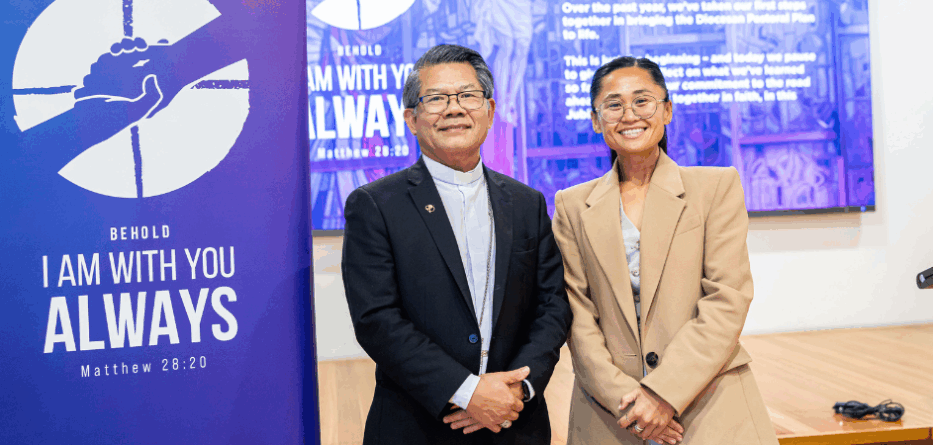
The Council of Jerusalem, recounted in the Acts of the Apostles, reveals striking insights for our ongoing journey as a synodal Church in the Diocese of Parramatta.
Upon arriving at the Church in Jerusalem, Paul, Barnabas, and other believers were welcomed in. Before beginning their discussions, they “reported everything God had done through them” (Acts 15:4).
In Greek, “reported” translates to anangellō (ἀναγγέλλω) —meaning to tell or announce—and the announcement wasn’t just “everything,” but rather, hosos (ὅσος), meaning “how great” all that God had done through them. The posture of these disciples tells us that they knew, acknowledged, and remembered God, who has always been faithful.
Why is this important to emphasise? Synodality is a call to conversion and deeper communion—the “walking together” expressed by the literal translation of “synod.” Synodality leads to the renewal of the Church, inspired by the Holy Spirit. However, this is not possible without roots in our generous God who walks with us.
There are significant shifts in the life of the Church. The renewed invitation for all the baptised to recognise and realise their role and responsibility in furthering the mission of Jesus Christ today has been met with both hesitation and hope. These are not unusual responses to uncertainty.
Listening to the stories of our people, with over 5,000 people who participated through more than 1,000 submissions received through our Synod’s listening process, it became evident that there are wounds that need healing.
These are not easy tensions to hold, especially in the often-polarised contexts in which we find ourselves.
Yet, after the Resurrection, it is the crucified wounds that Jesus invited the doubting St Thomas to touch. The invitation is for us too, in our ever-evolving journey toward a synodal Church.
Even in our doubt, anger, and fear, we are invited to enter our personal and institutional vulnerabilities—and find Jesus there, calling us to conversion and communion.
In this last year, I have been struck by how tender this invitation is: to continue listening with an openness to being changed. In this Jubilee Year of Hope, as the entire Church reflects on our need for God, perhaps we can take courage from our early Church ancestors, who were willing to sit in the mess of zētēsis (ζήτησις) or “debate” with each other out of love—calling on the Holy Spirit to inspire truth and honesty for our way forward.
Jesus’ return signalled to us the hope offered through a life in God. This tells us that much more is still to be experienced, more still to be done, because we live in hope.
It is a hope that cannot be contained.
It is a hope that expresses the reality that we cannot remain the same.
This hope is for those who may have “seen it all” and believe that God no longer has something new to offer them.
This hope is for those who have felt that the Church hasn’t listened to or seen them or invited them to the table of communion.
This hope is for those struggling in silence—experiencing loneliness and sickness—who feel that darkness is their only friend.
This hope is for the women, children, and the poor, whom our Scriptures affirm as necessary to God, especially for the mission of the Church.
This hope is for anyone burdened by the suffering of others and of our world, who has given up on the possibility that things could be different.
This hope is for anyone hurt by the failures of leaders in the Church—leaders who forgot that their position meant a greater responsibility to accompany with compassion and care.
This hope, as Pope Francis would say, is for “todos, todos, todos”—for all, to the exclusion of none.
After the Council of Jerusalem, a letter was sent out to all the nations: “It seemed good to the Holy Spirit and to us…” (Acts 15:28).
The call to conversion, reconciliation, and communion is stronger than ever, and this is precisely where our Diocesan vision and plan for a synodal Church is situated.
In Pope Leo XIV’s first address to the cardinals after his appointment, he proclaimed “the marvels that the Lord has done.” In the same way, we echo the words of Pope Leo XIV, and those at the Council of Jerusalem, and give thanks for the desire of our Good God to be with us—always.
Here’s to the people of the Diocese of Parramatta, whose courage, faith, and hope have welcomed creativity, potential, and fresh ways of witnessing God’s love for our here and now. The mission is communion. May the Trinitarian reality of who God is remind us that we are never alone along the way.
Qwayne Guevara is a lay leader in the Diocese of Parramatta, who was the lead facilitator of the Diocesan Synod in Parramatta in 2023 and the development and launch of the Diocesan Pastoral Plan in 2024.
Learn more about the Diocesan Pastoral Plan, discover inspiring stories from our parishes, agencies and ministries, and explore new resources on our website portal: parracatholic.org/synodality