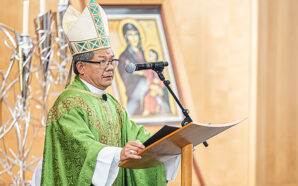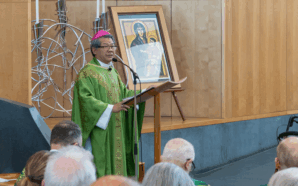



Most Reverend Vincent Long Van Nguyen OFM Conv DD STL, Bishop of Parramatta
2025 Homily for Christmas Eve
Praising God and enacting his kingdom vision in the world
Readings: Isaiah 9:1-7; Titus 2:11-14; Luke 2:1-20
“Glory to God in the highest heaven, and peace to people who enjoy his favour”
Dear brothers and sisters,
The words and the sentiments of joy, hope and peace that broke upon the world on the first Christmas night don’t seem to reflect the mood of the country and the city where people are still reeling from the massacre on Bondi 10 days ago. Even the prophecy of Isaiah that speaks of a light shining on those living in deep shadow does not seem to match our collective experience. The violence that visited our Jewish Australians and continues to affect so many innocent victims in so many places around the world envelopes us with its insidious power. We struggle to come to terms with it. Discord threatens national unity. A cacophony of discordant voices chokes the song of love, and recrimination seems to paralyse the path of future hope.
It is in this context that we gather to celebrate Christmas and to find inspiration to be signs of hope and instrument of unity for our divided world. In these troubled times, when war threatens global security, populism undermines democracy, social inequity fosters mistrust and division, our faith in the incarnate God binds us in human solidarity and stewardship of all creation. For the birth of the child Emmanuel symbolises God’s commitment to the world.
On this solemn night, God’s Word assures us that darkness no longer has the upper hand. The world is no longer condemned but redeemed. God’s plan for us has become a reality even as the child is vulnerable and threatened. The seed of hope once sown will grow and realise its possibility. The path to victory is inevitable; God’s plan set in motion in the birth of the Emmanuel is unstoppable.
In the first reading, Isaiah speaks of the coming of Messiah who would inaugurate a new reign of justice and integrity. The prophet, however, describes this hero figure not in conventional terms of power and dominance. He alludes to the way God brought about the unlikely victory over the Midianites despite Israel’s inferior forces. The Messiah will be manifested as a Prince of Peace who will restore the exiled and dignify the oppressed. He will implement a new social order that levels the playing field and prioritises the welfare and viability of the weakest links.
This prophecy spells an end to the imperial ideology, the winners-take-all system and trickle-down political paradigm. It finds echoes in Mary’s Magnificat, the Beatitudes and the parables of Jesus where God’s style of operation does the very opposite of the pecking order based on power and privilege: At Bethlehem, God signals his closeness with the lowly and his intent to reverse the world’s social order. He summons us to work towards a vision of a new world of communion, harmony and life flourishing for all, but especially the most vulnerable.
Like Isaiah, Luke describes the birth of Jesus as the new messianic era for humanity. “I bring you news of great joy”, the angel said to shepherds, “a joy to be shared by the whole people. Today in the town of David, a saviour has been born to you”. With this announcement, a new dawn had arrived for them, for humanity. The birth of Jesus was framed with a backdrop of imperial census that meant heavier tax burdens and economic exploitation. The Holy Family was, like many of the poor today, victim of an unjust social system. Yet with the arrival of the Messiah, the reign of God prevailed over against the rule of greed, selfishness and corruption. The path to hope is possible for those who adopt God’s new social order, for those willing to reimagine the world through the eyes of the lowly, marginalised and vulnerable.
Christmas offers us the opportunity to join the divine project of reconciling all in Christ. For with the Incarnation, God has reset the cycle of human behaviour. Jesus did not follow the script of the empire. He came as a poor and humble servant in order to minister at the thresholds of human vulnerability. He rejected violence, demonisation and scapegoating. We no longer need to use violence in order to counter violence; or resort to scapegoating mechanism to drive out the opponents.
The birth of Jesus is about the God who personally gets involved in our history and bears its burdens, He shares our sufferings and tears to the point of bloodshed and offers us a way out filled with life and hope.
Brothers and sisters,
The birth of Jesus signals God’s alignment with those who are at the edges of society. We are called, like Joseph and Mary, to choose and make the style of Bethlehem our own. This is the style of people who are willing to give of themselves in service of others. This is the courage to act outside survival instincts and to follow divine directives instead. Let us not lose hope. Let us renew our trust in God. Let us sing the song of the angel praising God and enacting his vision of a new world where all his children can flourish. This Christmas, as we contemplate the Christ child in the manger, let us commit ourselves to pray and work for justice in all its manifestations so that God’s reign will come in our world. Let us create a safe, dignified and just world for all, since our safety, dignity and justice are all intertwined.