

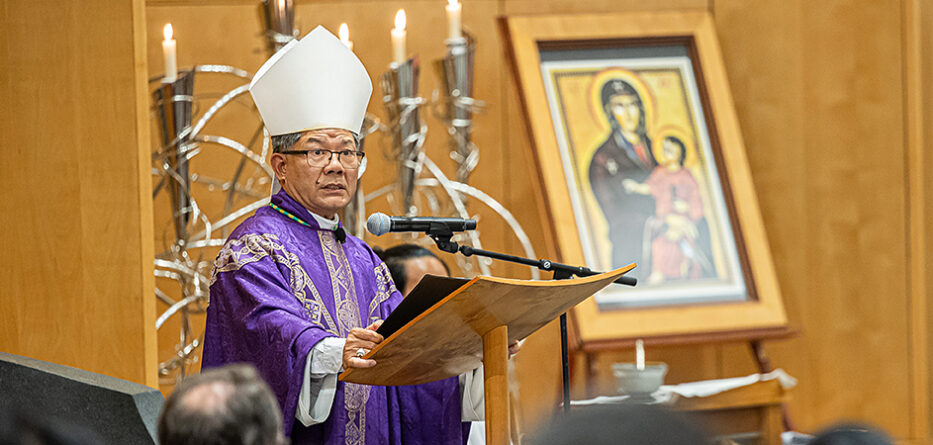
Most Reverend Vincent Long Van Nguyen OFM Conv DD STL, Bishop of Parramatta
Homily for Mass for the 30th anniversary of the St Patrick’s Cathedral fire
Readings: Deuteronomy 30:15-20; Psalm 1:1-4, 6; Luke 9:22-25
19 February 2026
Dear friends,
Tonight, we have come together to remember an event that has shaped the history of the Church in Western Sydney and the Blue Mountains. It was exactly 30 years ago that the fire broke out, engulfed and destroyed this very building in which we now gather. What happened then was so shocking, distressing and emotionally powerful that it edged sharply into the collective memory. We still remember where we were and what we were doing when we heard of the news or worse when we saw the fire with our own eyes.
One of the latter was Monsignor Boyle, who is concelebrating with us. John in his best-selling memoir has faithfully captured and recorded the amazing story of how the People of God have responded to the double challenge of repairing the old and building the new. The fire paradoxically was the catalyst for the young diocese to reimagine its symbol of unity, faith and mission. A bit like the tale of the once stolen Mona Lisa painting from La Louvre, the notoriety aided our cause. The national prominence we enjoyed was conducive to the fundraising campaign that was necessary for our subsequent undertaking. We were able to restore this historic building and build the new Cathedral as it stands today: a proud testament to the courage, resilience, generosity and faith of the people of Western Sydney, non-Catholics included, I might add.
God does work in mysterious ways. He brings about new life from apparent defeat and loss. This was true of the chosen people, the early Church as well as the Church through the passage of time. When we survey salvation history, we recognise that out of the crisis of the exile, the battered people of God became the nucleus of the new Israel. Similarly, out of the persecution of the early Christians in Palestine by the hostile forces, the universal Church was born. Even in our own context of Western Sydney, we are bolstered by those who came here as migrants and refugees. What was demonstrably a terrible event, the destruction by fire became an opportunity to re-imagine our place in the civic domain.
The Word of God inspires us to be the Church that is not distant and aloof but deeply engaged with the people. We are to be the sign of unity and instrument of peace. We are called to follow the humble Suffering Servant who draws us into the paschal mystery in order to reproduce the triumph of life in each of us and for the world.
The first reading tells us the story of God’s chosen people having to make a choice between the God of their ancestors. Moses brings all the tribes of Israel before the promised land and challenges the people saying “I set before you life or death, blessing or curse. Choose life and … obey his voice”.
Choosing to serve the Lord who delivered them from bondage, oppression and human indignity has real implications to the way they treat others. It means they have to give an account to God when they oppress the stranger, ignore the widow and mistreat the orphan. The God-decision goes hand in hand with the neighbour-decision. The God of love and freedom expects them to be champions of love and compassion.
A choice for God is more often than not a choice for a costly discipleship. This is what Jesus taught in the Gospel. To be His follower is to walk the path of the cross. It is to lose oneself for the sake of the kingdom. It is to commit oneself not to self-preservation but to self-sacrifice for the sake of others. “For anyone who wants to save his life will lose it; but anyone who loses his life for my sake will find it”.
Dear friends,
Tonight, we gather to celebrate the way many people involved in the cathedral fire and its aftermath, who helped the cause without counting the cost. They were the clergy, staff and parishioners. They were the firefighters, police, first responders, emergency workers who were deeply impacted and, in some cases, traumatised by what they experienced. We also remember the incredible generosity of many people who contributed to the temporary arrangements, the fundraising efforts and the mammoth task of rebuilding virtually from the ashes.
The Church is not just a building. Above all, it is a community of disciples witnessing to the Gospel of Jesus Christ and living as the sign of God’s kingdom on earth. Through the trauma of the fire, we witness the mobilising of the community spirit, the best of the Australian character and of the people of Western Sydney.
The path to a new future that is aligned with God’s purpose traverses through pain and suffering of our own. Therefore, let us, with God’s grace, enact faithfully the rhythm of the paschal mystery of dying and rising in the pattern of our Lord. Let us renew our commitment to be the face of God for the world. “If the Lord does not build the house, in vain do the workers labour”. Let us, with grateful hearts, commend to God all who have contributed to this vital chapter in our history.