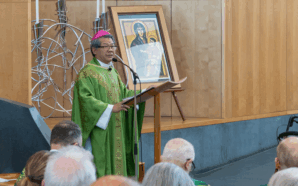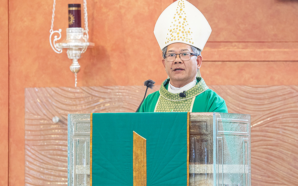


Most Reverend Vincent Long Van Nguyen OFM Conv DD STL, Bishop of Parramatta
Homily for the 3rd Sunday of Easter 2026 Year A
Readings: Acts 2:14-23; 1Peter 1:17-21; Luke 24:13-35
Emmaus is emblematic of our journey of discipleship
Dear sisters and brothers,
They say that a crisis can make or break us. The hard times can hurt us; but they can also become opportunities for us to make positive changes. Some 30 years ago, an arsonist set fire to our beloved historic cathedral in Parramatta. It was a distressing experience for many involved, both during and after the inferno, including clergy, parishioners, fire fighters, first responders and volunteers.
Providentially, however, this tragic event turned out to be the greatest catalyst for the young and fledgling diocese to reimagine its symbol of unity, faith and mission. A bit like the tale of the once stolen Mona Lisa painting from La Louvre, the infamy aided our cause. With generous support from across the board, we were able to restore the old and build the new Cathedral as it stands today: a proud testament to the courage, resilience, generosity and faith of the people of Western Sydney and the Blue Mountains.
The Word of God this Sunday teaches us that disappointment, pain and suffering ought not to have the last word on the people of faith. The Easter message which is written in bold relief reads that suffering and death are part of the divine equation. They are indeed the prerequisites for the paschal victory. In other words, there is no path to glory that sidesteps pain and sacrifice. Therefore, to be a disciple of Jesus is to emulate him in his self-emptying and death on the cross.
In the first reading, Peter tells the people that it is through the power of the crucified Jesus that he has enabled the paralytic to walk again. Contrary to his previous aversion to any suggestion of a suffering Messiah, he now speaks with utter conviction about the one who was killed and raised to life. Through the new prism of his conversion, Peter is able to articulate what previously was a scandal and a stumbling block for him, namely, the paschal mystery that Jesus had undergone.
Peter is a very different person who has converted from his obsession with power, dominance and pride. Earlier, he was rebuked and even called “Satan” because he wanted to remove the cross from the mission of Jesus- something the devil had tempted Jesus to do earlier. It was only after his conversion that he began to see things in a different light. He learned to let go of the old way of power, ambition and security. He could only become the true rock by emulating the Suffering Servant and walking the way of powerlessness, humility and servant leadership.
Similarly, the Gospel story bears witness to the transformation that enables those who follow the paschal pattern of Jesus to change their outlook in life. The two disciples did not understand how this paschal pattern played itself out in the life of Jesus. They only saw one part of the equation -much like the tangled knots on the back of an embroidery. They were unable to appreciate that there was a beautiful and meaningful design being woven together on the other side. What had unfolded in Jerusalem through their narrow and myopic vision was a total disaster.
Jesus the stranger however saw things differently. He began to open their eyes to see that God’s route to the fullness of life is intimately bound up with the cross. Jesus challenged them to look at his life of humble service, compassion, justice and solidarity which culminated on the cross with new eyes. He helped them to understand the way God worked in human history. Their eyes were opened and they recognised him at the moment of breaking of the bread, that is, the eucharistic re-enactment of the life, death and resurrection of Jesus.
My dear friends,
The disciples were tranformed after their encounter with the risen Jesus. They were re-energised for the mission as they returned to Jerusalem and shared their experience. The story of Emmaus is emblematic of our journey of discipleship. It reminds us that the God of transformation is with us. Out of the ashes of our shattered hopes and broken dreams, God makes new things grow. For if we suffer in and with God and God suffers in us, then we live in the hope that our suffering can be transformed into something positively life-changing.
Jesus demonstrated that a life worth living was a life lived for others. He showed by his own example that the love given wholly for others even at the cost of one’s life is the risk worth taking. Speaking of cost, Pope Leo has spoken truth to power despite being ridiculed and attacked. He reminds us and those in power of the Gospel-centred path to conflict resolution, reconciliation and peace-building through nonviolence. Let us accompany him with our prayers in the shared mission for the Church and the world.
The path to a new future that is aligned with God’s purpose traverses through pain and suffering of our own. Therefore, let us with God’s grace, enact faithfully the rhythm of the paschal mystery of dying and rising in the pattern of our Lord. Let us renew our commitment to embrace the path that Jesus himself has walked before us. May we like the disciples live out the paschal mystery and fulfill our missionary vocation of transforming the world. Let us accompany one another along this path with firm hope and abiding trust in our God.