

Homily for the 1st Sunday of Lent
Readings: Genesis 2:7-9; 3:1-7; Psalm 50; Romans 5:12-19; Matthew 4:1-11
22 February 2026
On Ash Wednesday, when the ashes were applied to our foreheads, we recalled that we are dust and unto dust we will return. Our Lenten journey of 40 days is a time for getting back to basics – stripping away some of the barnacles and focusing on what really matters. We are encouraged to pray, to fast, and to give alms.
LISTEN: https://soundcloud.com/frank-brennan-6/homily-22-2-26
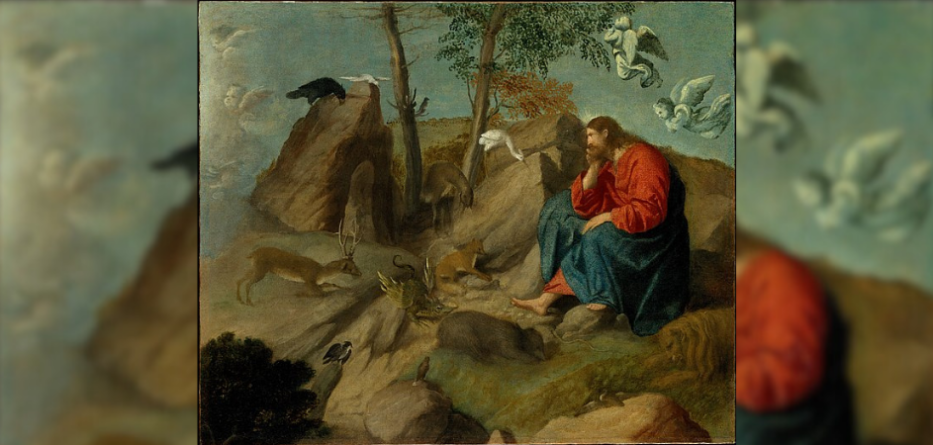
In today’s gospel from Matthew we encounter Jesus after his 40 days in the desert. The first Christians in the largely Jewish Matthean community would have seen a ready parallel between Jesus, the Son of God, spending 40 days in the wilderness and the Chosen People spending 40 years in the wilderness. Like the Chosen People in the desert, Jesus was tempted. Moses constantly reminded the Chosen People of God’s injunctions to maintain faith and adherence to the right path.
Each time Jesus is tempted, he responds with words spoken by Moses to the people in the desert when they were feeling abandoned by their God: ‘Man does not live on bread alone but on every word that comes from the mouth of God.’ ‘You must not put the Lord your God to the test’. And ‘You must worship the Lord your God, and serve him alone.’ Each time, the temptation for Jesus was to take the short cut, to obey and worship the tempter, to meet his short term needs or personal aspirations. But Jesus maintained his resolve. After 40 days, the angels appeared and looked after him. And after his resurrection, he is able to proclaim: ‘All authority in heaven and on earth has been given to me’. (Matthew 28:18).
John Anderson who was Leader of the National Party in John Howard’s day is interviewed in the weekend papers. At the age of 13 he hit a cricket ball that killed his sister. He recalls: ‘As a teenager I had to go looking for answers. You’ve been inadvertently and innocently the cause of another person’s death, and in my case my sister, and no matter how sympathetic people are, you feel no one understands. Your childhood ends. I didn’t come from a Christian home but that’s where my faith really stems from. I had to believe the wounds could be bound up, there would be some justice some day. Some people would say that’s a reason not to believe. I would say to not believe and to have no hope and no belief that one day the wounds will be bound up is much harder. I couldn’t go there. So that shaped me a lot as a person.’[1]
During Lent, we reconfirm our belief that the wounds can be bound up, that there can be justice some day, even if only in the life to come. In his message for Lent, Pope Leo draws on his Augustinian heritage. He quotes St Augustine, much like Pope Francis was fond of quoting St Ignatius Loyola. Augustine says: ‘In the course of earthly life, it is incumbent upon men and women to hunger and thirst for justice, but to be satisfied belongs to the next life. Angels are satisfied with this bread, this food. The human race, on the other hand, hungers for it; we are all drawn to it in our desire. This reaching out in desire expands the soul and increases its capacity.’[2]
Leo invites us to ‘a very practical and frequently unappreciated form of abstinence’. He urges us this Lent to refrain from words that offend and hurt our neighbour. He says: ‘Let us begin by disarming our language, avoiding harsh words and rash judgement, refraining from slander and speaking ill of those who are not present and cannot defend themselves. Instead, let us strive to measure our words and cultivate kindness and respect in our families, among our friends, at work, on social media, in political debates, in the media and in Christian communities. In this way, words of hatred will give way to words of hope and peace.’[3]
This Lent, let’s speak well of each other, as we seek to bind up the wounds and bring justice to our world. These 40 days could make a difference.
Be merciful, O Lord, for we have sinned.
A clean heart create for me, O God,
and a steadfast spirit renew within me.
Cast me not out from your presence,
and your Holy Spirit take not from me.
Be merciful, O Lord, for we have sinned.
Give me back the joy of your salvation,
and a willing spirit sustain in me.
O Lord, open my lips,
and my mouth shall proclaim your praise.
Be merciful, O Lord, for we have sinned.
Fr Frank Brennan SJ AO, Adjunct Professor of Thomas More Law School at ACU and Adjunct Research Professor at the Australian Centre for Christianity and Culture, is a former Rector of Newman College, University of Melbourne, and CEO of Catholic Social Services Australia (CSSA). His latest books include Pope Francis: the Disruptive Pilgrims Guide (ATF Theology, 2025), and Gerard Brennan’s Articles and Speeches: Maintaining the Law’s Skeleton of Principle (2 volumes) (Connor Court, 2025).
[1] https://www.theaustralian.com.au/inquirer/john-anderson-on-populism-political-decline-and-his-mission-to-fix-australia-and-the-world/news-story/6a4a5f25692984401a80d9355f79dd8f
[2] Augustine The Usefulness of Fasting, 1, 1.
[3] Leo XIV, Message for Lent, https://www.vatican.va/content/leo-xiv/en/messages/lent/documents/20260205-messaggio-quaresima.html