

Within hours of the announcement in Oslo, the President of the United States told a rally crowd in Syracuse that this year’s Nobel Peace laureate was a “mystery person,” adding, “I never heard of the person. Nobody did.” For good measure, he assured the crowd, “I know a lot of people.”
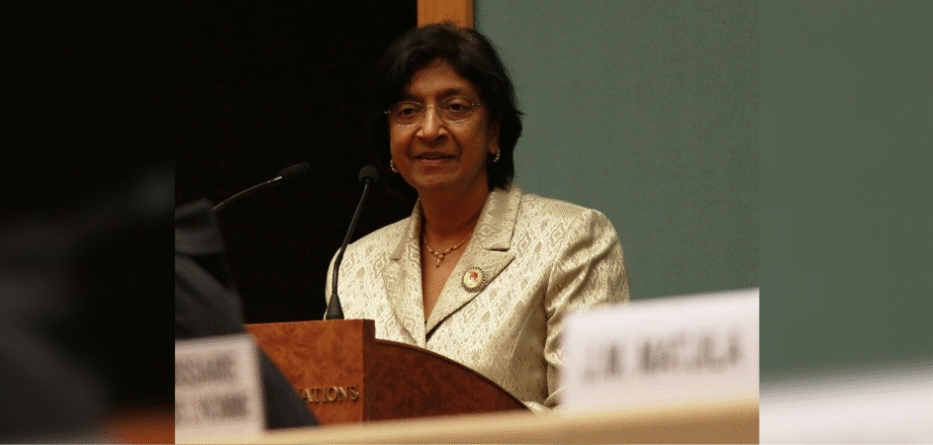
The ignorance of one man is not the measure of another’s significance. That Navi Pillay was unknown to the President says nothing about her and a great deal about where he has been looking. The survivors of Rwanda know her name. The political prisoners of Robben Island knew it. So does every woman who has sought justice for sexual violence in war. Here is what the “mystery person” has done:
- Broke a barrier under apartheid. In 1967, she became the first Black woman to open her own law practice in Natal, the daughter of a Durban bus driver whose community helped pay for her education.
- Exposed torture. In a Terrorism Act trial in 1971–72, she was part of the defense team that exposed torture and unlawful interrogation methods.
- Opened the doors of Robben Island. In 1973 she won the right for political prisoners there, including the jailed Nelson Mandela, to have access to lawyers. For her trouble, the apartheid government denied her a passport for many years.
- Defended her own husband. She represented Gaby Pillay, also a political prisoner, while he was tortured in detention.
- Made history on the bench. In 1995 she became the first woman of color elevated to South Africa’s High Court.
- Named rape as genocide. She served eight years on the International Criminal Tribunal for Rwanda, the last four as its President. Her tenure is best remembered for the Akayesu trial, which established that rape and sexual assault could constitute acts of genocide, ending the ancient lie that the bodies of women are the spoils of war.
- Served the world’s courts. She sat on the Appeals Chamber of the International Criminal Court in The Hague until 2008, then served as UN High Commissioner for Human Rights until 2014.
- Opposed the death penalty. In 2015 she joined the International Commission against the Death Penalty.
- Still at work at 85. She is currently an ad hoc judge at the International Court of Justice on whether Myanmar’s crackdown on the Rohingya breached the Genocide Convention. She also chaired the UN commission that concluded Israel’s government had committed genocide in Gaza, a finding Israel firmly rejected, which may explain why her name is suddenly unwelcome in certain quarters.
The Nobel Committee put the matter in three words: “Peace requires justice.” The Church has said the same for a very long time. Opus iustitiae pax — the work of justice will be peace (Isaiah 32:17) — was the motto of Pius XII. Paul VI told the world in 1972: “If you want peace, work for justice.” Navi Pillay has done that work for nearly sixty years, in apartheid courtrooms, in Arusha, in The Hague, and in Geneva, usually far from the cameras.
Peace is not a trophy one awards oneself for deals announced at rallies. It is the slow, costly labor of making the powerful answerable to the law. That is why the prize went where it did.
With thanks to Liturgy & Truth and Monsignor Arthur Holquin, S.T.L., where this article originally appeared.