

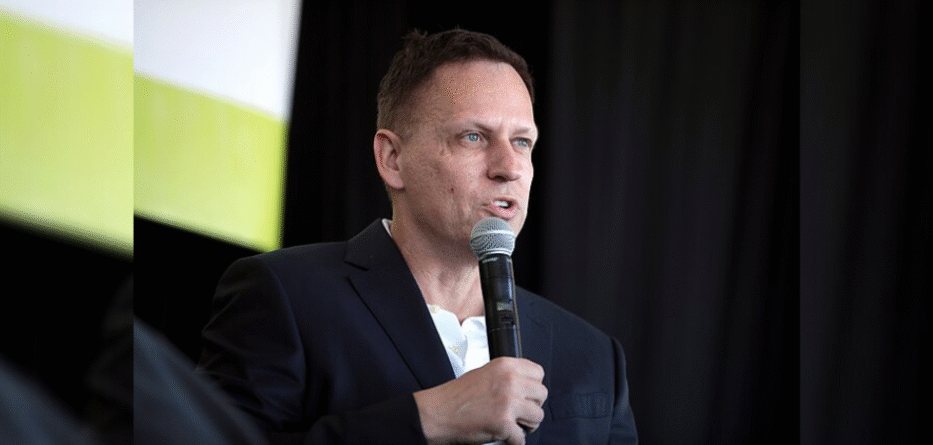
Rome, March 2026. In a private room, removed from the official circuits but not far enough to remain truly hidden, Peter Thiel delivered four lectures on the Bible, Christ, and the end of time.
The news leaked almost immediately, as tends to happen when the subject matter is too heavy with symbolism to stay confined.
Thiel — Silicon Valley entrepreneur, co-founder of PayPal, architect of Palantir, bankroller of decisive political campaigns in the United States — arrived in Rome not merely as a man of technology but as an interpreter of the Apocalypse. This slippage, from capital to sacred text, is where we must begin.
Anyone who listens to Thiel quickly notices that his vocabulary is built around two Greek words: katechon and eschaton. These are technical terms from Christian theology, but in his voice they take on an operative, almost strategic tone.
The katechon, in the Second Letter to the Thessalonians, is that which restrains, that which delays the manifestation of ultimate evil. The eschaton is the fulfillment — not the end as interruption but as the final meaning of history.
In the Christian tradition, these categories have been handled with caution, often with a kind of modesty. Thiel, instead, arranges them as though on a chessboard.
On one side, he places the katechon, which he associates with a surprisingly concrete constellation: Constantine, the Tridentine liturgy, political order, stabilized wealth, and founding violence. On the other, the eschaton, which he identifies with what he calls “hyper-Christianity”: Mother Teresa, non-violence, liberation theology, a Church beyond economics.
The construction is elegant, visually effective, but also rigidly binary. The history of Christianity — which is entanglement, tension, ambiguity — gets compressed into a stark opposition, tailored to a thesis already decided in advance.
The heart of the argument emerges when Thiel speaks of Apocalypse. He does not understand it as revelation in the biblical sense — an unveiling of God — but as a key for reading the present.
He is not interested in “the day and the hour”; what interests him is whether we are “in the month or the century.” The horizon shifts. Eschatology becomes chronology. And, above all, it becomes politics. The Antichrist, rather than a theological figure, is a concrete, identifiable historical possibility. This is the point at which the Gospel is transformed into an instrument of geopolitical analysis.
Within this schema, the word “peace” takes on an ambiguous meaning. Thiel insists on a passage from the First Letter to the Thessalonians: when they say “peace and security,” then ruin will come upon them. The citation is exact, but its use is revealing. Peace, in the contemporary discourse, becomes suspect. It can be the sign of an imposed order, of a stability purchased at the cost of freedom.
This is not a trivial intuition. But in the way it gets developed, it ends up coinciding with a systematic distrust of every form of supranational governance, of every attempt at regulation, of any brake on technological acceleration.
This is where René Girard enters the picture. Thiel cites him as a master, and indeed he was one. From mimetic theory, he inherits the idea of the scapegoat: societies are founded on the violence they discharge onto a victim. But in the passage from Girard to Thiel, something decisive happens.
For Girard, Christianity unmasks this mechanism and renders it unacceptable.
For Thiel, it becomes a tool of interpretation — and, between the lines, of management — of contemporary conflicts. No longer a revelation that defuses violence, but a lens for navigating within it.
Another axis of his argument is stagnation. For years, Thiel has maintained that progress has slowed. The great promises of the twentieth century — energy, space, medicine — have not lived up to expectations.
Technology has produced platforms, not material revolutions of equivalent magnitude.
“We wanted flying cars, instead we got a hundred and forty characters”: the line is well known, and it works because it captures a widespread frustration. But the conclusion he draws is more radical: stagnation is not merely economic; it is the sign that something — a force, a system — is holding back development. And this “holding back” gets folded into the katechon, reinterpreted as bureaucracy, regulation, the precautionary principle.
From there, the step is short. Whoever slows things down is preparing the ground for the Antichrist. Whoever accelerates, by contrast, stands on the side of resistance.
Artificial intelligence, biotechnology, advanced surveillance — these are not simply tools: they become elements in a cosmic struggle. The risk, naturally, is that the distinction between analysis and ideology dissolves. Theology does not illuminate reality; it organizes it according to a design that is already oriented.
One of the most striking moments in the lectures is the notion of the “political miracle.”
Thiel distinguishes between the supernatural miracle and the political miracle: the latter is the capacity to promise the impossible, to hold together irreconcilable opposites, to offer a synthesis that neutralizes conflict.
It is a subtle insight. Contemporary politics is full of such promises. But when this category is applied to democracy itself, the next step is an implicit delegitimization: democracy becomes a rhetorical device, a word whose meaning depends on who is using it.
At this point, the argument draws close to a precise tradition in political thought, in which conflict — the enemy — is the fundamental category.
It is no accident that, in the background, the figure of Carl Schmitt appears. The result is a vision in which freedom is no longer the center but a variable among others. And the Christian tradition, which has painstakingly bound together faith and the dignity of the person, gets reinterpreted as one pole of a tension to be governed.
And yet it would be a mistake to dismiss all of this as mere ideology. Thiel intercepts real fears. The risk of technology becoming an instrument of total control is not imaginary.
The danger of a peace that conceals injustice is concrete. The sense that history has a direction — and that this direction matters — is something that many contemporary discourses have lost.
It is here that his geopolitical analysis becomes most penetrating — and most problematic.
Thiel argues that the greatest risk of our time is neither total war nor the establishment of a world government, but an “unjust peace”: a stabilization of conflicts obtained at the price of freedom, a security that papers over imbalanced power relations, an order that holds because it is accepted, not because it is just.
His probabilistic schema — which assigns a low probability to global war, a minority probability to a just peace, and a majority probability to an unjust peace — can be disputed in its numbers, but it is revealing in its structure. It identifies a real point: peace can become a word that masks violence.
The Pauline reference — “when they say peace and security…” — is not a rhetorical ornament. It is a powerful interpretive key. It reminds us that peace can be a device, a slogan, a cover.
In this sense, the critique of pacifist rhetoric that ignores asymmetries of power is legitimate. But the way it is deployed already orients the conclusion: it feeds a radical distrust of international institutions, of every form of shared governance, of any attempt to construct an order not founded on competition among powers.
This is not a neutral position. It is a position that coincides with concrete interests. A fragmented, competitive, technologically intense geopolitical order is also the ideal environment for those who develop and sell intelligence and surveillance systems. Here, diagnosis and interest converge.
And it is precisely at this point that the deepest contradiction emerges. Thiel presents himself as the one who would restrain catastrophe, the watchman who does not sleep. But the solutions he proposes — technological acceleration, deregulation, competition among powers, the development of advanced instruments of control — are the very dynamics that could make the scenario he fears more likely. The artificial intelligence he invokes as an eschatological risk is the same technology he invests in. The surveillance systems that could sustain a totalitarian power are the ones he helps to build. The geopolitical fragmentation he defends makes it harder to confront the global risks he himself acknowledges.
This is not a simple inconsistency. It is a structure. The thinking operates in such a way that it cannot see the point at which it reflects back upon itself.
Theology, here, does not open the gaze: it fixes it. The concepts of Antichrist and katechon do not become instruments of discernment but categories that always point in the same direction.
And yet, to reduce all of this to ideology would be a symmetrical error. In this discourse there is also something that is absent elsewhere: a seriousness in engaging with biblical apocalyptic, a refusal to reduce Christianity to civic ethics, a perception that history is not neutral. The refusal to “fall asleep” has a Gospel root.
But what is missing is decisive. What is missing is Christ as a living presence, not as a typological figure. What is missing is the Church as a body, not merely as an institution. What is missing is prayer as a real act, not replaceable by analysis. What is missing is the logic of the gift, which is not the same as the logic of control.
What is missing, above all, is the poor. Not as a sociological category but as a theological locus. In Thiel’s construction, the poor are not the point at which history is judged; they are a collateral effect of the system, to be compensated for eventually. The difference is radical.
Listening to Thiel is useful. It forces us to take seriously questions that are often evaded. But his proposal remains internal to the very logic it critiques.
The question is right: how do we prevent technology from becoming dominant? The answer — to entrust ourselves to those who are accelerating that same technology — does not hold.
In the Signorelli painting he cites, the artist looks out at the viewer. It is a gesture that interrupts the scene. The question is no longer only what is happening within the painting. It is what is happening in the one who looks. The question is real: how will you respond?
The answer, however, is not to be found in acceleration. It is to be found elsewhere: in tangible justice, in active love, and in a hope that is not created but received.
With thanks to Union of Catholic Asia News (UCA) and Antonio Spadaro, SJ, where this article originally appeared.