

Ever since Pope Leo XIV was elected to be the successor of St Peter a little more than six months ago, people have been trying to work out what sort of pontiff he will be.
Will he continue in the vein of his predecessor Pope Francis, or will he revert to being a more ‘traditional’ pope?
From what he has said and done so far, the answer seems to be both, and neither; he is beginning to chart a course that is distinctly his own through his formation as the first Augustinian and first US-born pope.
Charting his own course
Right from his first speech in St Peter’s Square after his election, Pope Leo has often spoken of the need for peace through bridge-building and dialogue. This has ranged from his vocal opposition to wars, especially in Gaza and Ukraine, to combatting the increasing polarisation and hatred within societies, and the need to find common ground between fellow Christians and between Christians and other religions.
His first overseas trip highlighted some of these themes.
Where Pope Francis chose the Italian island of Lampedusa to visit refugee camps on his first overseas trip, Pope Leo went to Türkiye and Lebanon from November 27 to December 2.
In explaining the reasons for visiting these countries, he said going to Türkiye was primarily to join with other Christian denominations in celebrating the 1700th anniversary of the Council of Nicaea.
This would be “a truly important moment…a moment of genuine unity in faith”, he said. The choice of Lebanon was to “proclaim the message of peace in the Middle East, in a country that has suffered so much”.
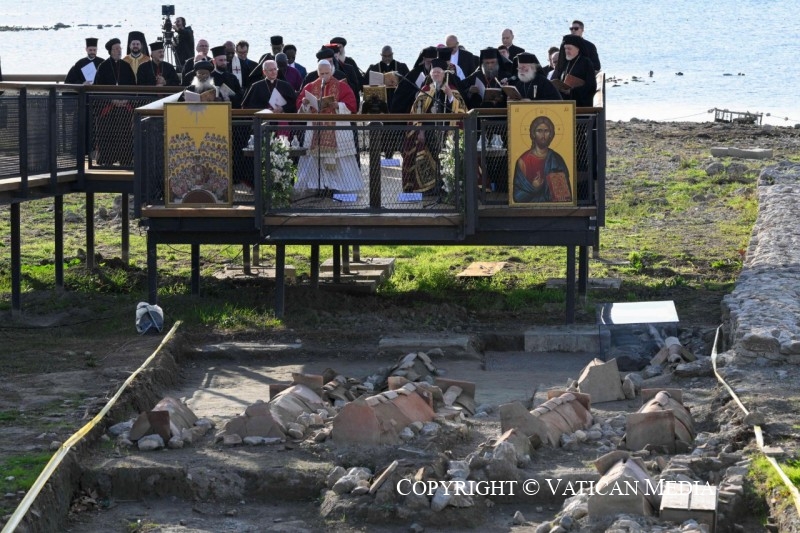
Pope Leo XIV and Patriarch Bartholomew during an ecumenical Prayer service on the 1700th anniversary of the Council of Nicaea near the archaeological excavations of the ancient Basilica of Saint Neophytos in Ísnik, during Pope Leo’s apostolic journey to Türkiye in November 2025. Image: Vatican Media
Both these countries were where Pope Francis had also wanted to visit, he said – one of several links Pope Leo has made between his papacy and his predecessor’s.
Another was his first apostolic exhortation, Dilexi te, or “I have loved you”.
This was begun by Francis before he died, but which Leo made his own. In it, he calls all Christians to love the poor and the marginalised as a “preferential choice”.
“Wanting to inaugurate a kingdom of justice, fraternity and solidarity, God has a special place in his heart for those who are discriminated against and oppressed, and he asks us, his Church, to make a decisive and radical choice in favour of the weakest,” Pope Leo wrote (16).
So far, he has canonised nine saints – Carlo Acutis, Pier Giorgio Frassati, Ignatius Maloyan, Peter To Rot, Vincenza Maria Poloni, Maria del Monte Carmelo Rendiles Martinez, Maria Troncatti, Jose Gregorio Hernandez Cisneros and Bartolo Longo – all of whom received approval for sainthood while Pope Francis was still alive.

Pope Leo XIV walks in front of St Peter’s Basilica adorned with portraits of Pier Giorgio Frassati and Carlo Acutis ahead of their canonisation on Sunday 7 September 2025. Image: Vatican Media
He has also pledged to continue his predecessor’s commitment to environmental restoration, as well as to synodality, which he described in a recent interview as a way “we can come together and be a community and seek communion as a church” not focused on “institutional hierarchy but on a sense of ‘we together’, ‘our church’”.
In that interview, he said synodality was the “antidote” to polarisation, where people could come together to listen to each other and reflect on what God is telling us through the Gospel. “I think this is a way of addressing some of the greatest challenges that we have in the world today.”
But Pope Leo hasn’t followed everything his predecessor has done. This began from his first appearance on the balcony of St Peter’s where he wore a red mozzetta, a traditional papal robe that Francis refused to wear.
He has moved the papal residence back to the Apostolic Palace in the Vatican and has already been seen at Castel Gandolfo, where past popes have often chosen to holiday in the summer, but where Francis rarely visited.
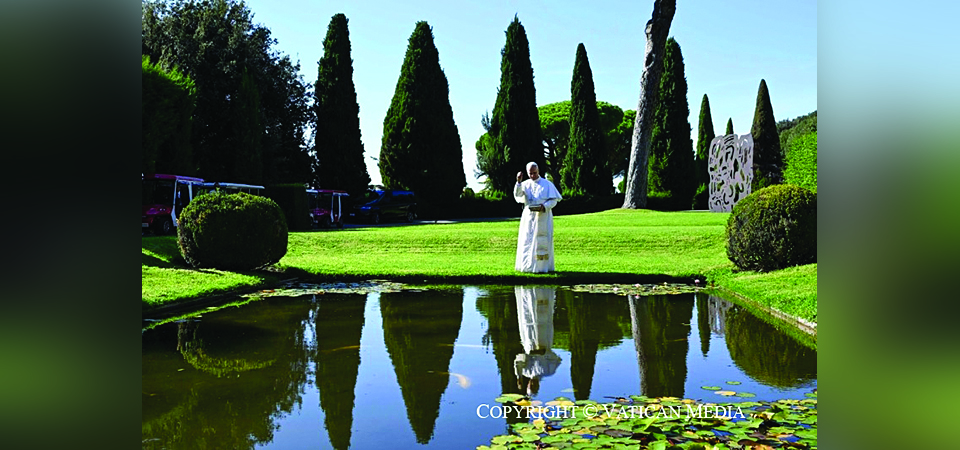
Pope Leo XIV during the inauguration of the Borgo Laudato Si’, located near Castel Gandolfo, outside Rome. Image: Vatican Media
Also, Leo allowed, in a kindly pastoral gesture, the Tridentine version of the Latin Mass to be celebrated, as an exception, in St Peter’s Basilica in October. At the same time, he has insisted that the liturgical reforms of the Second Vatican Council will continue to remain the Church’s central guiding liturgical principle.
A connection with Australia
He has a close relationship with Australia and Australian Catholics, having visited the country several times before becoming pontiff, and counting many Australians, including fellow Augustinians of the Diocese of Parramatta, among his friends.
One fellow Augustinian who has known Pope Leo since his time as Prior General, Fr David Austin OSA from Holy Spirit Parish, St Clair-Erskine Park, said like his predecessor, the pontiff would bring “the common touch born of hands-on experience and connectedness with the poor in the missions.”

Pope Leo XIV in Rome with members of the Australian Province of the Augustinians. From left, Fr Tony Banks OSA, Assistant General, Fr Tuan Anh Le OSA and Br Hoang Vu (Martin) OSA. Image: Augustinian Curia, Rome
“As time goes on his leadership style will become clearer. Certainly, his gentleness and soft-spoken manner, his humility and humour, his skill for listening and preference for dialogue are great strengths which will give credibility to his teaching, always faithful to the Gospel,” he said.
“Ever since Pope Leo was ordained and served initially in Peru, his experience of Church has been one of collaboration with, and empowerment of, laity following the cooperative model of ministry developed by the Augustinians there in the spirit of Vatican II.”
This article was originally published in the 2025 Advent & Christmas | Summer edition of the Catholic Outlook Magazine. You can read the digital version here or pick up a copy in your local parish.