

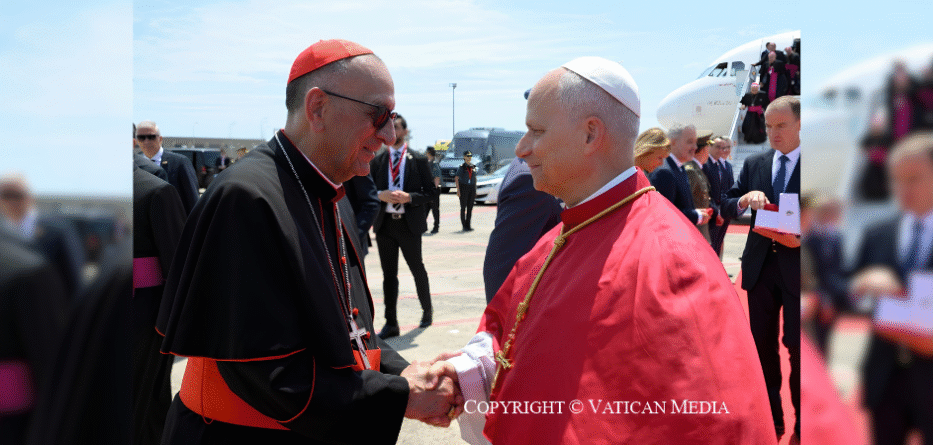
Pope Leo XIV’s long trip to Spain (June 6-12) opens a summer of papal visits to key places for Catholics in the old continent.
After Spain (with stops in Madrid, Barcelona, Tenerife, and Gran Canaria), pope Leo will visit Pavia in Italy where the relics of St. Augustine are venerated (June 20); the island of Lampedusa for a very particular “Fourth of July” (July 4); Assisi for the 800th anniversary of the death (Transitus) of St. Francis (August 6); Rimini for the annual gathering of the movement Communion and Liberation (August 22); and finally the trip to France (25-28 September). These trips will also be an opportunity for Leo to unfold his vision for Europe.
The decision to travel to Spain in June 2026, one of the great Catholic powers, also due to its colonial history in Latin America, represents Leo XIV’s renewed attention to Europe in his vision of history: it is a united and reconciled idea of history, in opposition to divisive hermeneutics of the past shaped by vindication and mutual opposition.
This was evident in the first speech he gave on June 6 in Madrid in his meeting with the king and queen of Spain, the authorities, civil society and the diplomatic corps:
“For the love of truth, I invite everyone to set aside the divisive and polarizing narratives of your societal reality and history, so as to overcome sterile simplifications through the fruitful appreciation of complexity. I see here a vocation particularly suited to Europe, in which Spain plays a unique and fundamental role. This is the gift that the ‘Old Continent’ can offer the world if it wishes to remain young, for youth is found in those who feel they have a future and a mission that still has meaning. Appreciating and studying complexity, learning not to deny it but to embrace it as a blessing, and fleeing from identity-based approaches that seem to explain everything yet only fill the world with ‘ghosts’ and enemies are the tasks of those who are heirs of a great history. New technologies have created an artificial environment where our fundamental choices are put to the test, prejudices are magnified, critical thinking is weakened and dominating interests spread death wishes. Nevertheless, goodness can prevail and spread.”
Leo sees Europe as a key place to preserve“societal reality and history” in their complexity, far from identitarian narratives, in a non-fundamentalist and non-puritan way. It’s a message the pope sends to both the ethnocentric and nativist right-wing forces and the “woke” temptation of issuing blanket condemnations of the past, often an opportunity to make Christianity the scapegoat in a reductionist approach to the history of humankind as a criminal enterprise.
In the same speech to authorities, Leo also acknowledged Spain’s role today in this context of a disrupted global order: “I express my gratitude to your country for its faithful adherence to international law and multilateralism, which is reflected in an active commitment to peace and solidarity among peoples.”
Leo’s trip to Spain is part of his effort to create unity and bring peace, in which Europe – with its investment in creating a new political project in the European Union – plays a key part. Leo’s focus on Europe is an expression of his commitment to multilateralism, as the Secretary of State, Cardinal Pietro Parolin, emphasized on the eve of Leo’s short visit to the Principality of Monaco – Monte Carlo on March 28, 2026:
“Europe must rediscover the inspiration of its founding fathers, moving from a logic of mere national interests and selfish security concerns to a genuine project of integration and solidarity, placing human dignity at the heart of all policy. Faced with the erosion of global norms, European countries are called to reaffirm the primacy of international law, using negotiation as the only tool for a just peace, which is not merely the absence of war, but the construction of shared truths.”
Leo unveiled important elements of his understanding of Europe in the homily at Mass for Corpus Christi before 1.2 million people in Madrid on June 7. He did not talk about the Christian past of Spain in nostalgic terms, but in an actualizing and inclusive perspective:
“Jesus travels the streets, crosses the squares and visits our neighborhoods, dwelling in the settings of our daily lives. He is a God who is close to us, who walks with his people, the Lord of history. He is comfort to the weak, light for families, hope for the sick and peace for those who suffer. The Christ who processes through the streets in the monstrance is the same one who identifies with the poor, the downtrodden, those who are alone and forsaken.”
On this trip to Spain, we are starting to see Leo’s vision of Europe, which will become more definite over the next four months, culminating in the visit to France at the end of September. It is a message that keeps together contemplation and action, identity and openness, past and future:
“Herein lies the task of Spain today and in the future: to ensure that the religiosity which has shaped and defined this country for centuries is not a museum of the past to be visited, but a school of faith from which to draw even today: A school that teaches us to kneel before God and before our neighbor, because no one can kneel before the Lord and despise their brother; A school that teaches us of the gratitude of love that becomes a gift, so that it may flow among us and break the chains of all selfishness; A school from which we learn that God is a real presence and that we too are called to be present in the realities and challenges of society, not shying away, but personally committing ourselves to the building of the common good.”
The question is how Spain and Europe will receive this message. There are a few papal trips that inaugurated a new season in the life of a national Church, like John Paul II’s trips to Poland in 1979. We will see whether Leo’s European trips fall into that category.
Certainly, Leo’s message to Spain and to Europe this week is also a message to America, just four weeks before the 250th anniversary of the Fourth of July 1776 is celebrated on the island of Lampedusa, the southernmost place in Italy and the landing spot for many migrants trying to reach Europe – those who are lucky enough to survive the crossing of the Mediterranean.
On the same day of Leo’s homily in Madrid and in another famous landing spot, in Normandy, the gap between the papacy and the US administration today was visible.
At the Normandy American Cemetery in Colleville-sur-Mer in France, on June 6,US Secretary of Defense Pete Hegseth used a speech marking the anniversary of the D-Day landings in France (June 6, 1944) to attack European immigration policies: “Sadly, today, different European beaches are stormed by different dangerous ideologies. Beaches in Spain, in Italy, in Greece, and in Bulgaria, boats and men arrive.”
“When will European capitals do something about that invasion, or is it too late?” Hegseth asked.
It was not clear whether Hegseth compared migrants crossing the Mediterranean to the Nazi invasion of Europe, or whether he inadvertently compared those defending Europe from migrants today to the Nazis of World War II. In that comparison, it was unclear who the Allies would be today.
In any case, it is clear that Leo XIV, whose father was one of the soldiers who, in 1944, landed in France (twice) to liberate Europe, is expressing a different idea about the role of the old continent and of Christianity within it.
With thanks to Global Catholic and Massimo Faggioli, where this article originally appeared.