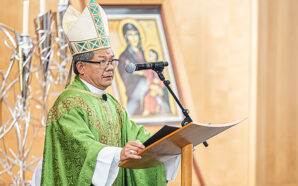


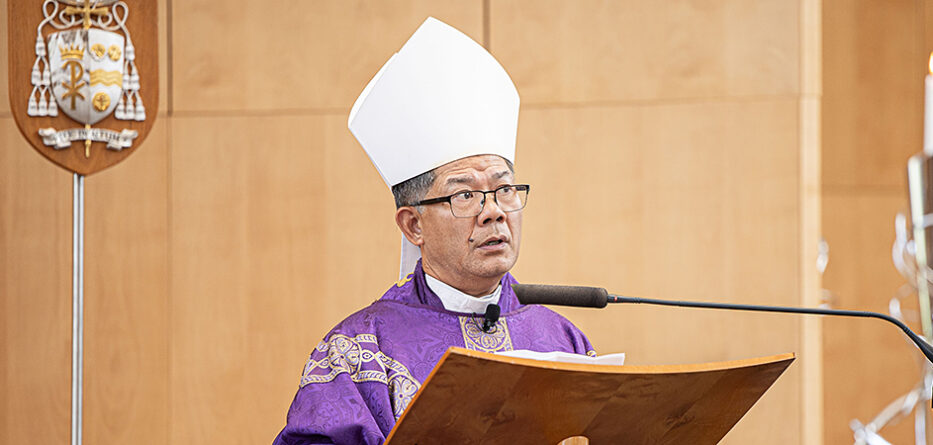
Most Reverend Vincent Long Van Nguyen OFM Conv DD STL, Bishop of Parramatta
Homily for the 2nd Sunday in Lent, Year A
Readings: Genesis 2:7-9, 3:1-7; Romans 5:12-19; Matthew 4:1-11
1 March 2026
Embracing the security of insecurity
Dear friends in Christ,
The security of insecurity seems to be a nonsensical self-contradiction. It does not make a lot of sense to those who are not familiar with the language of Christian spirituality and mysticism. How can one be secure with insecurity? It makes as much sense as Jesus’ saying, “whoever loses his life for my sake will find it”. Nevertheless, it contains a powerful Christian paradox and the kernel of the Gospel.
Recently, I officiated a ritual of the closure of a Sisters of Mercy chapel at Marymount. There were a lot of mixed emotions during the ceremony: sadness, grief, pain but also gratitude, trust and even hope. It was a kind of “losing one’s life” in action. It was a demonstration of the security of insecurity. For religious who espouse a life of poverty, it is not the building, or the property or any other temporal thing that they are attached to. It is the absolute trust in God that is what they are called to embrace. It is the discipleship of vulnerability, humility and powerlessness that religious are challenged to model for the rest of the Church. Hence, the ritual served as a reminder that we must learn to travel light, that we must radicalise our sense of trust by not holding onto things like possessions, wealth, institutional prestige, visibility and even numbers and membership.
Scriptures today teach us to embrace the security of insecurity. The pilgrims on the journey are challenged to leave their comfort-zone, to expand their horizons, to deepen their trust and grow beyond their self-imposed limits. This was exactly what Abraham was called to do. He left everything that was near and dear to him. He became an itinerant without any form of security. Abraham would hand over to God the security of home, inheritance, possessions and even the only son he had.
Abraham’s journey was a giant leap of faith, a leap into the unfamiliar, insecure and vulnerable. He abandoned every form of human security and placed his trust solely in God. Abraham teaches us that faith is not synonymous with certitude, satisfaction and fulfilment. Nor should it be manifested in dominance, power, arrogance and oppression of others. His journey that was riddled with extreme tests and trials foreshadows the self-emptying journey of Jesus.
Abraham’s journey of transformation through faith is also reflected in the story of the Transfiguration. It took place at a critical moment on the way to Jerusalem. Earlier at Cesare Philippi, the disciples had been given the lesson of who the Messiah was and what it means to be his followers. Against popular expectations, Jesus affirmed that he was not going to be the Messiah in the style of the Roman Emperor Caesar. To the shock and horror of Peter, suffering and death were the real deal. Indeed, Peter was rebuked because he wanted to remove the cross from the mission of the Christ and Christian discipleship.
The Transfiguration was another lesson to strengthen their commitment to follow the self-emptying and suffering Messiah. They were given a glimpse of future glory and an unmistakable message: there is no bypassing of the tragedy of the cross before the resurrection. The disciples must make their own Abrahamic journey of letting go, expanding their horizons and growing beyond their self-imposed limits. The voice from heaven is an invitation to embrace the biblical security of insecurity. To “listen to him” in this context is to follow Jesus in his imminent suffering, passion and death. It is ultimately to pass the litmus test of Christian discipleship.
Dear friends,
Our faith today is also being put to the test as that of Abraham and the disciples. We are challenged to walk the journey of transformation by living out the demands of our pilgrim faith. This requires of us to have the courage to let go of the familiar and secure, the courage to launch into the deep, with everything that it entails.
Faith does not manifest itself in size, successes, heroics and invincibility. Having faith does not mean brandishing a weapon or a magic power at one’s disposal. On the contrary, it often means walking the long hard road of fidelity, love and even suffering against our natural default position of safety, security and immunity.
Just as Jesus embraced the journey of downward mobility that brought him humiliation, betrayal, defeat, failure and death on the cross, the disciple’s proof of authenticity is not popularity, success and acclaim. Rather, he/she will have to prove his/her mettle in the crucible of suffering in imitation of the Servant Master.
As we gather in faith, we commit ourselves to the pattern of the paschal mystery. This was what Abraham learned from his journey into chaos and what disciples also learned from Jesus’ downward mobility and self-emptying model of living. Let us deepen our relationship with him, reaffirm our commitment and pledge our unwavering fidelity to his way of the cross. Most of all, may we be inspired by the example of Abraham and of our Lord himself in turning our journey of despair to hope, and darkness to life-altering experience.