

Patti Smith writes every morning from eight to ten, seated at the same café, at the same corner table—always the same one. When I arrive, she is bent over a notebook, her pen moving with a patient, concentrated rhythm. I hesitate to interrupt her; she is clearly absorbed. But I step inside anyway, because outside it is brutally cold. My iPhone reports a wind chill of twenty-six degrees below zero, and I feel my body shivering from the inside out. She notices my decisive entrance and pauses, looks up, smiles. Then she dips back into the notebook and says, “Two more words.” A moment later she looks straight at me. “You are my inspiration,” she says, with a touch of irony and tenderness. “An inspiring interruption.”
Inside the café there is a soft, enveloping warmth—the smell of coffee and toasted bread—and a pale winter light filtering through large windows. Patti is wearing a dark jacket, nothing conspicuous. She is seventy-nine years old, yet her presence is that of someone who has decided, with almost monastic discipline, never to stop paying attention to the world.
We first met in Amsterdam. Ours is a friendship that resists easy explanation. “I don’t remember a time when I didn’t know you,” she says at one point, using the tone she reserves for things that are both true and inexplicable. “How did that happen?”
Patti has just written the preface to one of my books, about the feet of Jesus. On behalf of the friars of the Sacro Convento, I had also asked her for a text on St. Francis of Assisi. They are brief, dense pages, born after weeks—indeed, months—of work that Patti calls not writing but contemplation.
“I’m a very slow writer,” she explains. “Sometimes it takes me months to write even the smallest thing. I thought: stay with one thought. Don’t move back and forth. Don’t scatter yourself. Stay there. Be faithful to that.” The sentence sounds like an instruction for prayer, or like the unwritten rule of a Renaissance workshop. And in fact the two texts, conceived separately, ended up speaking to one another spontaneously: one about Francis’s walking, the other about Jesus’ feet. “There was no intention,” she says. “I didn’t plan it. It simply happened.”
I remember the moment when, while working on the book, Patti sent me a message: “I am contemplating.” Not “I’m writing,” not “I’m thinking.” Contemplating. The word struck me deeply; it marked an entirely different level of understanding. Patti nods. “When I wrote to you that I was ‘contemplating,’ not simply thinking or writing, it was because I realized that something completely different was taking place.”
The genesis of the text on Christ’s feet is a story of involuntary pilgrimages. It began years earlier in Munich, in front of an exhibition of religious sculptures by a little-known artist. Patti had a Polaroid camera with her. “I photographed mostly the feet,” she says. Then, shortly before the pandemic, she went to Ghent to see the Ghent Altarpiece. Knowing it was about to close for restoration, she took a night flight to Brussels—without telling anyone, not even her daughter—then drove to Ghent and found a way to enter the cathedral with the restorer and the museum director. “There were only six of us,” she recalls. “They had to examine the altarpiece for hours.”
Then came Colmar, and Grünewald’s Isenheim Altarpiece. Patti even organized a benefit event just to be able to see it up close. The visit was long, intense. And yet, while she was there, she felt none of the emotion she had expected. The effect came later, like a slow tide. “When I left, I couldn’t stop thinking about how the artist had rendered Jesus—the feet of Christ. They were almost deformed, and the image stayed with me.” When I later asked her to write about precisely that, the coincidence struck her as a sign. “It’s always a sign,” she says, with a certainty that allows no rebuttal. “You’re more mystical than I am,” I say, half seriously, half ironically. She fixes me with her gaze.
When I left, I couldn’t stop thinking about how the artist had rendered Jesus—the feet of Christ.
One recurring theme in our conversation is the gap between who Patti Smith is and who America wants her to be. In Europe she is called a poet, an artist, a writer. Her records have done very well in France and Germany, but it was the book Just Kids that consecrated her as a writer: more than a million copies sold, in forty-three languages. Her most recent book, Bread of Angels, is already in thirty-six. But in the United States she is still a rock star. “People have a very hard time taking you seriously in other fields,” she says, with the calm of someone who has stopped getting angry at a prejudice that no longer wounds her. “They want to call you a ‘rocker.’ No. You’re a poet. But they don’t understand that it was always poetry.”
She never imagined herself writing music or songs, much less performing onstage. At the beginning there was only poetry. Rock came later—as a vehicle, not a destination. “In Europe they don’t look at you that way,” she says. “They see you as a whole. There’s no assumption that if you’re a rock star, you can’t also be an artist.” That, she adds, is one reason she spends so much time in Europe. “And then, politically, I’m always in trouble.” I tell her that I’m often in trouble, too. She laughs. “Look, in America even Pope Leo would be in trouble. He really would.”
I mention a certain sense of fear I’ve encountered speaking with some American professors. I ask her if she is afraid. She answers with a half-smile: “They can’t touch what truly matters to me.” And she adds, “Fear makes people aggressive, rigid, defensive. That’s why I think art, poetry, writing are not luxuries. They are tools for survival. They help us breathe.” To create inner spaces, I say. She nods.
“When I was young, I had almost nothing,” Patti says. “But I had books. And those books saved me. They gave me a language to name what I felt.” That is why she continues to believe in books even today, in a time that seems to have pushed them to the margins. “We live in a time when everyone speaks, everyone declares, everyone takes a position. But few truly listen. Few truly see.”
The conversation becomes more intimate when the subject of family arises. Patti discovered that she is half Jewish, and that her biological father was not the man who raised her. It is a theme she addressed in her latest book with a grace that, when I read it, struck me as a harmony of process—not a shock, but a harmony. And others have told me the same: they perceived something harmonious, not traumatic. She herself had told me about it some time ago, when we met—she confided in me the discovery of who her father was. Naturally, I had kept this to myself until the book was published.
Patti confirms that the tone was deliberate: she sought it, built it, wanted it. “So many people have found themselves in situations similar to mine. I know many: they often remain wounded, angry, feeling deceived. I didn’t.” Of course, she allowed herself sadness. “I loved my father very much, I admired him deeply and discovering that I did not share his blood made me sad. But not angry, not bitter. A tender, sentimental sadness.”
Her biological father died when she was an adolescent. She would never have been able to meet him. But instead of closing herself off in mourning, Patti found in it a form of gratitude. “It’s as if I were reborn: ‘So this is how I got here.’ It’s extraordinary.” I think this story could help people. We live in a time when many discover truths about themselves of which they were unaware, sometimes traumatic ones. Her account can help one receive these truths without being broken by them.
For Patti, Just Kids will remain her most popular book, and that is fine with her: young people recognize themselves in that story. But the new book is different. “It’s more universal. I wrote it in my seventies, looking at everything with greater distance. It’s more mature.” Reading it, I had the sense of a work of transfiguration: the elements of Just Kids return, but as if refracted through the light of another age.
There is a book on the table, completely worn, with scribbles by her young son scattered through the pages. It is Hermann Hesse’s The Glass Bead Game. Patti has had it since she was a teenager and speaks of it as a companion for life. “Like many young people, I had read all his books,” she says. “But for some reason I could never get to the end: I would fall asleep, or it felt too long.”
Then, once she had finally finished it, she conducted an experiment. She placed it next to her bed. Every evening before sleeping, she opened it at random and read a few pages. Every morning, the same. She did this for a month. “The chronology of the book began to become three-dimensional,” she says. “I could almost see things happening in my head. Each time I read a different passage, it was like looking from a different angle: it wasn’t linear.” After a couple of months, the experience became “transformative.” “Sometimes I would say to myself: ‘I’ve been there. I’ve seen that garden.’”
It is a way of reading that resembles lectio divina, I tell her—a way of inhabiting a text rather than consuming it. And it tells me something profound about the way Patti Smith relates to knowledge: not through analysis, but through presence.
She comes from a working-class family, raised in a rural area where no one finished school. “There was no cultural life: a small movie theater, no library.” But her parents read, and that was enough to awaken in her a kind of romanticism toward education that never left her. “I’m not a good student,” she admits. “I never was. I could never have gotten a scholarship. And yet, in my dreams I dreamed of this: of almost belonging to an ‘ecclesiastical’ world, in a broad sense.” She uses that strange adjective: ecclesiastical. I tell her she is not an intellectual in the academic sense, but that her poetic gaze is worth far more. She says, “I’m not an intellectual, I’m not a great essayist. I don’t have an academic vocabulary, I’m not analytical. But if it’s a matter of a poetic gaze on something, then yes.”
Books have always spoken to her with a prophetic voice. She recalls the first time she saw a work translated into many languages: she was twenty-three years old, at William Burroughs’s house. “I saw his book in German, in French, and I thought, ‘What does it feel like to have your words in different languages?’ And he, as he always did, said to me, ‘It will happen to you, too.’” She replied, “Really?” She was writing poetry, not books. And yet today her titles exist in forty-three languages, including Icelandic.
“It’s important to preserve this sense of wonder,” she says. And in the way she says it, I understand that it is not a platitude. It is a discipline. A daily choice.
It’s important to preserve this sense of wonder.
I tell her about my experience with the artist Michelangelo Pistoletto, who is now ninety-three years old. He and I wrote a book of conversations. I tell her about how I brought to him the imam of Rome, the rabbi of Florence, and a Hindu nun. We all went to his house in Biella and worked together. We are trying to find a new way of understanding interreligious dialogue. I believe that the language of art and poetry is the only one truly capable of uniting. All religions have expressed themselves through a poetic language.
Patti listens, her eyes shining. “It sounds like my father’s dream,” she says. “He loved talking with people of different religions. He invited priests, Adventists, Jehovah’s Witnesses. He was extremely well-versed in Scripture—he would stump them all.”
When Pope Francis’s name enters the conversation, the tone changes. It becomes more grave. I was close to him, and I miss him deeply. Patti responds with the force of an elegy: “So many people miss him. Not only believers. People didn’t realize how much they took him for granted. What is missing is the love he radiated. It was authentic.”
She recounts the time she met him with her daughter Jesse. Behind her there was a man with a child and a rabbit. Patti still had a few moments to speak with him, but she felt she had already received everything. So she said to the pope, “Do you want to play with the rabbit?” Everyone laughed. Francis smiled, took the child by the hand. “He was so human,” Patti says. “He knew how to speak to children because he was authentic. The love was real. And all of us, in the end, are children.”
I ask her if she saw that in the Epstein files Steve Bannon wrote that Francis should be “taken down.” “I’m not surprised,” Patti says. “They tried to discredit him, but they didn’t succeed. You can’t take down love.”
Of Pope Leo XIV she says: “He’s very intelligent, very lucid. He’s American: he won’t be easily manipulated. That bothers many people.”
The name Robert Mapplethorpe returns like a basso continuo. “His work has often been reduced to scandal, to provocation. But in reality there was an extremely strong spiritual quest. He was obsessed with beauty, with form, with light.” He was not religious in the traditional sense, but he sought the absolute. “And that, in the end, is a form of religion.” You feel it strongly in Just Kids, I tell her. She nods. “Because that’s how I lived it. Not as a story of excess, but as a path. Robert was much more disciplined than I was. He had absolute concentration. I was more chaotic. But we supported each other. It was a vocational friendship, if I may use that word.” I tell her it’s the right word. Patti continues: “And this kind of friendship doesn’t end with death. It continues. Sometimes, when I’m working, I still feel his presence. Not in a sentimental or mystical way, but as a push: ‘Go on. Don’t stop. Don’t simplify.’”
It’s a form of fidelity, I say. And I think that Pope Francis had this same kind of fidelity toward humanity. Patti confirms it emphatically: “He never simplified. He never reduced people to categories. He always looked at them one by one.” And she adds: “Those who truly love unsettle things. Because they can’t be used. They can’t be instrumentalized.”
The conversation slows, becomes more reflective. I confess that I feel a bit orphaned. I should now be doing office work with fixed hours. I can’t manage it, and instead I travel, write, give lectures. The only framework in which I recognize myself is wonder. I do my best to give the best of myself. There are responsibilities in life.
Patti nods. She too has many responsibilities: children, sisters, family, work. “But the part of wonder cannot be suffocated,” she says. “It’s a gift, and it must be safeguarded.” Then she adds an image that strikes me for its biblical simplicity: “When I have to do something necessary, even if I don’t want to, I say, ‘It’s Caesar’s time.’” It’s her way of holding together the two dimensions of existence: contemplation and necessity, vision and duty. “Wonder is not something we invented,” she says. “It’s a gift. And when you receive a gift, you have a responsibility. You can’t waste it. You have to nourish it. But at the same time you have to live, you have to do what must be done.”
Patti reflects on how this tension between gift and duty has allowed her to endure. “If we gave ourselves over only to the visionary side, we would burn out too quickly.” She reflects, “When I was young, I thought the artistic life was a form of total freedom. Then I understood that it’s not. It’s a different form of responsibility. You’re not responsible only for yourself, but also for what you awaken in others, for what you transmit.” It’s an ethical responsibility as well as an aesthetic one, I say. “And spiritual,” Patti adds.
I ask her whether writing is necessity for her, and she is unequivocal. It’s not a choice, it’s a condition. “When people ask me if I regret stopping music, I say no. But if someone prevented me from writing, it would be terrible. Even then I would continue writing in my head. We cannot not write. It’s a gift and a curse.”
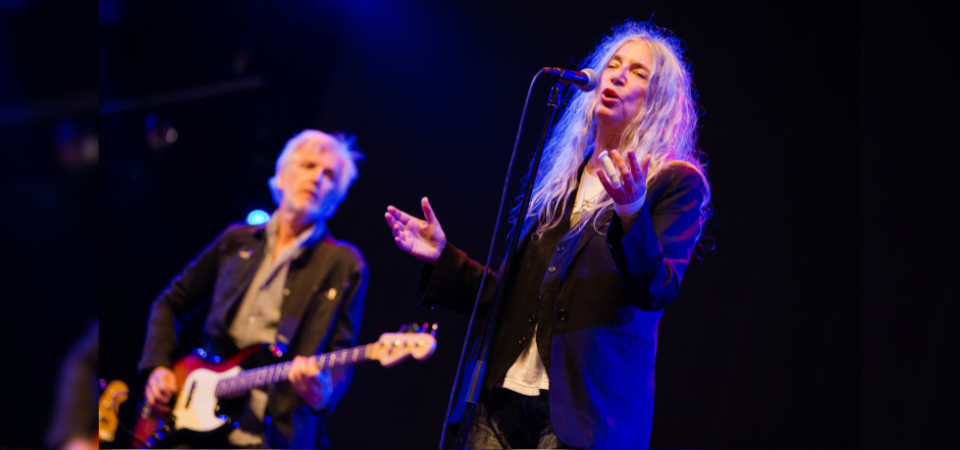
Patti Smith will continue to write. Even when she says she will stop. Even when the fatigue is great—and this year it is, after nearly seventy concerts to say farewell to the historic band, after a project with her son. “As long as I have something true to say, I’ll continue,” she says. “When that’s no longer the case, I’ll stop.” I tell her I don’t think that will happen soon. “Maybe not,” Patti replies. “But it doesn’t depend on me. It depends on life.”
We stand up. She puts her notebook back into her bag. The café has grown noisy. Outside, the cold cuts your breath. She adjusts my scarf around my neck.
Reproduced with permission by Commonweal.