

It has been said that in no language are the overtones of the word “home” quite what they are in English. Certainly, in America, the word has a special aura about it. “Home for Thanksgiving,” “home before dark,” “homey”: all of them imply love and welcome. When Robert Frost wrote, “Home is the place where, when you have to go there, / They have to take you in,” he spoke for many millions of us. The very claim on “life, liberty and the pursuit of happiness” is a claim on being at home in the world.
But here’s the rub: claims can be contested. Houses divide. Homes fall into conflict. Whether through poverty or war, through disaster or divorce, homes, we all know, are terribly fragile and often in upheaval.
The Jewish and Christian scriptures remind us of this. In the Second Book of Samuel, when David is settled into his own home after much conflict, he wishes to build a temple, a house for God, in celebration. He is told instead that God will be at home not so much in a place as in a people, though a place they shall have. And he is also told that it will be a long haul.
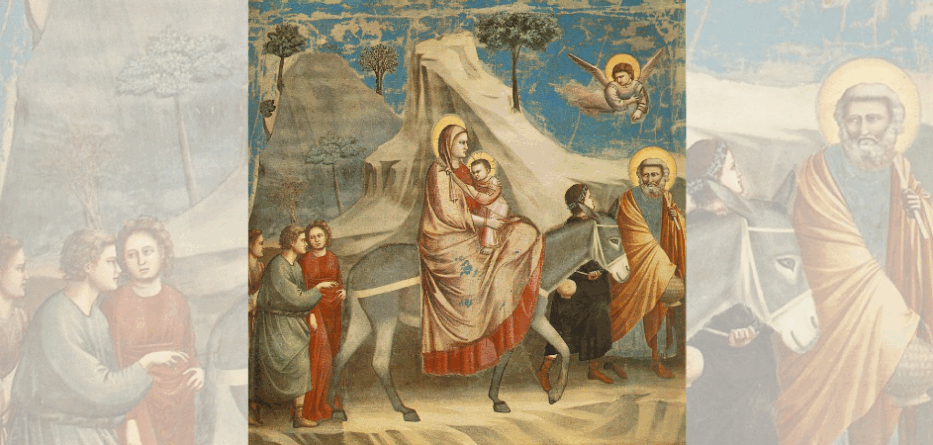
In Luke’s gospel, a girl in Galilee is assured that, through her keeping faith with God, a son will be born to her who will vindicate David’s hope, a hope which might itself be called one for life, liberty, and the pursuit of happiness. All this is astounding to Mary, and is good news indeed. But then comes the birth of a son away from her own home, and out of any home, in a stable. Too soon after that, she, her husband, and her child are all refugees, fleeing for safety and security.
Growing up in Morningside Heights in New York City and at Corpus Christi Grammar School, I had no experience of such displacement. But the memory of the Holy Family should sharpen the attention of all of us to those in our own country who, for whatever reasons, have nobody to take them in. We have all hymned America as the “home of the brave,” and long may it be so. But any country that is truly “under God” also must seek to be the home of the helpless, the unfortunate, and the seemingly expendable. This is the very essence of the Bible—and how God deals with us all. If this sense of responsibility for one another fades from the American dream, we will be left with a nightmare of selfishness.
Throughout the world, perhaps the two most widely known images of human dwelling are the White House and the Capitol. Both stand for power, even for supreme power. But both also stand, even to people who will never set foot in America, for a hope that power will be well employed—with great skill, certainly, but also with compassion, generosity, and a readiness to help make the world more than a stockade, an armed camp, a refuse dump, or a place of strangers: to help make it a home. The men and women we elect will rarely persist in that aim unless we recommission them by our own conduct. Domestic policy, like foreign policy, begins at home.
When you fly over America, the land below presents itself as one where many promises have been fulfilled, many opportunities met. Green or gold, the miles of crops unfold, the roads thread from town to town. But the success, even partial success, is something given to us in trust, and conditionally. The condition is that we develop the hearts of homemakers, for all in need. If we do not, we will find ourselves strangers in our own land.
To develop such hearts, to become human, takes time. And it is seldom accomplished without suffering. But through it all there is one constant: the patience and fidelity of God. How clumsily, how unrealistically, with what a rush so many of us, and certainly I myself, have sought this goal of full and true humanity—only to discover gradually how God, the Holy Mystery who is our absolute future, is patient with our straining time, even taking it into God’s own life. The love of neighbor which had seemed like the love of God, a moral imperative and recommended pattern of behavior, proved to be far more: the discovery and entry into God’s own life. God was not just pleased if we could be healing, encouraging, or messengers of justice. God was there, in the care and hope and justice, taking our time into God’s own.
For if God is eternal but also offers divine life and grace to a world freely being created, then that world’s—that cosmos’s—time and history, our time and history, truly becomes God’s time and history, too. We had set off on a journey to a goal—and discovered that we were already, however unworthily, already living in it. Through the patience of the Great Tutor, we have been learning that the Incarnation was specific to a certain time and place—but also calls all time and space to union with it.
Incarnation, God’s becoming human with and for us in Jesus of Nazareth, was, from the beginning, an extended temporal event, less a moment (birth) than a story (the beginning of a life). And clearly the life, the humanity of Jesus, cannot be complete at birth. There were years of unseen labor, presumably learning carpentry from Joseph. After the baptism by John, the opening of his public life and ministry, there was his testing in the wilderness, both crucial experiences for the course of his life. He had yet to experience the effect of his preaching, his healing of the sick, his companionship with outcasts, his mastery of the natural world. Not to mention the growing antagonism of leaders both religious and civil.
More and more clearly, it appeared who this unique man was and who he presented himself as. The climax of his life comes with a week of utmost challenge and ultimate rejection, only then to be vindicated by the God he called Father. “As with all of us,” writes Elizabeth Johnson, “the mystery of his person was never totally expressed…until the time of his death, when he transcends this world and is raised from the dead. Then his ultimate identity burst upon him in all clarity.” Then he is the fully human and fully divine person he was meant to be, the startling, suffering savior once born in utter helplessness and now raised as “the first fruits of those who have fallen asleep.”
But is his humanity complete even then? He is “One and Unique,” writes Hans Urs von Balthasar, “and yet one…who is to be understood only in the context of mankind’s entire history and in the context of the whole created Cosmos.” He was not born for himself and the glory that is naturally his, but “for us and for our salvation.” And we are one with humanity past and, we now realize, one with a vast humanity for centuries to come. They too are called to be his, the body of Christ, which will be complete only when time is complete. It is not simply a matter of adding to the communion of saints. It is a matter of “completing Christ,” achieving the whole Christ, which St. Augustine called “totus Christus.”
We are invited to appropriate this larger vision in a still deeper sense by theologians who speak of “deep Incarnation,” writers who point out that in becoming flesh, the Word of God becomes united not only with the human species but with all living creatures and with “the cosmic dust of which they are composed,” as Johnson says. “The incarnation is a cosmic event.”
Reflecting many years ago on humanity in the cosmos and the hope our faith gives us for it, Karl Rahner wrote: “Is not each person completely that person’s self, entirely brought to that fulfillment which the person should have and which God has eternally planned for the person, only when all persons are made perfect in the kingdom of God? Must not all individuals wait for their ultimate fulfillment upon the complete fulfillment of all things?” We think we are human because we behave like humans. But if we are honest with ourselves, we know that we are but struggling wayfarers whose true selves will appear only when brought with the entire cosmos before the blinding light of God—when we are finally one with the risen Christ.
But what would—what can—it mean to be fully one with the risen Christ? Heaven is perhaps the most comprehensive word we have for that, yes, “home.” For Thomas Aquinas, it was “the beatific vision.” But in the modern world we need a more dynamic expression. Still: Is heaven a state of fulfillment, the kingdom of God eternal that already is complete, achieved, awaiting us? Our blessed, longed-for home beyond all time? Or is heaven perhaps, in a deeper sense, a destination of our redeemed creation to which, as one with the risen Jesus, we may be now called to contribute?
To put it another way: if the risen Christ is now working the redemption of his father’s creation and we are called to be one with him, are we not also called, in what the Scholastics termed “secondary causes,” to contribute to a heaven in the making? I invite you to consider a “deeper eschatology.”
Many prayers of our Masses urge us to turn from earthly things to those that are eternal. But those prayers risk overlooking that God calls God’s creation good and in Christ redeems it. We then, limited and wayward though we well may be, as the family of Christ, the great mystery as Paul put it, have contributions to make to a heavenly home. We are working toward a home-to-be much more than we are hoping for a home already ready.
Think of whether we hope in this life for more poetry such as Seamus Heaney’s, more art such as Gerhard Richter’s, more music such as Arvo Pärt’s. It is not a matter of indifference that we hope for and prize the discovery of vaccines for a disease like Covid. That we admire the construction of the James Webb Space Telescope, which reveals not just other planets far away but whole galaxies billions and billions of light years away. The great achievements of science are in no way dangers for faith. They are ways to give it body.
Still more do we “have work” to do for our Church. It is not simply the vocation of bishops and priests to renew the Church in this century but the calling of the entire People of God. It matters profoundly that we heal the division among Christian churches and also with other religious communities on this earth. It is imperative, if, as the Second Vatican Council teaches, we are truly the sacrament of the unity of humanity, that we be a global Church. We must be a democratic Church moving finally beyond clericalism, a Church in which women and men are equal members, a synodal Church adept at communal discernment, a People of God confident that the Holy Spirit can guide us to new life in the Gospel in a new century. And, above all, we must be a Church for the poor.
These are not tasks “for officials.” They are, even in small measures, who we are graced to be if we realize new, deeper, more inclusive understandings of the Gospel. For we live not simply on a beautiful, terribly endangered earth, but in a cosmos born of the creative love of the Creator God. And our home is not finished but called to be, a home for which we bear responsibility as disciples of Christ—as do members of the Chosen People, followers of Buddha, or any number of other human beings seeking enlightenment and peace.
And finally, as everything about a true home is true, the call and the destination are beautiful—and joyous. Charles Darwin wrote toward the end of his life and without apparent regret that his scientific studies had left him no longer able to enjoy Shakespeare. Fyodor Dostoevsky, on the other hand, let Prince Myshkin speak his hope: “Beauty will save the world.” For many young people, “the beautiful” is a preoccupation for an elite few. But I have learned how wonderfully various and compelling God’s world—better said, God’s cosmos—is. And if beauty is what arrests and compels human attention, whether in the splendor of a sunset or the sorrow of a scar, a Frederic Edwin Church landscape, a character such as August Wilson’s King Hedley II, or the Webb image of a galaxy billions of light years away, there is too much marvelous variety in the evolving cosmos for us not to become more alert to the beauty of the artisan of it all.
It is easy enough to appreciate the harmonious, the splendid, the musical moments of our experience. Harder to recognize what distortion, darkness, and dissonance can reveal. But the same Spirit who establishes order can comfort the sorrowful; the Spirit who illumines can guide through the night; the Spirit who teaches song can interpret discord. The beauty of God can come in the mode of fulfillment, in achieved form and luminous color and delicate balance. But also in the mode of what Edward Schillebeeckx called contrast experiences: in protest against violence, in fury at injustice, in conscientious objection.
To say that the Spirit of God teaches us to see again and to hope to see wholly is not now to claim completion. I find myself at ninety-one each year happier and more blessed to be a Jesuit priest—but journeying still. This too: beauty is always fresh, new, surprising. And if a patient God is making our time God’s own and our suffering God’s own, God’s very being our—yes—home, then how can we not hope that one day finally and forever God’s Spirit will say “Welcome home”—and teach each of us the most beautiful words of all: Take me. I am yours.
Reproduced with permission by Commonweal.