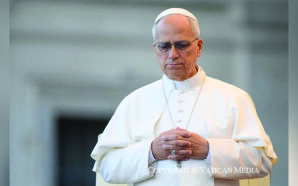


Pope Leo XIV said on June 21 that there should be no tolerance in the Catholic Church for any form of abuse — sexual, spiritual, or abuse of authority — and called for “transparent processes” to foster a culture of prevention throughout the church.
But Canon 489 of the 1983 Code of Canon Law is inconsistent with that call.
The Australian Royal Commission into Institutional Responses to Child Sexual Abuse in its 2017 Final Report found that the victims of child sexual abuse in the Catholic Church took 33 years on average to talk about their abuse.
The Commission outlined “the ways in which the issue of record retention is critical to responding to delayed disclosure of child sexual abuse.” It recommended that institutions should allow for this delayed disclosure by retaining records relating to child sexual abuse “for at least 45 years.” The Church’s canon law is inconsistent with that recommendation.
Canon 489 §2 of canon law states:
Each year, documents of criminal cases in matters of morals, in which the accused parties have died or ten years have elapsed from the condemnatory sentence, are to be destroyed. A brief summary of what occurred along with the text of the definitive sentence is to be retained.
The Royal Commission recommended amending canon law to remove this requirement.
What Canon 489 requires
In common law legal systems, a third-party summary of a trial is not evidence of what occurred in civil or criminal proceedings because of hearsay rules. The documentary evidence in a case, such as the signed statements of witnesses and relevant records, is known in canon law as “the acts”.
Such documentary evidence is often admissible in common law systems even when the witness has died or cannot be found. These are the documents that must be destroyed under Canon 489.
In 2019, Pope Francis abolished the pontifical secret over child sexual abuse. That did not affect Canon 489. Pope Francis specifically retained what he called “office confidentiality” in other parts of the Code. The Holy See in its 2020 response to the Royal Commission did not accept the Commission’s recommendation to reform Canon 489. It remains in force.
In 2023, the Swiss bishops conducted an inquiry into the cover-up of sexual abuse by some bishops in their dioceses. On Dec. 12, 2023, Bishop Bonnemain, on behalf of the Swiss Bishops’ Conference, announced that they would no longer destroy files dealing with child sexual abuse, despite being required to do so under Canon 489.
Under Canon 455, Bishops’ Conferences cannot change canon law in their area of operation unless the Holy See approves their proposal in what is known as a recognitio. No such approval has been given.
Can bishops dispense themselves?
Some canon lawyers, writing in The Pillar, have argued that bishops have, “as a general legal principle recognized in the Code of Canon Law, the power to dispense from any universal norm not explicitly reserved to the Holy See and, since Canon 489 isn’t a law specifically reserved, this includes the instruction to purge old case files.”
Canon 87 grants bishops the power of dispensation, allowing them to dispense “the faithful” from universal laws, except for penal and procedural laws and those reserved to the Holy See.
The obligation under Canon 489 to destroy evidence in cases of child sexual abuse applies solely to bishops, not to “the faithful.”
The Pillar argument implies that Canon 489 is not a “procedural law,” even though it can be categorized as one. The argument also suggests that bishops can dispense themselves from any provisions of the Code of Canon Law, except those reserved to the Holy See. The Appendix to the New Commentary on the Code of Canon Law lists some 22 reserved exceptions.
Canon 87 does not allow a bishop to dispense himself from his obligations under the Code. If bishops could dispense themselves from all 1752 canons of the Code except the reserved 22, the Code would be reduced to a useless piece of paper.
If bishops had the right under Canon 87 to dispense themselves from compliance with Canon 489, one would have expected the Holy See to respond to the Royal Commission by saying its recommendation was unnecessary because bishops already had that right. The Holy See’s response offers no such suggestion.
The Pillar article also claims that Canon 489 was intended to preserve the reputations of those accused of canonical crimes. Yet, as the Holy See noted in its response to the Royal Commission, the requirement to destroy evidence applies only when the accused has died or has been found guilty through a canonical procedure. It does not apply to complaints and evidence in cases where no canonical procedure has been commenced and the evidence has not been tested.
One would have thought that if any reputations deserved preserving, it would be those of living persons who have never been found guilty, not the reputations of proven perpetrators. Besides, there is little chance that anyone’s reputation would be affected by what is locked in the diocese’s secret archive, to which, under Canon 490, the bishop alone keeps the key.
The requirement to destroy evidence in the case of a deceased accused is also problematic. The estates of deceased persons can be sued, but this is usually pointless because the estate has been distributed when there is a delay in bringing proceedings. On the other hand, the evidence gathered in canonical investigations could be useful to a victim in proceedings against the Church or one of its institutions.
A broader failure of transparency
All institutions, whether religious, commercial, or social, have a tribal tendency to preserve their reputations. Christianity adds an extra dimension to that tendency through its requirement to bring in converts.
There is little point in the Catholic Church bringing in converts through the front door of the Church if they are streaming out through the sacristy because of the sexual abuse of children. The Australian Royal Commission, throughout its Final Report, noted the frequency with which the Catholic Church’s laws and documents refer to “scandal,” which results in a loss of faith.
The retention of Canon 489 is another reflection of the Church’s counterproductive obsession with secrecy and avoiding scandal. It is not the Holy See’s only transparency failure. Its failure to publish its disciplinary cases, as recommended by the Australian Royal Commission and the French CIASE Report, and its failure to comply with its reporting obligations under the United Nations Convention on the Rights of the Child are significant transparency failures.
The theologian Massimo Faggioli has pointed out that the revelations of child sexual abuse in the Church have been the most serious crisis the Church has had to confront for 500 years.
Church membership has been declining in Western countries where inquiries into abuse and its cover-up have been held. On the other hand, Church membership has been increasing in places like Africa. Secular inquiries in Africa into child sexual abuse and its cover-up may only be a matter of time while the Church retains laws such as Canon 489.
Popes are absolute monarchs in the Catholic Church when it comes to canon law. No doubt Pope Leo has a lot on his plate, and his health issues don’t help. But he can change Canon 489 with the stroke of his pen. It would be consistent with his calls for transparency.
*Kieran Tapsell is a retired civil lawyer and the author of ‘Potiphar’s Wife: The Vatican’s Secret and Child Sexual Abuse’ (Second Edition 2024). He was a member of the canon law panel before the Australian Royal Commission into Institutional Responses to Child Sexual Abuse.
With thanks to Kieran Tapsell and Global Catholic, where this article originally appeared.