

First Sunday of Lent
Readings: Genesis 9:8–15; Psalm 24:4–9; 1 Peter 3:18–22; Mark 1:12–15
18 February 2024
SPIRITUAL REFLECTION with Katherine Stone MGL
I don’t know about you, but at about this time every Lent, 40 days seems like a long, bleak stretch of time. It’s probably mostly to do with the thought of going without whatever of life’s pleasant things that I have chosen to give up this Lent!
This feeling of interior bleakness does help, however, in getting me in touch with the exterior bleakness of the wilderness where Jesus spent his 40 days in today’s Gospel. The outlook for him mustn’t have been much more pleasant than it is for me at the beginning of the 40 days. Why would the Spirit take Jesus to such a place?
In the history of Israel and even the Church, the wilderness (or desert) has traditionally been a place of encounter with God. Moses, the people of Israel, Elijah, John the Baptist, Jesus himself—for millennia, men and women of prayer have taken themselves into the desert in order to be rid of all distraction and encounter the living God.
Each Lent, we, too, follow the Holy Spirit into our own experience of “wilderness”, not to prove to God or ourselves that we can go 40 whole days without coffee or chocolate or alcohol, but to encounter the living God.
The things we give up help us to create the wilderness experience. Without them, we have less to distract us from prayer, and thus from encounter with God.
Well, that’s the idea, anyway. In my experience, it’s much easier to rid ourselves of chocolate than to rid ourselves of the desire for chocolate. And so, in the wilderness, we’re prey to temptation, which is ultimately trying to get us to settle for less than what we had set out for: a simple fix of chocolate, rather than allowing my physical desire to point me to the deeper reality of my inner, spiritual desire for God.
Alongside this, we also discover the wild beasts. They’re actually living in us all of the time, but they tend to behave in a more civilized manner when we feed them with regular coffee and take the edge off their appetites with alcohol or Netflix. But without those distractions, we see more of our inner wild beasts in their natural ferocity: our laziness, impatience, quick temper.
How is it in all of this chaos that we have any hope of meaningful encounter with God?
On the face of it, it doesn’t seem like Jesus had an encounter with God in the wilderness either. Looking more closely, however, we see that “the angels looked after him”. The only other time that we hear of angels ministering to Jesus was in a similarly bleak place—his agony in Gethsemane. In the places of his deepest struggles and weakness, Jesus encountered the compassion of God.
Perhaps for us, too, it is only when we let go of our distractions and face our weaknesses and struggles that we can experience God’s compassion. This might even be in the form of “angels” that God sends to look after us: the person who allowed us to enter the heavy traffic, the one who got our washing in before it rained, the listening ear that was present to our struggles, the word of wisdom that gave us hope to hold on to.
Perhaps our daily focus this Lent could be on naming the “angels”—the tangible experiences of God’s compassionate love and mercy for us during this wilderness experience. Rather than giving all of our attention to our temptations and the wild beasts inside, let’s choose to recognise where we have encountered God’s saving compassion.
REFLECTING ON THE READINGS THROUGH ART with Mgr Graham Schmitzer
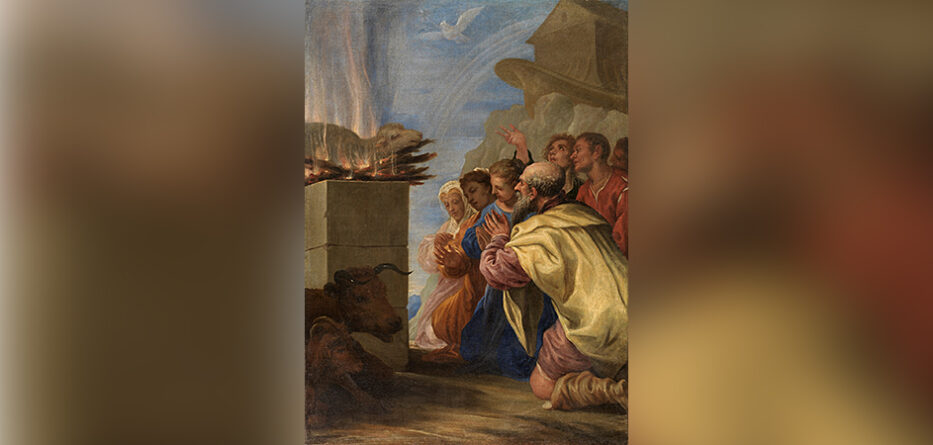
Noah and his family after the Flood – Juan Antonio de Frías y Escalante (1633–1669)
“Noah and his family after the Flood” (1667), Oil Canvas, 114cm x 83cm. Prado Museum, Madrid, Spain. Public Domain.
We’ve all heard the comment, “You don’t have to go to church to be a Christian.” The person who argues this would have been laughed to scorn, especially by the Christians of the first century. It is true that we must all have a personal relationship with God and that we must acknowledge Jesus as our personal Saviour, but even in the world at large, we are more than just a collection of individuals. We belong to a family. We are citizens of a nation. Great problems arise when we cut ourselves off from others. We cannot come to maturity without the love, concern, and support of others. I am unable to love if I have not already experienced love.
The Scriptures are always our guide. They speak of God’s relationship with his people. They speak of mankind’s search for God, but even more of God’s search for us. Individuals are highlighted, but only in that they stand for, or represent, the community.
An underlying theme is that God’s people are a Covenant people. The word is not used too much in modern language. We prefer the word “contract”, but it has a business-like ring about it. I’ll trade you this if you give me that! Covenant is warmer, with love as its basis. Marriage is a contract in civil law but is viewed as a covenant in religious terminology—two people who have each found in the other someone to whom they can entrust the full giving of their heart’s love, and from whom they are sure of receiving an equal return of love. In time, the concept would deepen in understanding as the people of the Old Testament grew in their knowledge of God. For it is God who first uses the word, as we see in today’s first reading. Following the Great Flood, “God spoke to Noah and his sons, ‘See, I establish my Covenant with you, and with your descendants after you.… There shall be no flood to destroy the earth again…. Here is the sign … I set my bow in the clouds’” (Gn 9:8, 11, 13). Notice that God places on himself the responsibility of keeping this Covenant. He remembers his promise when he sees the rainbow.
For the next two Sundays, “Covenant” will again be prominent as we call to mind the stories of Abraham and Moses. The remarkable thing is that, despite Adam’s sin, God had fallen in love with his people: “For the Lord takes delight in his people” (Ps 149:4). He would not give up on them. In the psalms, two words almost became a continuous refrain: “remember” and “forget”. “They forgot the God who was their saviour,” (Ps 106:21) but “he remembers his Covenant for ever” (Ps 105:8). Why do we need Lent each year? Because we keep forgetting. A covenant involves two parties, and our responsibilities will be spelt out on the Third Sunday by God himself in the giving of the Ten Commandments.
We are “saved” by God—saved from ourselves basically—not just as individuals, but as a people, a family, symbolised by God’s protection not just of Noah, but his whole family. The story of the ark has been greatly trivialised. For many, it conjures up memories of school concerts or of cute animals running across the pages of children’s Bibles. The ark, of course, represents the house of the Church, and its wood reminds us that Christ will save us through the wood of his cross.
The early Fathers of the Church picture the cross as a raft Christ throws out to us to rescue us from the deluge of sin. “If someone were to catch sight of his homeland from afar, separated by the sea, he would see his destination, but lack the means of reaching it. So it is with us…. We glimpse our goal across the sea of the present age…. But to enable us to go there, the One who is our goal came to us…. He brought us to the plank by which we can make the passage. No one may cross the sea of his age unless he be carried by the cross of Christ.… So, do not forsake the cross, and the cross will carry you” (St Augustine, Commentary on John’s Gospel).
In the second reading, St Peter makes great use of the symbolism of the destroying waters to remind us of our redemption by being plunged into the waters of the font, a reality we will dramatically commemorate on Holy Saturday night. Water well represents Christ’s death and resurrection, for water is a sign of both destruction and life. Without water, we cannot live.
“Ark” for many people will conjure up Thomas Keneally’s Schindler’s Ark—Oscar Schindler’s factory, or “Ark”, where he gave Jewish workers as much protection as possible in the shadow of Auschwitz.
God is very patient. He has a plan, and carry it out he will. St Paul saw himself as the greatest example of this: “Mercy, however, was shown me, because until I became a believer I had been acting in ignorance; and the grace of Our Lord filled me with faith and with the love that is in Christ Jesus. Here is a saying that you can rely on and nobody should doubt: that Christ Jesus came into the world to save sinners. I myself am the greatest of them; and if mercy has been shown to me, it is because Jesus Christ meant to make me the greatest evidence of his inexhaustible patience” (1 Tm 1:13–16). God is like any parent who has plans for their child. They are prepared to wait years for the child to mature. In their love, which of course involves discipline, they overlook the child’s mistakes, and to do this they actually need to enter the mind of the child. This is the very meaning of the Incarnation. In order to show us that he knows and understands us, God became one of us.
This is no better brought out than in the account we read in today’s Gospel. Here, as in the Garden of Gethsemane, we see Christ at his most human. We will never know exactly what went through his mind in those 40 days. We can only guess. The key word St Mark uses is “wilderness”. We can only project onto Our Lord the problems, the doubts, the fears we all face throughout life. It is of such comfort to us to know he shared them. “Driven” by his longing to know God’s will, he had left his home, left his employment. At this stage he had no close friends that we know of. He was on his own, with nothing than his belief in his Father. Our lives are filled with highs and lows. St Mark poetically portrays this by saying Jesus was accompanied by beasts and angels. The “40 days” is symbolic— Jesus is living out, in person, Israel’s testing for 40 years in the desert of Sinai. The temptations he faced would have followed him to the cross, for we see him still agonising in the Garden. He must have realised his fate at the end of his retreat when he learned of his cousin’s arrest.
The disciples could only have learned of this intimate experience from the lips of Jesus himself. As we listen to today’s Gospel, he takes us, too, into his confidence to give us encouragement. In our difficulties, doubts, and worries, he is with us. “Come to me, all you who labour and are overburdened, and I will give you rest. Shoulder my yoke and learn from me, for I am gentle and humble in heart” (Mt 11:28–29)—humble because he has already borne our burdens. And, remember, yokes were made for two.
Born in 1633, Juan Antonio de Frías y Escalante settled in Madrid at a very young age. Even though he passed away at a young age of 36, Escalante managed to establish a significant career by primarily working for the churches and convents in the city. He greatly admired the paintings of Tintoretto and Veronese from Venice, and was also influenced by the artistic style of Van Dyck. Escalante displayed remarkable talent and productivity at a young age. His The Dead Christ was so admired, some thought it was the work of Titian. Due to his tragically short life, Escalante was unable to reach the artistic maturity that his peers anticipated.
But the very fact that the Museo del Prado possesses 24 of his canvasses speaks for itself. Most of them came from different convents in Madrid. Noah and his family after the Flood is one of a series of 18 canvasses painted for the sacristy of one particular convent—La Merced Calzada—between 1667 and 1668. It is fascinating to note that all of Escalante’s works in this series revolve around themes from the Old Testament that foreshadow the mystery of the Eucharist. These paintings received high acclaim from classical writers during that period.
In the painting we see Noah and his family offering a sacrifice of thanksgiving to God for their rescue from the flood. The sacrifice is not a bullock (resting in the foreground), but a lamb, prefiguring the sacrifice of the Lamb of God. About the assembled family is the Ark, symbol of the future Church of the New Testament, and the appearance of the rainbow, the sign of God’s Covenant with mankind. Hovering above the scene is the dove which announced the end of the destruction (Gn 8:11). But, of course, our mind goes immediately to the symbolism of the Holy Spirit. He had hovered over the waters of creation (Gn 1:2) bringing life from chaos, and in the mind of St John, would create the life of the Church from the apparent failure of Christ’s death on the cross. “And bowing his head, he gave up his spirit” (Jn 19:30). The Fathers of the Church always saw a double meaning in those words.
Katherine Stone MGL is a Missionaries of God’s Love (MGL) sister living in Varroville, NSW. Originally hailing from Tasmania, she joined the MGL Sisters in 2005. Since then, she has lived in Canberra, Melbourne and Sydney, studied theology and spiritual direction, and has done a term as formator. These days, her main ministries are spiritual direction, talks and teaching, and retreat giving. She is also the MGL sisters’ vocations director. Her passion is Jesus—as may be apparent from her ministry, she loves talking about him and to him, and hearing others share their own experiences of him.
Monsignor Graham Schmitzer is the retired parish priest of Immaculate Conception Parish in Unanderra, NSW. He was ordained in 1969 and has served in many parishes in the Diocese of Wollongong. He was also chancellor and secretary to Bishop William Murray for 13 years. He grew up in Port Macquarie and was educated by the Sisters of St Joseph of Lochinvar. For two years he worked for the Department of Attorney General and Justice before entering St Columba’s College, Springwood, in 1962. Mgr Graham loves travelling and has visited many of the major art galleries in Europe.
With thanks to the Diocese of Wollongong, who have supplied this reflection from their publication, Pietà – Lenten Program 2024. Reproduced with permission.