

Homily for the Feast of the Ascension 2026
Readings: Acts 8:5-8,14-17; Psalm 66; 1 Peter 3:15-18; John 14:15-21
Listen at: Soundcloud
Thursday was 40 days since Easter – traditionally celebrated as the feast of the Ascension. For convenience, we now celebrate the feast on Sunday.
Luke has the apostles experiencing the presence of the Risen Lord for forty days. We are supposed to recall that Moses was with the Lord fasting for forty days and forty nights as he wrote on the tablets the words of the covenant, the Ten Commandments. And Elijah having eaten, went forty days and forty nights to a cave at Horeb, the mount of God where the word of the Lord came to him. Now after forty days, the Risen Lord has disappeared from the sight of the apostles.
At the Transfiguration, Luke had Jesus accompanied by Moses and Elijah. Just as the women at Jesus’ tomb saw two men in shining garments, so too the apostles at the Ascension see two men in white garments who ask them: ‘Men of Galilee, why are you standing there looking at the sky?’
Scripture scholar Luke Timothy Johnson tells us: ‘Jesus’ physical removal is for Luke the condition for the gift of the Holy Spirit. Moses has to leave in order for Joshua to work with his prophetic spirit; Elijah had to depart in order for Elisha to gain a double portion of his prophetic spirit. So long as Jesus was physically present, he was available only to those he directly encountered; by the Spirit he became powerfully present to many through his prophetic successors.’
The Ascension marks Day One of the rest of salvation history with Jesus not physically present and with the Spirit urging us on. It’s situation normal. And when perplexed about Jesus’ absence and the action or inaction of the Spirit in our lives and in our troubled world, we are like those apostles hearing the men in white ask: ‘Men of Galilee, why are you standing there looking at the sky?’
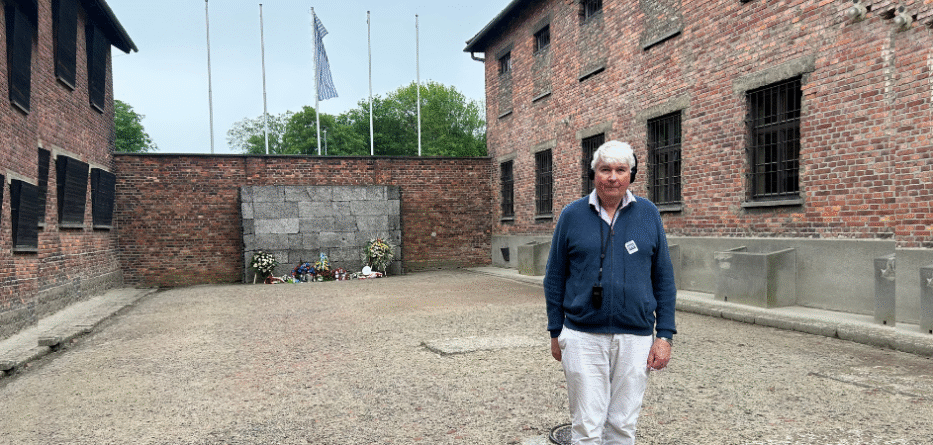
This past Thursday was like no other Ascension for me. I was visiting Auschwitz and Berkenau where over a million people were killed by the Nazis. 90% of those killed in the gas chambers were Jews. Thankfully 2 million people each year now visit these ghastly places where the plaques in every language spoken by the victims declare: ‘For ever let this place be a cry of despair and a warning to humanity, where the Nazis murdered about one and a half million men, women and children, mainly Jews from various countries of Europe’.
I recalled Mark Dreyfus who last year attended the 80th anniversary of the liberation of the Auschwitz concentration camp. His great grandmother was murdered there. He quoted the words of Elie Wiesel: ‘Memory has become the sacred duty of all people of good will.’
I recalled also the testimony of Peter Wertheim, co-CEO of the Executive Council of Australian Jewry. This month, he told the Royal Commission into Antisemitism and Social Cohesion:
‘At the age of 16, (my mother) and her whole family were transported to the death camp at Auschwitz Birkenau. They were met on arrival by Nazi officials, including Joseph Mengele. They went through the selection process. My mother lost both her parents and her three younger siblings. Not even a photograph survives of her younger siblings. I don’t even know what they looked like. My mother and her two older sisters survived. They were sent to work camps in Germany. Went through a succession of events that made it improbable, on each occasion, that they would survive and yet – and they did. It was a succession of improbable outcomes, which is my personal definition of a miracle. So my mother survived the camps.’
Like the men of Galilee in today’s first reading, I spent quite some time on Thursday, standing dumbstruck looking into the sky. Being Catholic, and being neither Jew, Pole or German, I was grateful that our Polish pope John Paul II came to Auschwitz so early in his papacy on 7 June 1979. When living in Poland, he had visited often. Auschwitz was in his diocese. As pope he was accompanied by a group of bishops including the German Archbishop Joseph Ratzinger. John Paul said: ‘It is impossible merely to visit (here). It is necessary on this occasion to think with fear of how far hatred can go. Auschwitz is a testimony of war. War brings with it a disproportionate growth of hatred, destruction and cruelty. It cannot be denied that it also manifests new capabilities of human courage, heroism and patriotism, but the fact remains that it is the reckoning of the losses that prevails. That reckoning prevails more and more, since each day sees an increase in the destructive capacity of the weapons invented by modern technology. Not only those who directly bring about wars are responsible for them, but also those who fail to do all they can to prevent them.’
As Pope Benedict, Ratzinger returned in May 2006 and said: ‘To speak in this place of horror, in this place where unprecedented mass crimes were committed against God and man, is almost impossible – and it is particularly difficult and troubling for a Christian, for a Pope from Germany. In a place like this, words fail; in the end, there can only be a dread silence – a silence which is itself a heartfelt cry to God: “Why, Lord, did you remain silent? How could you tolerate all this?” In silence, then, we bow our heads before the endless line of those who suffered and were put to death here; yet our silence becomes in turn a plea for forgiveness and reconciliation, a plea to the living God never to let this happen again.’
Benedict concluded:
‘At Auschwitz-Birkenau humanity walked through a “valley of darkness”. And so, here in this place, I would like to end with a prayer of trust – with one of the Psalms of Israel which is also a prayer of Christians: “The Lord is my shepherd, I shall not want. He makes me lie down in green pastures; he leads me beside still waters; he restores my soul. He leads me in right paths for his name’s sake. Even though I walk through the valley of the shadow of death, I fear no evil; for you are with me; your rod and your staff – they comfort me…I shall dwell in the house of the Lord my whole life long”.’
Being neither Polish nor German, the Argentinian Pope Francis when he came ten years later stood silent throughout and signed the Book of Honour with these words: ‘Lord, have mercy on your people, Lord, forgiveness for so much cruelty’.
On this feast of the Ascension, we stand, looking into the sky, devastated but hopeful. May the Spirit fill our hearts as we commit to no more war.
Fr Frank Brennan SJ AO, Adjunct Professor of Thomas More Law School at ACU and Adjunct Research Professor at the Australian Centre for Christianity and Culture, is a former Rector of Newman College, University of Melbourne, and CEO of Catholic Social Services Australia (CSSA). His latest books include Pope Francis: the Disruptive Pilgrims Guide (ATF Theology, 2025), and Gerard Brennan’s Articles and Speeches: Maintaining the Law’s Skeleton of Principle (2 volumes) (Connor Court, 2025).
1 Luke Timothy Johnson, The Acts of the Apostles, Sacra Pagina Series (Collegeville, MN: The Liturgical Press, 1992), 30–31.
2 Royal Commission into Antisemitism and Social Cohesion, Transcript, 5 May 2026, P-200.
5 See https://press.vatican.va/content/salastampa/en/bollettino/pubblico/2016/07/29/160729d.html