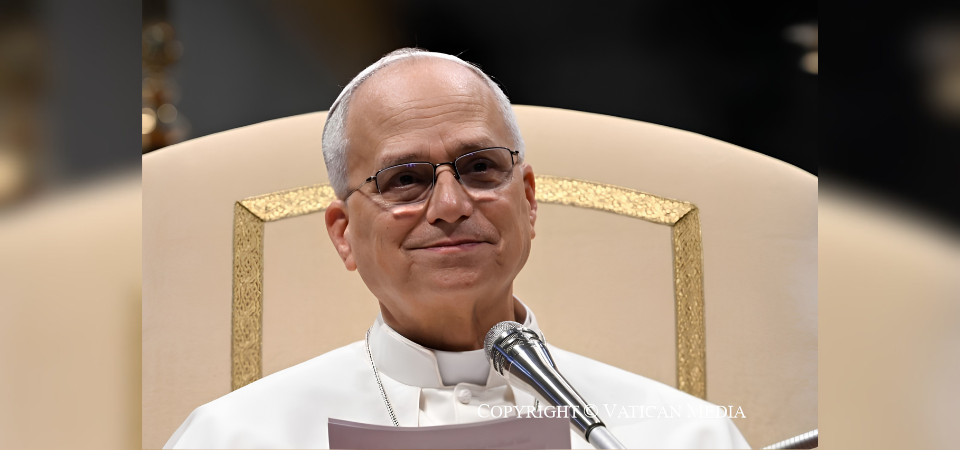


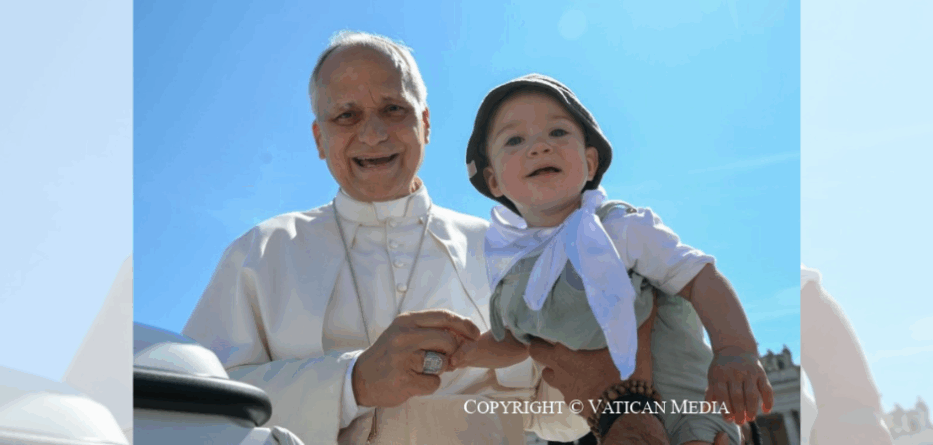
No pope had spent as much time in Australia before being elected than Pope Leo XIV. One of my favourite photos of him shows him saying Mass on the beach at Collaroy in Sydney when he was the head of the Augustinian order. By his side is the yellow and red bag that was given to pilgrims to World Youth Day in 2008. I still have mine. I must go and dig it out of the garage and see if the pen still works.
Robert Prevost was just one of 400,000 people in the crowd at Randwick racecourse when Benedict XVI arrived to say Mass. Luckily, there were no races that day, as I was sleeping on the home straight. It was a big crowd. I was supervising 50 students who all had a great time, not all of them observing the strict letter of the Catholic teachings. Benedict had never been outside Europe before he became Pope. Europe was the centre of his world and his theology.
Not so Pope Leo. He had been everywhere. He knows the complexity of his vast community and is determined not to be imprisoned by any one part of it. When he was elected, I rang one of the Augustinians at Melbourne’s South Yarra Parish.
‘What is he like?’ I asked.
‘He is a man of few words,’ replied Fr Kevin. ‘But he means what he says.’
That firmness of purpose is evident in the first encyclical that has come entirely from Pope Leo’s hand, Magnifica Humanitas, published this week. Last year, he released Dilexi te, completing a project started by Pope Francis.
Some people will miss the warmth of Pope Francis’ writing. His letters often felt like a big hug. Magnifica Humanitas is more like the exhortation of a coach at half time when the game is hanging in the balance. It has a lot to say about Artificial Intelligence, but it covers other ground as well, notably the horror of war, humanity’s worst addiction.
Pope Leo doesn’t deal with problems in isolation. He has found a voice. This encyclical is measured, systematic, considered, focussed and strong. There are few colourful flourishes of language. He builds an argument in a painstaking and sometimes dry manner. But you can’t doubt that he means what he says. There were plenty in the church who paid lip-service to Pope Francis’ invigorating vision but basically ignored his call for a less clerical, less walled-in, less dainty kind of church. I don’t think that will happen this time.
It will take years, perhaps decades, for the world to fully digest this rich encyclical. There are a few points that stand out to me at a couple of readings.
1. The moment.
Magnifica Humanitas revises the entire traditional of Catholic Social Teaching. If it wasn’t an encyclical, the first two chapters would be a terrific introduction to the roots and purpose of the Catholic Social Tradition for students in Catholic Schools and Universities. The pope goes over the whole thing, including Vatican II, beginning with the encyclical of Leo XIII, Rerum Novarum, published in 1891. Leo XIII said, ‘The proclamation of the Gospel cannot overlook the concrete lives of people.’ (MH #3). Leo XIII’s ‘new thing’ included the dehumanisation of workers in factories and other workplaces. Rerum Novarum ‘reminds us that there is no authentic evangelisation that does not also affect the structures of human society.’ (MH # 30). Pope Leo’s active engagement with Catholic Social Teaching is a great support to Caritas. It is our agenda and he supports it lock, stock and barrel.
Leo XIV is also alive to the temptation that has existed throughout history for those in power to dehumanise those who make the money for them. A quarter of the way through what used to be a new century, Leo can see the possibility of AI doing what factories once did, even if in a less physical manner. He stands up against the replacement of people by robots. His concern, like that of his namesake, is the unwitting cooperation of humans in their own dehumanisation. If robots choose our words, they also choose our thoughts:
Thus, intelligence, when absolutized, overshadows other essential dimensions of life, such as affection, the will, commitment and relationships. Similarly, technical power, if left unbalanced, does not make us more capable; it makes us more isolated and more vulnerable to being dominated and excluded. This critical point does not oppose intelligence, but serves as a reminder that when intelligence becomes self-referential, its true purpose of serving life and the human person is lost. (MH#113)
2. The person.
Pope Leo believes that what makes us human is our flaws, our shortcomings. None of us is complete on our won. We are frail and mortal. AI is set up to achieve perfection. This is not human.
Our relationship with life seems to be in crisis today. Everything that appears as a “limit” — incapacity, illness, old age, suffering, vulnerability — tends to be seen primarily as a defect to be corrected, rather than as a reality through which our humanity matures and opens itself to relationship. And yet we must remember that humanity flourishes not despite limitations, but often through them. The light of faith offers a perspective on reality that helps us recognize what we call the “contingency” of the things of this world. (MH #118)
What makes us special. Leo expresses this in an exquisite passage:
So-called artificial intelligences do not undergo experiences, do not possess a body, do not feel joy or pain, do not mature through relationships and do not know from within what love, work, friendship or responsibility mean. Nor do they have a moral conscience, since they do not judge good and evil, grasp the ultimate meaning of situations, or bear responsibility for consequences. They may imitate language, behaviour, and analytical skills, or even simulate empathy and understanding, but they do not understand what they produce, for they lack the affective, relational, and spiritual perspective through which human beings grow in wisdom. (MH #99)”
3. The environment
For an encyclical that doesn’t leave much out, Magnifica Humanitas is very quiet about the environmental crisis that is devastating many parts of the world, leading to poverty and suffering. It does make half a dozen references to Pope Francis’ Laudato Si’ (2015), but none of these are really about Pope Francis’ ecological concerns. Leo uses Laudato Si’ only to speak about human dignity.
His encyclical is undeniably anthropocentric. It is hard to miss a quiet and subtle walking back of Pope Francis’ Christocentric or creation-focussed theology. Maybe Pope Leo will speak about ‘cry of the earth’ at a later stage, but on the strength of this I would not be holding my breath. Indeed, while expressing important questions about Artificial Intelligence, Magnifica Humanitas does not mention the common concerns about the environmental issues that come with it. It is said that every question asked of AI costs a litre of fresh water in cooling and other impacts. None of this features. Furthermore, when the encyclical itemises various aspects of Catholic Social Teaching (subsidiarity, the common good etc) it studiously avoids ‘care for our common home.’
4. War and violence
Speaking out against war and violence has been the hallmark of Leo XIV’s pontificate so far and he has been one of the few voices for sanity on the world stage. His willingness to speak out in a measured and calm manner has brought reassurance to millions of people both inside and outside the church. It is hardly surprising that his first encyclical is forceful on this issue. It insists on a Gospel of peace. He raises important questions about the use of AI as an instrument of war and violence.
His most radical words are hidden away towards the end. Some may recall that deep in Laudato Si’, quietly and unobtrusively, Pope Francis said that non-human animals had dignity and purpose in and of themselves. They did not exist simply for the benefit of humans. Thus, he reversed an understanding that went back at least as far as Aristotle.
The same thing happens in Magnifica Humanitas. You have to get to #192 before you find this:
Today, more than ever, without prejudice to the right to self-defense in the strictest sense, it is important to reaffirm that the “just war” theory, which has all too often been used to justify any kind of war, is now outdated. Humanity possesses far more effective and capable tools for promoting human life and resolving conflicts, such as dialogue, diplomacy and forgiveness. The use of force, violence and weapons reflects a relational poverty that always has disastrous consequences for civilian populations.
The just war theory thus comes to share the same status as capital punishment in Catholic teaching. It has not been absolutely and utterly dismissed. But it’s pretty close. The classic just war theory spoke of ‘proportional means.’ St Augustine, one of its creators, was writing in a time of swords and chariots. They could surely do enough damage. It is a nonsense to speak of proportional means in the context of contemporary weapons and the businesses that profit from them.
A special guest blog by Michael McGirr, Mission Facilitator for Caritas Australia.
Reproduced with permission by Caritas Australia.