

St Patrick’s Day might be a day to celebrate Irish culture, but it has an added significance in the Diocese of Parramatta, where our cathedral, two of our parish churches at Blacktown and Guildford, and several schools are named after the famous saint.
And as the Diocese celebrates its 40th anniversary this year, it is also a time to reflect more broadly on the influence of our early Catholic pioneers in the Parramatta area, especially those from Ireland, such as the Sisters of Mercy and Sisters of Charity.
St Patrick’s Day started as a religious feast day in the 17th century to celebrate the life of Saint Patrick who was born in Roman Britain in the fifth century. He later became a missionary in Ireland where he converted thousands of pagans to Christianity, often by using the three-leaf clover as a way to explain the Holy Trinity.
Dean of St Patrick’s Cathedral in Parramatta, Fr Robert Reidling, said the celebration of St Patrick was important for the Australian Catholic Church and the Parramatta Diocese in particular because of the Irish influence on the Church here. But it was also important to remember that St Patrick’s actions and his message were just as important today as they had always been.
“When you look at St Patrick himself he was a very bold missionary and a very successful missionary,” Fr Robert said.
“Pope Francis and Pope Leo are calling us to go out into the world boldly and spread the good news, just as St Patrick did. So stripping away all the myth and legend of him, interesting as it might be, I think St Patrick is as relevant today as ever.”
This year’s St Patrick’s Day festivities at the cathedral started on Sunday with parishioners and visitors celebrating the feast of St Patrick at morning masses and then in the cathedral grounds throughout the day.
Hundreds turned out to enjoy the barbecue, Devonshire tea and stalls selling everything from baked goods to plants, while there was a petting zoo and Irish dancing to keep the crowds entertained.
Parish coordinator at the cathedral Pascarl El-Hage said St Patrick’s Day holds a special significance in the life of the parish.
“More than simply a festive occasion, it is a time when the community gathers in faith, friendship and gratitude, celebrating the legacy of our patron saint and the vibrant parish life that continues to grow year after year,” she said.
Fr Reidling said the celebrations were an important community building event for the parish, where new and old parishioners could connect “and make them feel it’s more than just a place to go for Mass and to be nourished by the Eucharist”. It’s also “a place to live out the Eucharist by being together and connecting and showing our oneness as a community”.
The day before these festivities, on Saturday 14 March, a Mass was held at the cathedral for St Patrick’s Primary School, which this year is celebrating 100 years at its current site on the corner of Villiers and Ross streets, in Parramatta.
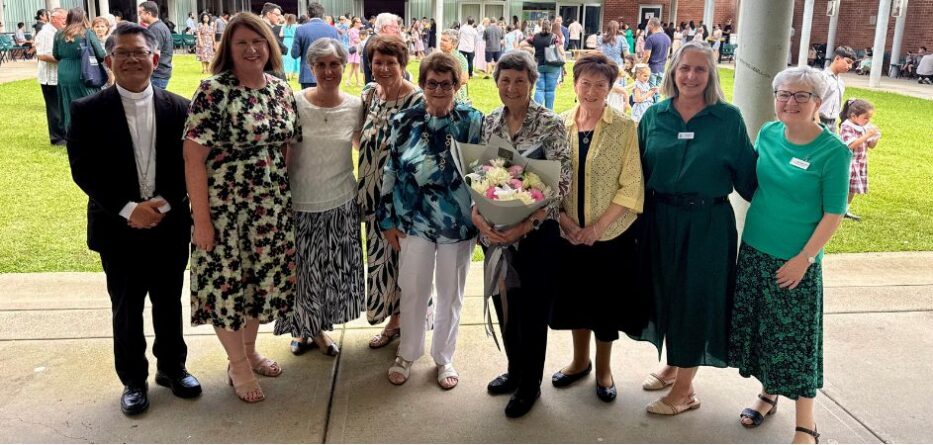
The Sisters of Mercy were instrumental in the development of the school, which is one of the oldest parish schools in the country, having been founded in 1820 by Fr John Therry in nearby Hunter Street. The sisters took over running the school in 1888 and handed responsibility to the first lay principal, Joan Coyle, in 1985.
The current Principal, Bernadette Fabri, said Saturday’s Centenary Mass at the cathedral, celebrated by Bishop Vincent Long OFM Conv, was a coming together of the school community, with past students and teachers, as well as representatives from Catholic Schools Parramatta Diocese (CSPD) and the Sisters of Mercy and others to celebrate the rich history of St Patrick’s Primary.
“The school has such a strong and rich heritage, especially under the tutelage of the Sisters of Mercy,” she said.
“There are lots of nationalities here and it’s extremely faith filled. They very much value Catholic education.”
She said the school would hold its St Patrick’s Day and centenary celebrations at the school on Friday, 20 March, with lots of activities for the children.
These celebrations are an example of the Diocesan Pastoral Plan priority of Mission, and the objective to be An Inclusive and Welcoming Church. Visit Synodality to learn more.