

Homily for 6th Sunday of Easter 2026
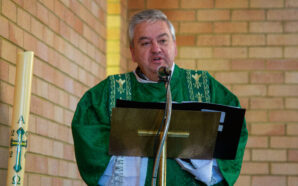
Very Rev Luis Fernando Montano Rodriguez VG PP
10 May 2026 | Mother’s Day
There are more people here than usual who come to this Mass, maybe some of you are coming because it’s Mother’s Day and you’ve promised Mum to join her for mass. So well done.
Today, as usual, I have a story for you. As I said, I wanted to reflect on Mother’s Day and link with the readings that we have today. This story is not mine it was written by an American writer. She passed away in 1996 her name is Erma Bombeck, and the story is called “When God created Mothers”. It goes like this:
“When God Created Mothers”
When the Good Lord was creating mothers, He was into His sixth day of “overtime” when the angel appeared and said. “You’re doing a lot of fiddling around on this one.”
And God said, “Have you read the specs on this order?” She has to be completely washable, but not plastic. Have 180 moveable parts…all replaceable. Run on black coffee and leftovers. Have a lap that disappears when she stands up. A kiss that can cure anything from a broken leg to a disappointed love affair. And six pairs of hands.”
The angel shook her head slowly and said. “Six pairs of hands…. no way.”
It’s not the hands that are causing me problems,” God remarked, “it’s the three pairs of eyes that mothers have to have.”
That’s on the standard model?” asked the angel. God nodded.
One pair that sees through closed doors when she asks, ‘What are you kids doing in there?’ when she already knows. Another here in the back of her head that sees what she shouldn’t but what she has to know, and of course the ones here in front that can look at a child when he goofs up and say. ‘I understand and I love you’ without so much as uttering a word.”
God,” said the angel touching his sleeve gently, “Get some rest tomorrow….”
I can’t,” said God, “I’m so close to creating something so close to myself. Already I have one who heals herself when she is sick…can feed a family of six on one pound of hamburger…and can get a nine-year-old to stand under a shower.”
The angel circled the model of a mother very slowly. “It’s too soft,” she sighed.
But tough!” said God excitedly. “You can imagine what this mother can do or endure.”
Can it think?”
Not only can it think, but it can reason and compromise,” said the Creator.
Finally, the angel bent over and ran her finger across the cheek.
There’s a leak,” she pronounced. “I told You that You were trying to put too much into this model.”
It’s not a leak,” said the Lord, “It’s a tear.”
What’s it for?”
It’s for joy, sadness, disappointment, pain, loneliness, and pride.”
You are a genius, ” said the angel.
Quietly, God said, “I didn’t put it there.” …
That’s my story for Mother’s Day. Why am I giving you the story? As I said, this weekend, we have a very providential combination of Mother’s Day on this Sunday, in Mexico, mother’s day is always celebrated on the 10th of May regardless of the day of the week, and as I said, it is providential because it gives us the chance to reflect, on mother’s day because we appreciate and we honor the love of a mother, we know when motherly love it is done right it becomes a symbol, a sacrament and is a foretaste of divine love.
And we know when it’s not done rightly, it leaves one of the deepest wounds in the human heart.
That’s why it’s important to reflect on this and the readings that we are given. The first reading comes from the book of the Acts of the Apostles, and it talks about Philip that we already know is one of the seven deacons that we heard last week.
He goes to Samaria. He preaches the word, and people get baptized, but there is something missing in that community, and it is the link with the Mother Church, the link to the Apostolic Faith.
Therefore, from Jerusalem the apostles go to Samaria, and they bring that particular link with the mother church, their experience of the risen Christ. The disciples, as we see, were going around communities of especially places with new converts who wanted to see and talk and hear those who have direct contact with Jesus and the risen Christ.
What happens in the narrative is that we get to see is through the apostolic presence, the apostolic intercession of the apostles, the gift of the Holy Spirit is given.
So, what we get to see, and as we’re going to see, when we move on, on the readings and the Acts of the Apostles is that the gift of the Holy Spirit that will be the mark of the Christian communities. This presence and gift of the Holy Spirit is what Jesus talks about in the Gospel that we heard today.
What we have in the Gospel today is a part known as the farewell discourse, as we know Jesus is preparing His disciples for his departure, and we know departures are always difficult. So, Jesus is preparing his disciples. So far, Jesus has been for them their everything, their companion, their teacher, their master, their example, the strength. Jesus knows this and he can sense an atmosphere of uncertainty, therefore, a few times in these discourses Jesus will remind his disciples “not to let their hearts be troubled”
These few chapters in the Gospel of Joh, will develop a kind of “theology of assurance”. The support Jesus will give his disciples when he is not around in the way they have experienced him so far. Jesus is teaching the disciples how they can keep going when Jesus is gone, and that’s what we heard today is the promise of the Holy Spirit. And as I said, I have for you my three lessons that unite or at least try to unite the readings that we heard today with the celebration of Mother’s Day.
Lesson number One: Mother’s Day rightly celebrates consolation and presence. The readings that we heard today, root that same comfort in God Himself in the person of the Holy Spirit. John 14:16 gives us the word paraklētos (παράκλητος) a word that is difficult to translate because it is a rich, versatile legal and relational term with no direct English equivalent. Literally means “someone called to the side of another,” and it implies a strong person who helps, defends, or advocates, combining roles of comforter, counsellor, and legal helper. The term carries a range of meanings and bibles sometimes successfully or not quite, translate as Advocate, Counsellor, Helper, Comforter, Friend, and Strengthener which tell us that the word cannot be fully captured by one English word. On Mother’s Day we are invited to reflect that just as a Christian mother and every Christian, comforts best when we point to the Spirit of God who consoles and abides in us. Thomas Aquinas clarifies that Paraclete means Comforter/ Advocate and that his consolation is a real divine help for sorrow best than anyone can offer even a mother. The Holy Spirit is then, the ultimate Comforter. We need to keep in mind that while the Holy Spirit is a distinct divine person rather than a literal female figure within the Trinity, the Holy Spirit exercises a maternal mission, nurturing us so we can grow in holiness, protecting us by standing by our side to provide courage, and comforting us in times of sorrows, just as a mother cares for her child. And for that we are grateful for our mothers and more to God for the gift of the Paraclete.
Lesson number two: Mother’s Day rightly celebrates the Maternal love that often expresses itself as intercession, asking God to give what cannot be manufactured. That’s exactly what the first reading in the book of Acts highlights: joy begins with proclamation, but the Spirit is received through prayer and the Church’s mediation. The reading tells us that the Samaritans hear Philip and see signs, and “there was great joy.” However, the first reading stresses that the decisive completion of the gift of God of the Holy Spirit, happens when apostles pray “that they might receive the Holy Spirit,” and then they lay hands on them, and “they received the Holy Spirit.”. Mothers embody a distinctly Christian kind of influence when their love becomes prayer that brings others to receive the Spirit, not just comfort in the moment, but the gift that transforms from within and accompanies us through life. The readings help us to reflect that the role of mothers and any disciple of Jesus is most fruitful when we act as intercessors with our words and prayers so we can lead others to receive the Holy Spirit and to abide in Christ. In Catholic tradition, Mary is our mother who intercedes for us, it is through her prayer and intercession that water is changed into wine, and she joins the church as we pray for the gift of his Spirit. And for that we are grateful for our mothers who intercede and pray for us but more grateful to God for the gift to his Son who intercedes and pleads our cause constantly.
Finally, lesson number three: Mother’s Day rightly celebrates the influence of our mothers in our lives. This is the deepest maternal pedagogy, that a mother teaches the child not only by words but in the shape of life when we learn how love looks in daily decisions. The Gospel that we heard today frames this as the path to the Spirit’s abiding presence: the Spirit of truth and the indwelling Christ are not abstract ideas; they are lived through keeping commandments in love. Read in that light, the mother’s influence on their children’s faith can be understood as a human sign that reflects—without replacing—God’s own action, namely the indwelling work of the Holy Spirit who forms believers from within. Catholic teaching explains that this “within” dimension is real: by grace, Christians become “the temples of the Holy Spirit” and are “living stones” in building up the Church.
Therefore, when we say a mother’s influence is a “symbol” of the Spirit’s indwelling, the point is not that motherhood manufactures faith, this is a gift from God, but that a mother’s lived faith can become an outward, visible channel of inward grace—a sign that God is acting within the child.
Pope Francis describes mothers as a primary channel by which children first receive faith as something lived, not merely taught because Mothers pass on “the deepest sense of religious practice” and because the “seed of faith” is “inscribed in the first prayers” and “first acts of devotion” the pope affirms that without mothers, faith loses “warmth.”
That language (“first prayers,” “seed,” “warmth,” “deepest sense”) matches the logic of our gospel today. We, as the children of God, come to know the Father through a living encounter with Jesus mediated by love and presence, so that God’s work can grow within us. And for that we are grateful to our mothers, for the gift of faith, but more grateful to God who gives us the Spirit to lead us into the fullness of life.
Happy Mother’s Day.
Very Rev Luis Fernando Montano Rodriguez VG PP